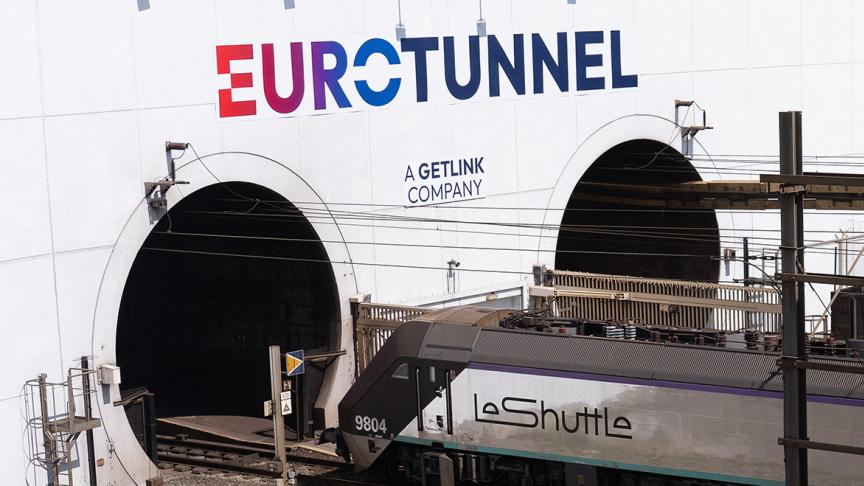
At Eurotunnel, around 1,000 learners practise customer relations scenarios from Rise Up. That is an unusual size for conversational practice, and it is what makes the case interesting: at that volume, the question is no longer whether the tool works, but whether people use it a second time.
One clarification before going further, because the confusion is common. Rise Up is a French LMS, the training platform where employee pathways live. Articulate Rise 360 is an authoring tool, used to build modules. Two different products, two different jobs. This article is about the LMS.
What this case adds comes down to one sentence: customer relations is not learned in a single session, and nobody spontaneously replays a training exercise. Eurotunnel tackled that with gamification and challenges between teams. The operational side of the deployment — handling disrupted situations — is told in the Eurotunnel case on managing disruption.
The scheme addresses roughly a thousand learners. That order of magnitude rules out certain methods: you do not put a thousand people through trainer-led role play, and you do not follow a thousand individual progressions by hand. Anything that depends on a trainer being present for each practice run hits an organisational wall.
That is the starting point for this kind of project. The question is not "what is the best teaching format in the abstract" but "which format holds a thousand people without losing what makes practice valuable".
The scenarios cover customer relations. In passenger transport, that means exchanges that happen standing up, often in noise, with someone who is in a hurry, annoyed, or both. What is at stake is not knowledge of the procedure, which the teams have, but the way it is said. We developed that subject in soft skills in passenger transport.
It is precisely the kind of skill the module-and-quiz format does not measure. You can answer a question about the right approach correctly and still be lost for words in front of an angry customer.
Employee pathways live in Rise Up. That is where the courses, the assignments and the follow-up are. Putting practice somewhere else would have meant asking a thousand people to remember a second way in and to go looking for it of their own accord. On a scheme whose whole point is voluntary repetition, that was the mistake to avoid.
The scenario opens in an iframe inside the Rise Up page. The learner clicks, the conversation starts, there is no second sign-in screen. Their identity is passed across by the launch. This detail decides everything else: every extra point of friction between the intention to practise and the start of practice removes a share of the people.
The mechanism is standard. Face Up is declared once as an external tool, the two platforms exchange their credentials, and every launch after that is cryptographically signed. There is no account to create, no user file to import, no second list to keep up to date. The principle is explained without jargon in LTI 1.3 explained for training teams, and the platform-side implementation in the tutorial for integrating Face Up with Rise Up.
The score out of 100 and the completion status come back into the LMS through the AGS service. Nobody has to export anything or reconcile two files. For a scheme with a thousand learners, that is not a convenience: it is the difference between follow-up that exists and follow-up you give up on. What exactly comes back, and how to split it across several grade lines, is covered in AGS and sending soft skills results back to the LMS.
A relational skill does not settle on the first attempt. It becomes a reflex through being replayed, when the right wording arrives without thinking about it. That is the mechanism, and there is nothing original about it: it is the mechanism of any physical skill.
The problem is that repetition cannot be decreed. You can make an activity compulsory and get exactly one completion per person — the first, done reluctantly, usually the day before the deadline. What is missing is not the obligation, it is a reason to go again.
Eurotunnel uses gamification to encourage practice. The idea is simple: make what you do visible, give a marker of progress, turn a task into a performance you want to improve. The score out of 100 stops being only a management tracking item and becomes a personal target.
The mechanism works because it lines up with what conversational practice already allows: starting over as often as you like, with no witness and no consequence. A learner who did not like their performance can redo it immediately. Gamification gives them a reason to.
The second lever is the challenge between teams. It moves motivation from individual ground to collective ground, and that is what changes the most. An individual reminder is easy to ignore; the sense that your team is counting on you is harder to ignore.
The collective angle also produces a useful side effect: people talk to each other about the exercise. They compare approaches, swap advice, comment on the situations. Training leaves the screen and enters the team conversation, which no scheme can achieve on its own.
One precaution is worth taking, though: a challenge based purely on the final ranking favours those who were already comfortable. What deserves to be highlighted is the practice — the act of going again — at least as much as the result.
On the HR side, what is tracked is how teams progress on the skills of their new customer relationship approach. That wording is worth pausing on: it is not learner satisfaction, nor the number of modules completed. It is a shift in skill against a framework the company has chosen.
It is also what sending back several grade lines rather than a single figure makes possible. You can then see where teams are moving forward and where they remain stuck, which is usable information for the rest of the training plan.
The second indicator tracked is how engaged the teams are. On a scheme that rests on voluntary repetition, that is a first-order indicator rather than a secondary measure. It tells you whether the lever is working.
That is also what makes the gamification-and-challenge pairing consistent with what is measured: you encourage practice, then you look at whether practice actually happens.
Neither progress against a framework nor engagement tells you what happens on the day the customer is genuinely standing there. They tell you the teams have practised and are improving on what has been defined as important. It is a shared reference point, not a verdict, and it replaces neither managers' observation nor feedback from the front line.
That is the main lesson of this case. Many projects handle the content first and adoption later, once the completion figures disappoint. Here, the question "what will make people want to go again" was asked at the same time as "what are we getting people to work on". That is not the same thing as adding a badge afterwards.
Between an automated nudge and a team challenge, the gap is considerable. The first speaks to an obligation, the second to belonging. On teams that already work together day to day, as they do in passenger transport, the second lever is immediately available.
Finally, it is worth seeing exactly what the LTI integration contributes: it removes the obstacles, it does not create the desire. Without it, the usage lever would be cancelled out by access friction. With it alone, not much would happen either. The two go together, and the general framework is described in the guide to integrating Face Up with your LMS.
This deployment does not prove that a technology works. It shows how you get voluntary repetition out of a thousand people who have a job to do besides: by removing access friction through LMS integration, then by giving a reason to go again through gamification and the collective.
If you are building something comparable, put the usage question on the table from day one. The LTI configuration is sorted in a single working session; the wish to have another go has to be designed.