
A finance director never asks whether the training was enjoyable. They ask what it produced. For technical skills, the answer is easy to build. For a people skill — handling an angry customer, delivering bad news, correcting someone without breaking them — the exercise turns delicate, and there are two temptations: refusing to put a number on it, or putting any number on it.
AGS, or Assignment and Grade Services, is the LTI 1.3 service that sends the results of an external activity back into the LMS gradebook. Technically, it carries a score out of 100, a completion status, and can feed several grade lines. That is not the hard part. The hard part is what you put inside.
This article covers both. First, exactly what AGS sends back and how to configure it usefully. Then the real question: how to fit a people skill into a gradebook without betraying it. It follows on from our explanation of LTI 1.3 and completes our guide to integrating Face Up with an LMS.
AGS transmits a numeric value against a scale. In Face Up's case, that is a score out of 100, calculated from the practice session the learner has just completed. The LMS receives it and writes it into the designated column, exactly as it would for an assignment or a quiz.
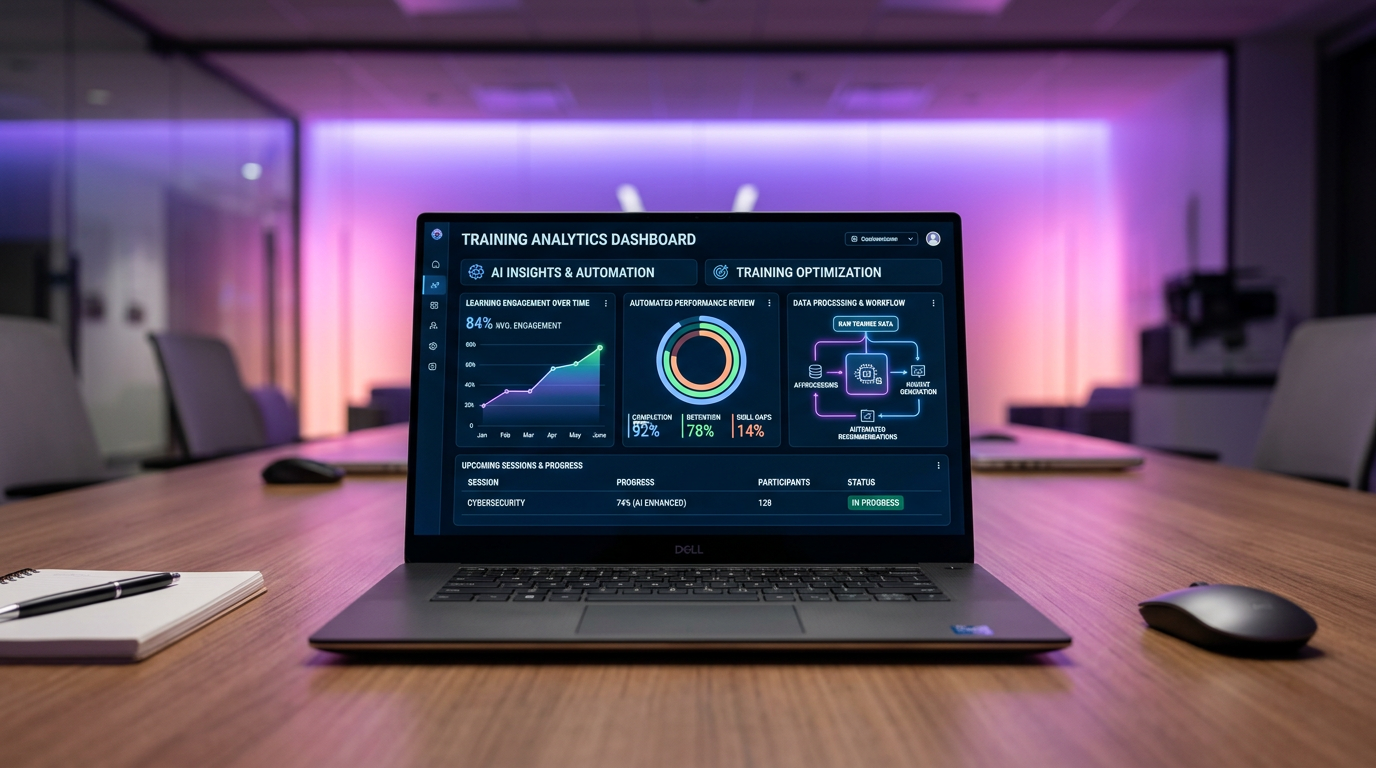
The value is not the number itself, but the fact that it arrives in the right place with no human intervention. No export, no reprocessing, no delay between the session and the follow-up. The training lead sees the state of their cohort in the tool where they already look at everything else.
AGS also reports that the activity was carried out, independently of the level reached. That is a separate piece of information from the score, and it matters more than people assume.
For a programme that has to evidence the completion of a learning path, it is the compliance data point. For the teaching team, it is the first warning signal: a learner who never runs a practice session is not a weak learner, they are an absent one, and the two call for different responses. Keeping them apart stops you reading an empty cell as a failure.
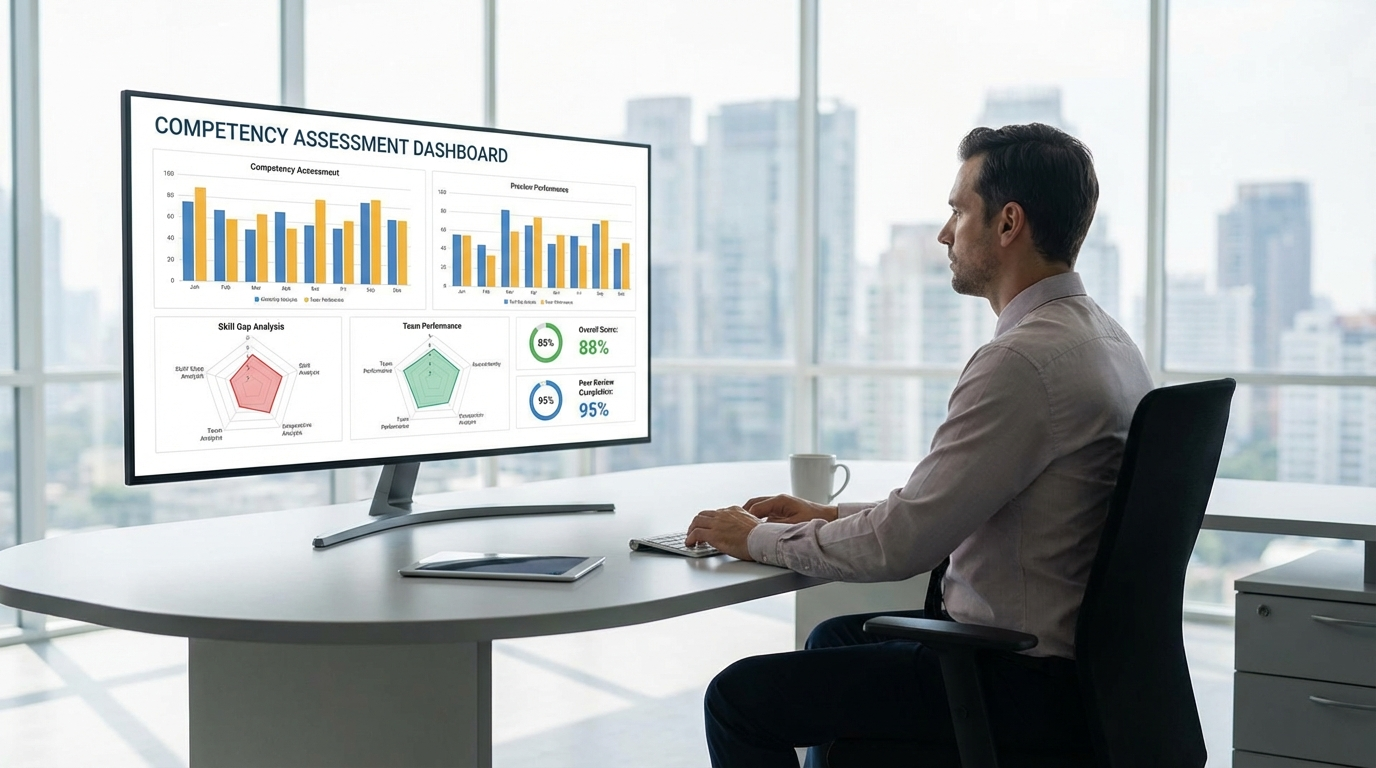
The point most often missed: AGS does not force a single column. One activity can feed several grade lines, and therefore several columns of the gradebook. That is what makes a reading by dimension possible instead of one global figure, and we will see below why it is decisive.
This is configured when the activity is created in the course — in the very place where the trainer picks their scenario through Deep Linking. The structural decision is therefore taken while building the course, not after the fact.
A practice score says one precise, limited thing: in this situation, with this other person, at this moment, the learner produced such and such observable behaviour. They let the other person speak, or cut in. They reflected back, or did not. They stated the decision clearly, or buried it. They held the line, or gave way.
It is an observation of conduct, not a personality judgement. A score of 62 does not mean “this learner lacks empathy”. It means “in this exchange, the expected listening markers were thin on the ground”. The nuance is not cosmetic: the first phrasing closes the door, the second opens up a piece of work.
It does not say what the learner will do on Monday in front of a real customer. A people skill is contextual: fatigue, stakes, hierarchy and the history with the other person all weigh heavily. A high score is an indication of capability, not a guarantee of transfer.
Nor does a single isolated measure say much. One-off performance mixes the skill with the circumstances. What can be interpreted is a gap: between two attempts, between the start and the end of a programme, between an easy situation and a tense one.
Finally, it does not replace the trainer's eye. A learner can tick the expected markers without conviction, or hold an excellent conversation in a way the rubric undervalues. That is precisely why the score is read alongside the debrief, never instead of it.
Should you give up on marking, then? No, and the argument is practical. Without a number, a people skill disappears from dashboards, therefore from trade-offs, therefore from budgets. It goes back to being a subject everyone calls important while never being able to show what it produces.
The number has three virtues: it makes progression visible, it allows a learner to be compared with themselves over time, and it starts the conversation. A trainer who sees three learners move from 45 to 70 while two stay at 40 knows who to speak to at the next session. It is the same reasoning we set out in assessing and measuring soft skills: the measure is not the truth, it is a trigger for attention.
Take two learners on 65. The first listens remarkably well but never dares to decide anything. The second decides quickly and well but does not hear the other person. The same figure covers two opposite profiles, calling for two opposite kinds of support.
A single mark manufactures that confusion. It offers the comfort of a ranking and removes the useful information. On a technical skill, an average makes sense because the dimensions are homogeneous. On a people skill, it adds up things that do not add up.
Several grade lines solve the problem with no extra complexity for the learner: they run one practice session, and the gradebook receives several columns. Three or four dimensions are enough, chosen because they describe the job in question.
Each line becomes readable and actionable. The trainer no longer says “you are on 65”, they say “your listening is solid, your closing is still vague”. The first statement produces disappointment, the second produces an exercise.
The most useful reading is longitudinal. Run the same family of situations at the start and at the end of the programme, with the same dimensions, and compare the lines. You are no longer comparing people with each other, you are comparing a learner with themselves.
It is also the sturdiest evidence structure for a funder or a board: a before, an after, identical dimensions, a whole population. Combined with business indicators, it feeds a ROI calculation approach that holds up under challenge.
This is where the skill is built. After the practice session, the learner gets feedback on what they did: the moments the exchange turned, what they said at that point, what a different phrasing would have produced. The score summarises; the debrief explains.
A programme where scores are watched but debriefs are never used gets numbers that creep up and understanding that does not. The reverse — a serious debrief, picked up afterwards by the trainer in the room — moves both. The principles for running that feedback are the ones inherited from role-play in training, which conversational learning builds directly upon.
A reflex is not installed in one go. A people skill practised once gives you a snapshot; practised five times over three months, it gives you a trajectory and, above all, it genuinely changes behaviour under pressure.
The number of attempts is therefore an indicator in its own right, and it is already in your LMS through completion. CCI Hauts-de-France and CCI de Grenoble — two chambers of commerce and industry — use it explicitly with their two audiences, professionals on short courses and students through their apprenticeship training centre, placing practice before the session to prepare, during it to apply, and after it to embed.
At Eurotunnel, around 1,000 learners practise customer relations scenarios from Rise Up — the French LMS, not to be confused with the authoring tool Articulate Rise 360. What HR tracks comes down to two things: skills progression on their new approach to customer relations, and team engagement. To encourage practice, they rely on gamification and challenges between teams.
Engagement is not a comfort metric. On a skill that requires repetition, it drives the outcome: a team that practises willingly will progress further than a team ticking off an obligation. The operational context of those scenarios is described in our article on managing disruption and in soft skills in passenger transport.
Evidence is not manufactured at the end. It is decided when you design the programme: which dimensions, which reference situation, which initial measurement point, which final one. Three grade lines chosen before launch are worth more than ten indicators reconstructed afterwards.
Decide on the population you will follow, too. A whole cohort gives you a robust trend; a handful of volunteers gives you an anecdote. On a wide rollout, the framing is the same as the one described in deploying soft skills training at scale.
The score alone convinces the teaching team. What convinces a board is setting it against an indicator the business already tracks: complaints, repeat calls, post-contact satisfaction, turnover in a team. You are not demonstrating causation, you are establishing concordance — and you say so in those words.
That honesty is your strongest asset in a steering committee. A team that reports “our learners progressed on three measured dimensions, and complaints on this theme fell over the same period” is far more credible than a team promising a performance percentage.
Do not promise that a score of 80 guarantees a behaviour. Do not promise that a mark in the gradebook certifies a people skill. Do not compare learners with each other across different scenarios.
What you can promise is already substantial: real, repeated practice, detailed feedback after every exchange, dimensions tracked over time, and data that lives in the LMS rather than in a spreadsheet. That is exactly what designing a learning path should aim at, as we set out in integrating customer service training with the LMS.
AGS settles a logistical question — getting a score out of 100, a completion status and several grade lines back into the LMS gradebook — and puts a pedagogical one on the table: what do we actually want to know about progress on a people skill?
The answer comes down to three moves. Split rather than aggregate, so each line names an identifiable behaviour. Compare a learner with themselves over time, rather than learners with each other. And read the number alongside the debrief and the number of attempts, never on its own.
A score out of 100 does not prove that someone can hold a difficult conversation. It proves they have practised, that we know what they practised, and that we can say which way they are heading. For many organisations, that is the first time such a sentence can be written about people skills — and it is enough to keep a programme standing in front of a board.