
Every year, organisations invest heavily in training their customer-facing teams. And every year, satisfaction surveys expose the same gaps: a lack of empathy, scripts that feel disconnected, an inability to handle the unexpected. The explanation is straightforward: most training programmes rely on methods that do not match the nature of the skills they are meant to build.
Interpersonal skills are not knowledge you memorise. They are reflexes you construct. Reading the principles of active listening is no more sufficient than a theory lesson on swimming is enough to keep you afloat. That is the fundamental difference between knowing and doing — and closing it is the job of the teaching method.
The traditional format — a trainer in front of a group, with slides and quizzes — has real merits. It sets a theoretical frame, introduces shared vocabulary, and raises awareness of why interpersonal skills matter. Classic e-learning (videos, interactive modules, quizzes) adds flexibility and scale.
But both formats share one structural limitation: they engage declarative memory ("I know that") without developing procedural memory ("I know how"). A learner who aces a quiz on handling difficult customers may still fall apart in front of a genuinely angry one. Stress, emotion, time pressure — none of these are present in a multiple-choice test.
These methods remain useful in the awareness phase. They become a problem when they make up the entire learning path, which is still far too often the case.
Face-to-face training with an experienced trainer, including role plays and live feedback, remains the benchmark for developing interpersonal skills. Human interaction is rich, the trainer can adapt in real time, and group dynamics support learning through observation.
But classroom training has three structural limits. Cost, first: booking a trainer and a room, and pulling employees off the floor for one or more days, is a significant investment. Scalability, second: training 500 advisers face to face takes months. Retention, third: without regular practice afterwards, learning erodes within weeks — the well-documented Ebbinghaus forgetting curve.
Learning science is unambiguous: complex skills are acquired through deliberate practice in realistic conditions. That is the principle behind scenario-based learning — whether you call it simulation, role play, or situational practice.
The mechanism is simple: place the learner in a credible situation, let them act on their current reflexes, then give them structured feedback so they can adjust. Repeating that cycle — act, receive feedback, adjust — gradually builds new automatic responses.
Practice scenarios come in several forms. In-person role play with a trainer or a peer offers rich interaction at a high cost. Role play with an AI avatar offers availability and scale, with multimodal feedback (content, tone, emotion). Branching scenarios in e-learning present choices with consequences, but remain limited in their ability to reproduce the complexity of a real conversation.
The most effective way to develop interpersonal skills is blended learning — a hybrid path that combines different formats according to the objective of each phase.
Awareness phase: classic e-learning (short videos, interactive infographics) to set the theoretical frame. Flexible, consumed at the learner's own pace. Duration: 1-2 hours.
Discovery phase: a workshop, in person or as a virtual classroom, to go deeper into the concepts, share examples from the floor, and start with simple practice scenarios. Duration: 2-4 hours.
Intensive practice phase: repeated simulation sessions with feedback, either in person with a trainer or independently with AI avatars. This is the phase where reflexes are actually built. Duration: 4-8 hours spread over several weeks.
Retention phase: spaced microlearning (reminders, mini-scenarios, recall quizzes) to consolidate learning and counter forgetting. Duration: 10-15 minutes a week for two to three months.
Microlearning — modules of three to ten minutes taken regularly — is the most effective method for sustaining skills over time. Built on spaced repetition, it reactivates neural connections at the optimal moment.
In customer service training, microlearning can take the form of mini-scenarios ("How would you respond to this customer?"), flashcards on positive language, short videos contrasting a good and a poor example, or five-minute sessions with an AI avatar on one specific situation.
Ideally, microlearning is built into the working routine: five minutes at the start of the day, a quick session between two calls, a weekly challenge. Conversational learning platforms make this easier by offering short sessions calibrated to each learner's level.
The arrival of AI conversational learning marks a shift in customer service training. Instead of reading a scenario or watching a video, the learner lives the interaction with an avatar whose reactions are natural and unpredictable — like a real customer.
This approach addresses all three limits of classroom training. The marginal cost per session is low, which makes it possible to deploy at scale. Availability is constant: learners can practise whenever they want, as often as they want. And multimodal analysis (content, tone, posture, emotion) delivers feedback that is more detailed and more objective than a human observer can provide.
The trainer's role evolves but does not disappear. It shifts from "the person who runs the session" to "the person who designs the scenarios, reviews performance, and leads the debriefs". That is a move up the value chain for the profession — and it is why a trainer-first approach sits at the heart of our thinking at Face Up.
Choosing a teaching method comes down to four factors.
The learning objective: raise awareness (e-learning), build understanding (classroom), build skill (simulation), sustain it (microlearning). Each objective calls for a different format.
The number of learners: 20 advisers are easily trained in a room. 500 advisers require scalable digital tools. 5,000 advisers demand an automated system with targeted human supervision.
Budget and timeline: a three-month rollout on a tight budget points towards digital. A premium programme for a small team can justify classroom delivery.
The skills being targeted: non-verbal communication is best worked on face to face or on video. Conflict handling needs immersive practice scenarios. Product knowledge can be delivered through e-learning.
A handful of mistakes come up again and again in customer service training programmes.
Betting everything on theory: hours of slides on active listening create no reflexes whatsoever. Theory should account for at most 20% of training time, with the remaining 80% given over to practice.
Training as a one-off: a single day of training every two years produces no lasting change. Retention requires regularity: short, frequent sessions beat an occasional marathon.
Neglecting feedback: a practice scenario without a debrief is a wasted opportunity. Feedback must be specific, factual, and geared towards improvement. Analysis and assessment tools make that feedback objective and actionable.
Ignoring the reality on the floor: training scenarios disconnected from an adviser's daily work lose credibility immediately. The best programmes are built from real cases, validated by the teams who handle them.
An effective customer service training path follows a logical progression. First, assess the current level so the content can be adapted. Then set the theoretical frame (why these skills matter, what the principles are). Move quickly to practice, with scenarios of increasing difficulty. Finally, sustain the learning over time with microlearning and regular feedback.
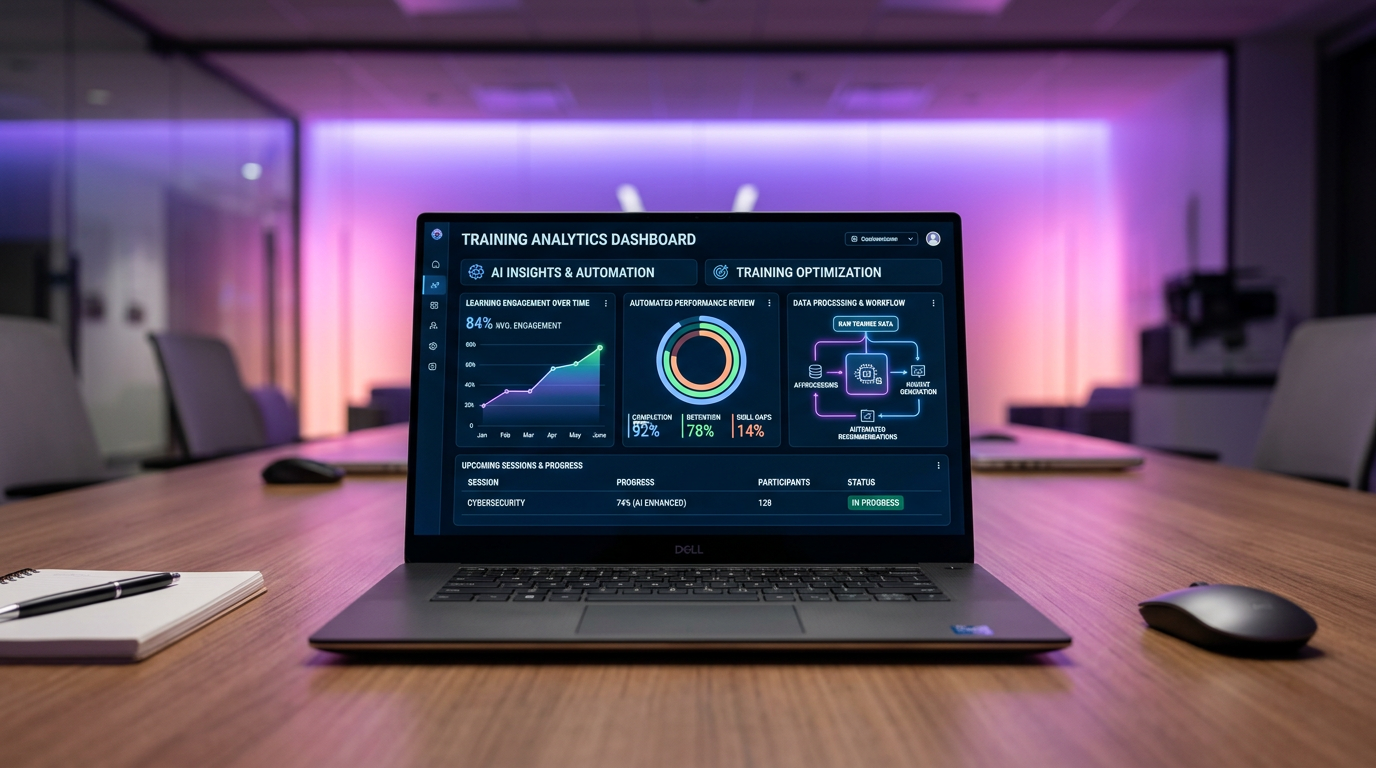
Success is measured by observed behaviour change on the floor, not by a quiz score. The key indicators — customer satisfaction, resolution rate, quality of interactions — should be tracked before, during, and after training in order to demonstrate the ROI of the programme.