
Going digital is no longer optional for training providers. It is a condition of survival. Corporate clients now expect flexible formats, content that can be accessed remotely, and real-time progress metrics. For behavioural skills training, the challenge is twofold: how do you digitalise something that rests, by its nature, on human interaction? This article is a practical guide for training providers who want to transform their soft skills programmes without sacrificing pedagogical quality — covering the tools, the methods and the business models that work.
L&D teams no longer want to send twenty people into a room for two days. They want modular pathways, accessible on mobile, compatible with the operational constraints their teams live with. Tenders now routinely include digital criteria: LMS compatibility, blended formats, progress analytics. A provider offering classroom delivery alone is shutting itself out of a growing share of the market.
In the classroom, a provider's revenue is capped by the number of trainers available. Every session needs a facilitator, a room and logistics. Digital breaks that ceiling: content created once can be deployed to hundreds of learners simultaneously. The business model shifts from billing by trainer-day to recurring licence revenue, with significantly better margins.
The most effective model for soft skills is not all-digital, it is blended. A typical pathway combines e-learning modules for the theory (communication models, analytical frameworks, methodologies), digital role-play for the practice (conversational scenarios with AI avatars, video-based exercises), and in-person sessions for collective debriefing and retention. This format cuts classroom time by 50 to 70% while maintaining, and often improving, learning outcomes.
For some audiences — geographically dispersed staff, teams on shift patterns, large-scale onboarding — fully digital is the only realistic option. The key is replacing trainer-learner interaction with learner-AI interaction of sufficient quality. Conversational learning platforms make it possible to build realistic role-play scenarios where the learner practises against avatars calibrated to challenge them, not to validate them.
Some providers digitalise selectively: a self-service catalogue of e-learning modules for cross-cutting topics (communication, stress management), and facilitated sessions for subjects that need personal support (leadership, conflict management). This approach lets you test digital delivery gradually, without calling the whole model into question.
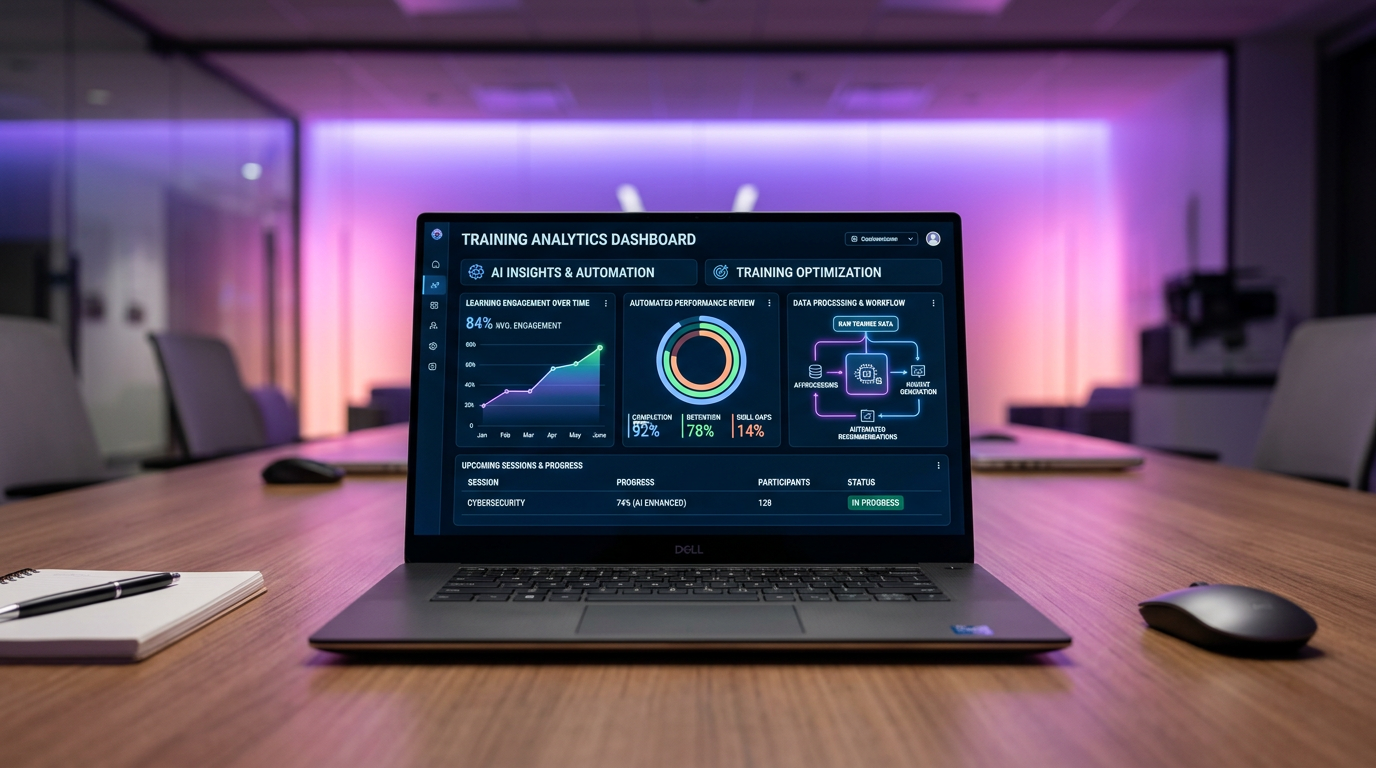
The LMS (learning management system) is the backbone of any digital strategy. For a training provider, the choice depends on several criteria: white-labelling (offering the platform in the client's brand), native integrations (SCORM, xAPI, LTI), detailed per-learner analytics, and ease of managing multiple clients. Solutions such as 360Learning, Moodle, Docebo and LearnUpon cover these needs at different levels of sophistication.
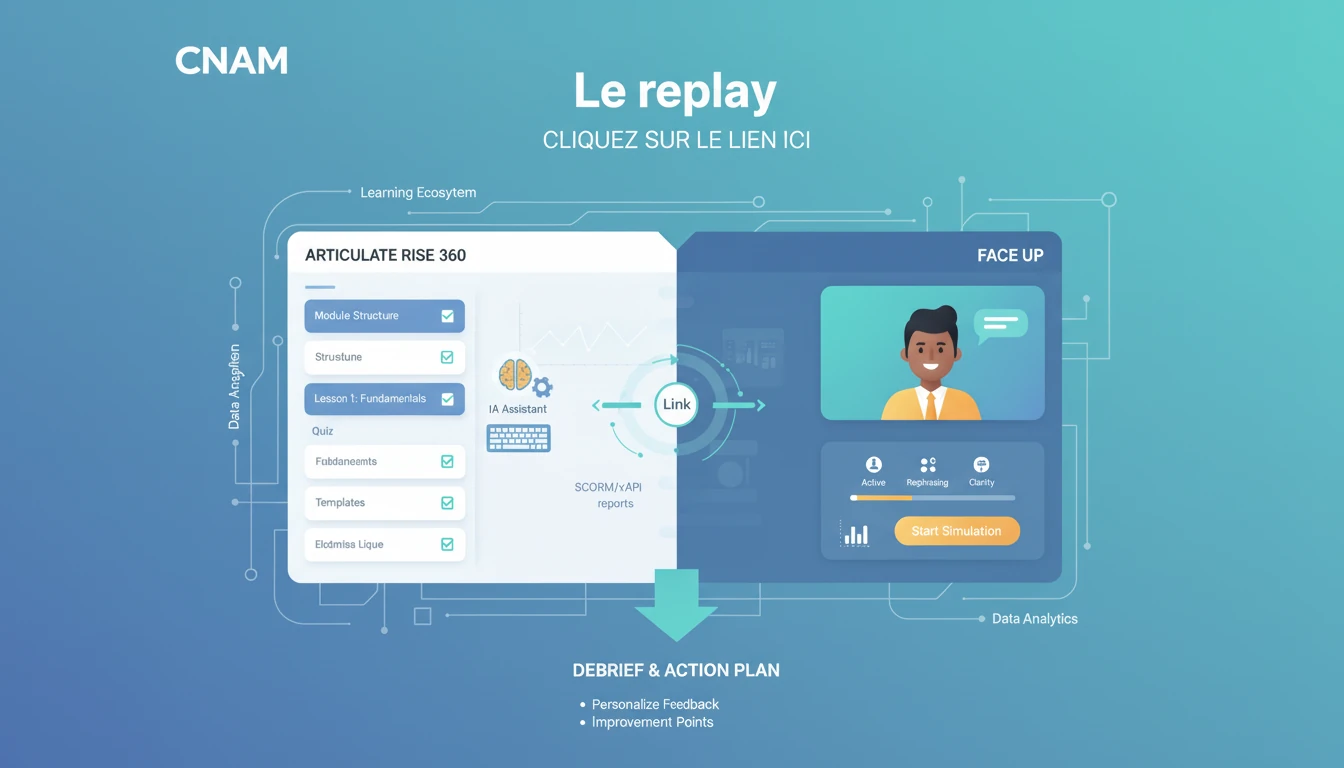
Creating good digital content no longer requires advanced technical skills. No-code authoring tools let instructional designers build interactive pathways without development work. For soft skills specifically, conversational scenario authoring is essential. These tools support branching dialogue, characters with defined personalities, and multimodal assessment criteria (what is said, tone of voice, posture).
This is the technology that changes the equation for soft skills. Conversational learning platforms such as Face Up allow you to build role-play scenarios with AI avatars whose behaviour adapts to the learner's responses. The advantage for a provider: a scenario built once can be used by thousands of learners, each of whom has a unique experience shaped by their own conversational choices.
Not every piece of content should be digitalised at once. The first step is to audit the existing catalogue and identify high-volume, low-specificity courses — these are the ideal candidates. Highly bespoke courses, or those with a strong emotional component, can stay in the classroom for now, or move to blended.
Digitalisation often fails because trainers do not buy into it. They see digital as a threat to their profession. In reality it changes their role: they move from transmitting knowledge to designing experiences and facilitating progression. Train-the-trainer programmes need to cover both the digital tooling and the design of blended pathways.
Moving to digital changes the structure of costs and revenues. Upfront investment (content creation, technology licences) is higher than classroom delivery, but the marginal cost per learner falls sharply. Pricing has to evolve with it: per learner, per session, per annual licence, or unlimited access. Sales arguments should lead on cost per learner trained rather than cost per training day.
The most common trap is turning a training deck into an e-learning module without rethinking the instructional design. Content built to be delivered by a trainer does not work as self-study. Going digital means rethinking learning objectives, activities and assessment specifically for the format.
National quality certification schemes for training providers — Qualiopi in France, and equivalent frameworks elsewhere — impose traceability and monitoring requirements that apply just as much to digital delivery. Whichever platform you choose must generate attendance evidence, progress reports and compliant certificates. This criterion is routinely underestimated when tools are selected.
Digitalisation is not only a technology project, it is a human one. Trainers, sales teams and clients all need support through it. A change plan with pilot phases, structured feedback and progressive adjustment materially improves the odds of success.
Digitalising soft skills training is no longer a choice; it is a necessary step to stay competitive. The providers who make the transition successfully combine pedagogical intelligence with the right technology: an LMS, authoring tools, and AI conversational learning. Blended remains the most effective model for interpersonal skills, cutting classroom time while holding the quality bar. The point is to start now — prioritising high-volume programmes and differentiating your offer on the quality of the digital experience you deliver.