Training your teams in customer relations is one thing. Knowing whether they are genuinely improving is another. Yet many organisations invest in customer relationship management training without ever measuring the skills their people actually acquire.
The result is predictable: training budgets spent with no visibility on the return, employees working through modules without knowing where they stand, and managers who sense an improvement but cannot quantify it.
Assessing interpersonal skills is not a luxury reserved for large organisations. It is a practical lever for steering skills development, identifying where reinforcement is needed, and demonstrating the value of training to senior management.
A customer service competency framework sets out the technical and behavioural skills expected in each customer-facing role. It acts as a compass for training, assessment and professional development.
A good framework covers several dimensions: core customer relations competencies such as active listening and empathy, verbal and non-verbal communication, handling difficult situations, and command of the different customer channels.
For each competency, define observable levels of mastery. Take active listening: level 1 — the adviser lets the customer speak without interrupting; level 2 — they systematically paraphrase to check their understanding; level 3 — they pick up the implicit needs behind what the customer says.
A framework disconnected from the front line is worthless. Every competency should be tied to concrete professional situations. A bank adviser does not have the same needs as a public transport agent or a retail sales assistant.
To build something relevant, involve front-line managers and the employees themselves. Analyse the recurring situations, the friction points with customers, the moments of truth in the customer journey. The framework then becomes a living tool, grounded in operational reality.
Direct observation remains the most reliable method: a trainer or manager listens in on a customer exchange and scores the competencies against a grid. It is the gold standard, but also the most time-consuming. No manager can observe every employee on every interaction.
That is why observation is usually reserved for key moments: initial assessment, the end of a training programme, occasional quality audits. It gives a precise diagnosis, but not continuous tracking.
Role plays and simulations allow you to assess skills in a controlled setting. The advantage is range: you can test situations that rarely come up on the job, such as an aggressive customer, a complex complaint or a crisis.
AI-driven simulations add something significant: they make it possible to assess every learner individually, on standardised scenarios, with multimodal analysis covering the content of their answers, their tone and their posture. Feedback is immediate and consistent, without the bias of a human assessor who is tired by the end of the day.
At Face Up, every simulation session generates usable data: response time, relevance of arguments, objection handling, ability to paraphrase. These indicators feed directly into progression tracking.
Quizzes test theoretical knowledge: procedures, sales arguments, compliance rules. They are useful for verifying that the fundamentals have landed, but they are not enough on their own. Knowing that you should paraphrase is no guarantee that you will do it in front of an angry customer.
Always combine quizzes with practical assessment to get a complete picture of competency.
Customer satisfaction surveys (NPS, CSAT), first-contact resolution rates and average handling time all reflect interpersonal skills indirectly. They complement educational assessment by measuring the real impact on service quality.
One caveat: these indicators are shaped by many other factors — processes, tools, workload. They need to be cross-referenced with individual assessments to isolate the improvements that genuinely come down to skill.
An assessment grid for customer service skills should be simple, observable and actionable. These are the essentials:
Greeting and first contact — Does the adviser establish a positive connection? Do they identify the customer's need quickly? Do they adapt their approach to the person in front of them?
Listening and understanding — Do they ask the right questions? Do they paraphrase? Do they detect implicit needs?
Response and argumentation — Do they propose appropriate solutions? Is their explanation clearly structured? Do they handle objections with confidence?
Managing emotions — Do they stay calm in the face of aggression? Do they show empathy without being overwhelmed by it? Do they defuse tension?
Closing and follow-up — Do they summarise what has been agreed? Do they check that the customer is satisfied? Do they make the necessary commitments?
Favour a four-level scale (insufficient, developing, proficient, expert) over a mark out of ten. Even-numbered scales avoid central tendency bias — everyone landing on 5 out of 10 — and force the assessor to make a call.
Each level must be tied to observable behaviours. "Proficient" on its own says nothing: describe what an employee at that level actually does. This reduces subjectivity and allows assessors to calibrate against one another.
A number of professional certifications attest to customer service competency, from qualifications aimed at contact centre advisers to sector-specific service standards and quality labels. Availability and recognition vary considerably from one market to another.
For training providers, offering a certified pathway makes the proposition more attractive and can help unlock training budgets and funding schemes. It is a strong commercial argument — provided the certification is genuinely recognised by employers in the target sector.
Not every organisation needs an external certification. An internal pathway, with clearly defined progression levels, is often enough. What matters is the rigour of the assessment and the recognition it carries inside the organisation.
An effective internal pathway combines theoretical training, active learning methods, simulation-based assessment and sign-off by the manager. It gives employees visibility on their own progress and drives engagement with the training.
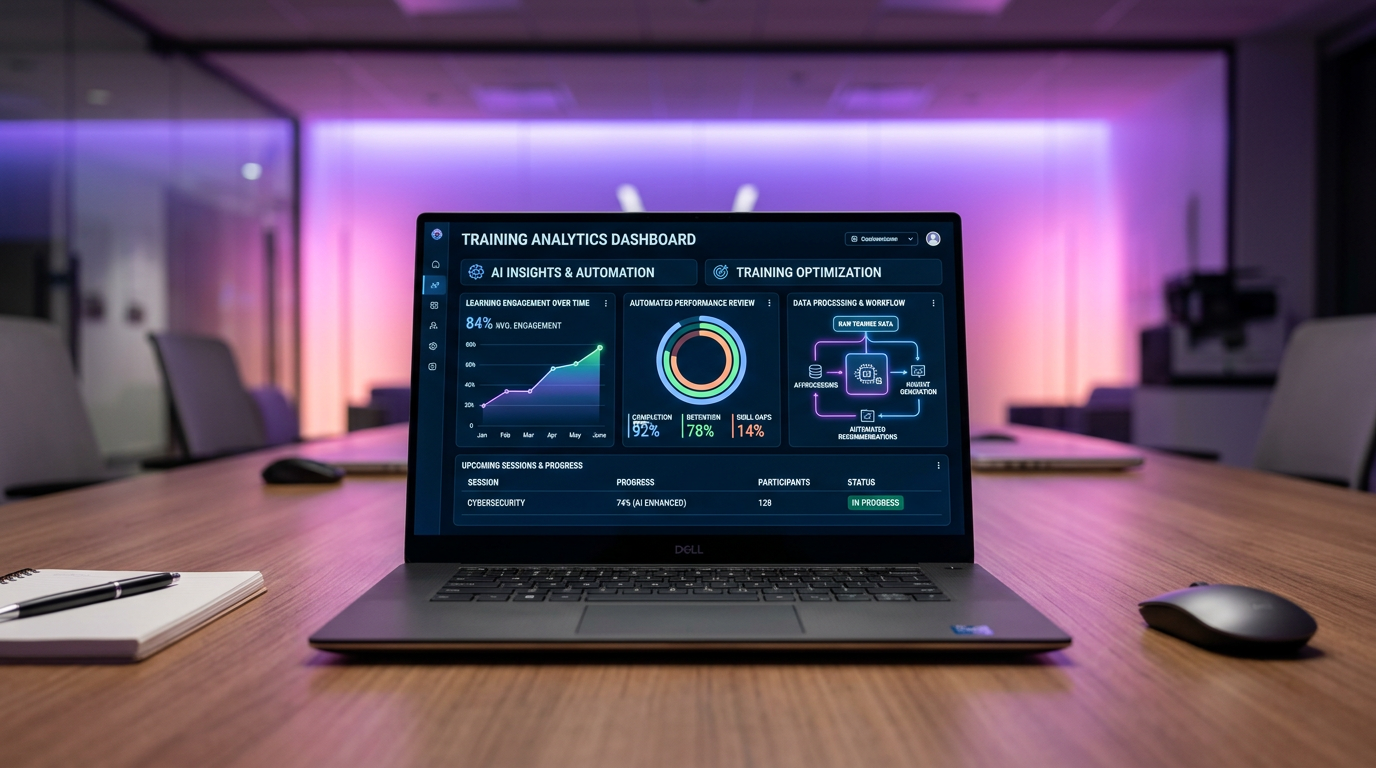
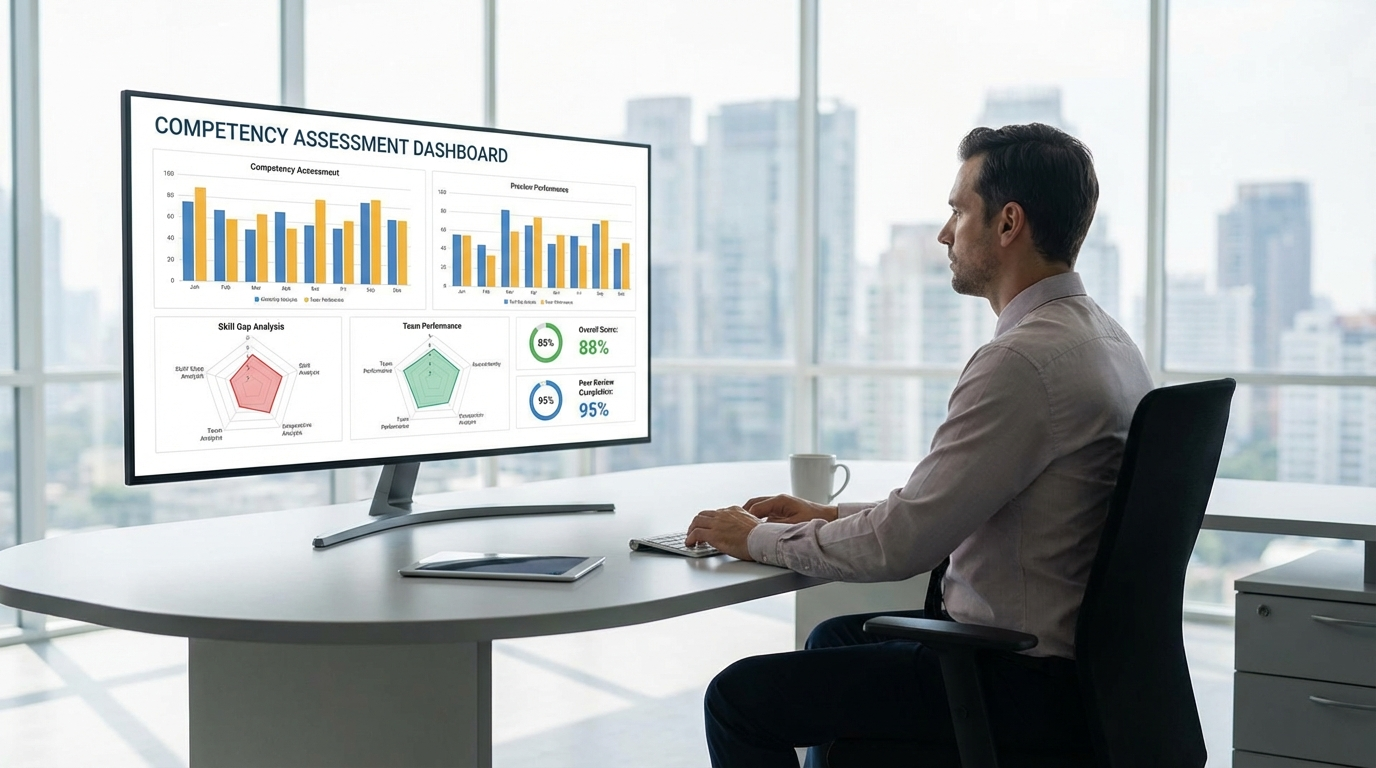
A one-off assessment is not enough. To steer skills development you need continuous tracking. Modern learning platforms provide dashboards showing scores by competency, changes over time and comparisons between teams.
Face Up includes these analytics natively: every simulation session feeds the learner's competency profile. Trainers can see individual and collective progress, spot where people are getting stuck and adjust the pathway accordingly. That is the whole principle of AI-powered conversational learning: every interaction generates usable data.
Assessing immediately after training measures short-term acquisition. The real question is whether the skills are still there three months later. Delayed assessments — at 30, 60 and 90 days — measure how deeply the learning has actually embedded.
Microlearning and spaced refresher sessions counter the forgetting curve. Short, regular simulations let people practise and be assessed at the same time, without blocking out whole days of training.
For accredited training providers, assessing what learners have acquired is usually a formal requirement. You have to demonstrate that the target competencies are assessed during and at the end of the programme, using objective criteria and documented evidence.
Simulation platforms such as Face Up make that straightforward: every session is logged, and results are time-stamped and archived. Progression reports become evidence you can use directly in an audit. Compared with managing paper assessment sheets by hand, the time saved is considerable.
Assessment is not an end in itself. It feeds an improvement cycle: diagnosis, targeted training, practice, assessment, adjustment. That cycle turns training into an ongoing process rather than a one-off event.
To measure the ROI of your training programme, cross-reference assessment data with operational indicators. The correlation between rising simulation scores and improving customer NPS is the strongest argument there is for sustaining investment in training.
Start with a simple framework, clear assessment grids and a tracking tool that fits. Sophistication comes with the maturity of the system. What matters is starting to measure — because what is not measured does not improve.