
Role-play is probably the most powerful method available for developing customer-facing skills — and the one most often misused. Too many training sessions simply ask two participants to "act out a scene" with no framing, no clear learning objective and no structured feedback. The result is an uncomfortable experience that produces no lasting learning.
A well-designed role-play is the opposite. It is a structured exercise with a realistic scenario, a clear objective, defined assessment criteria and, above all, a debrief that turns lived experience into acquired skill. When those elements come together, the results are striking.
The best scenarios come from the front line. Ask your teams: "What is the most difficult customer situation you have faced recently?" Real cases carry a credibility that academic scenarios cannot match. Learners recognise the situation and engage with it immediately.
For each scenario, define a customer brief (who this customer is, what their situation is, what they want) and an adviser brief (what your role is, what resources you have, where your limits sit). The richness of the scenario depends on the precision of these briefs.
Scenario difficulty must match the learner's level. Too easy and they learn nothing. Too hard and they give up. The optimal learning zone — what Vygotsky called the "zone of proximal development" — sits just beyond the comfort zone.
A typical progression in customer relations training might run: a customer with a simple question (level 1), a customer with a legitimate complaint (level 2), an angry customer (level 3), a manipulative customer (level 4), and a complex situation involving several parties (level 5).
Each scenario should target one or two specific skills. A scenario that tries to assess everything assesses nothing. Examples of precise objectives: "Practise empathetic reformulation with a frustrated customer", "Use the DESC method to set a boundary with a persistent customer", "Adapt your register to the customer's profile".
Two participants act out the scene while the group observes. The format is simple and cheap, but it creates two problems: the peer playing the customer often lacks realism, and observers either lose interest or feel judged when their turn comes.
The trainer, or a professional actor, plays the customer. This format gives precise control over difficulty and realism. The "customer" can adjust their behaviour in real time to keep the learner inside their learning zone.
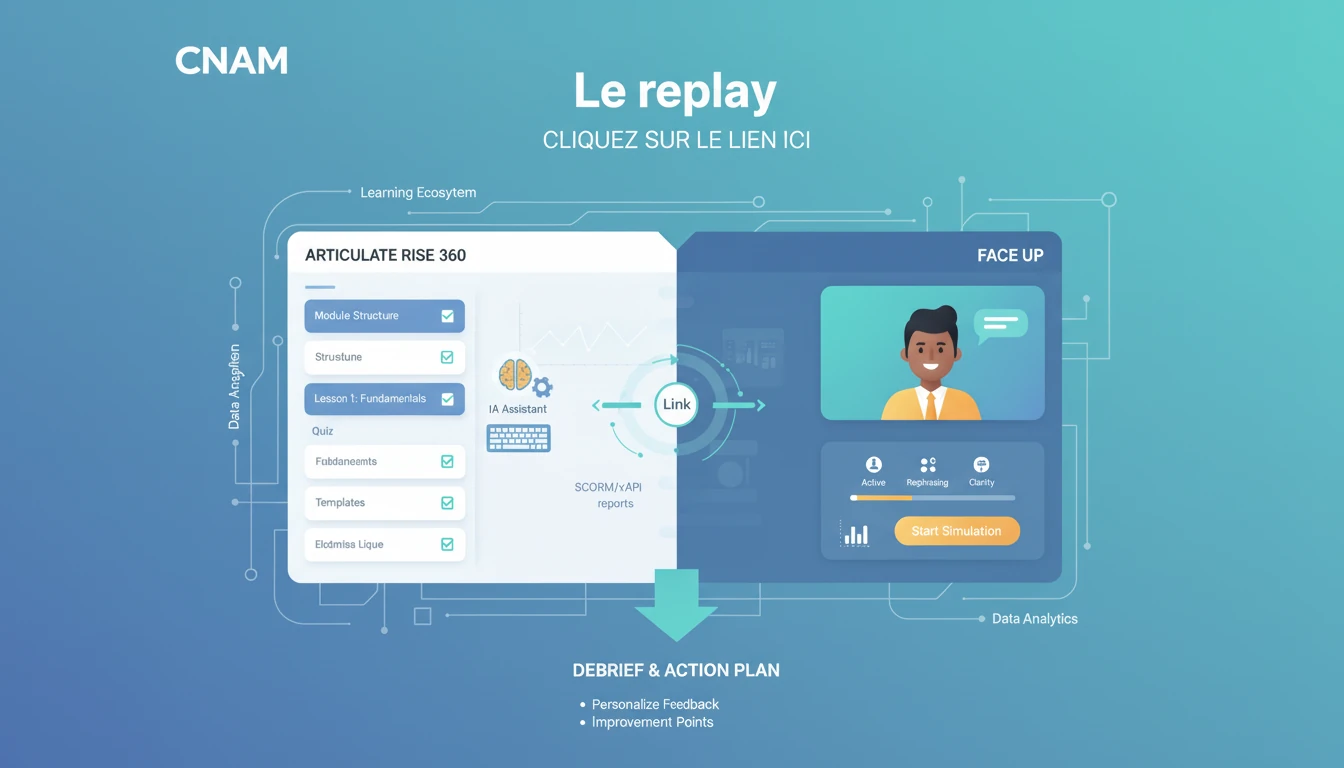
The learner interacts with an avatar whose responses are generated by artificial intelligence. This format offers permanent availability, unlimited repetition and automatic multimodal feedback. Conversational learning platforms such as Face Up let trainers configure the customer's personality, the context and the assessment criteria through a no-code authoring tool.
This format solves the main weakness of peer role-play: learners can practise alone, without being judged, as many times as they want. The social awkwardness that holds back so many participants disappears.
Role-play without feedback is entertainment. It is the debrief that turns lived experience into acquired skill. Well-structured feedback multiplies the impact of a simulation by a factor of three to five, according to learning sciences research.
The SBI method structures feedback in factual, constructive terms. Situation: "When the customer expressed their frustration…" Behaviour: "…you immediately offered a solution without reformulating…" Impact: "…which left the customer feeling they had not been heard."
This format avoids vague judgements ("that was good", or "you weren't empathetic enough") and produces actionable feedback: the learner knows exactly at which point to adjust their behaviour.
Starting with what works well is not indulgence — it is a pedagogical necessity. Learners need to know what to keep doing before they can absorb what to change. The recommended ratio is three positive points for every area of improvement.
AI conversational learning platforms add a further dimension to feedback: multimodal analysis. Beyond verbal content — the words used — the AI analyses tone of voice (calm, tense, monotone) and, on video, posture and facial expressions.
This objective feedback is valuable because it surfaces unconscious behaviour. An adviser may not realise that their delivery speeds up under pressure, or that their face betrays irritation when a customer repeats a question. Multimodal analysis makes the invisible visible.
In a set-up that combines AI role-plays with human supervision, the trainer gains a new superpower: live observation and replay. Instead of watching a single interaction in real time, as in a classroom, they can follow several learners at once, review key moments on replay, and build their debrief on precise evidence.
This observation-and-debrief model sits at the heart of Face Up's trainer-first approach. The trainer does not lose their role — they transform it. They move from "the person who plays the customer" to "the person who analyses performance and guides progress". That is a step up in skill for the trainer as well.
An effective role-play session follows a precise four-part rhythm.
1. Briefing (10 min): present the scenario, restate the learning objectives, assign roles. The trainer sets out the observation criteria that will feed the debrief.
2. Play (5-15 min): the interaction runs. The trainer observes without intervening, unless the learner is completely stuck. In an AI format, the learner runs the session independently.
3. Debrief (15-20 min): the learner self-assesses first ("How did that interaction feel? What worked well? What would you change?"), then the trainer gives feedback using SBI, then the group discusses if relevant.
4. Replay (5-10 min): the learner replays the key moment identified during the debrief, applying the recommendations. This immediate second attempt is essential to embed the new behaviour.
Role-plays do not work in isolation. They belong inside a structured learning pathway.
Beforehand, a theoretical input sets the frame: the principles of active listening, communication techniques, the DESC method. Learners arrive at the role-play with a reference model.
During the practice phase, repetition is critical. A single role-play is not enough. Research suggests it takes six to ten repetitions of a situation, on average, for a new behaviour to become automatic. This is where AI simulations earn their place: they make that repetition possible at marginal cost.
Afterwards, microlearning and short refresher sessions keep the skills alive over time. Periodic assessment measures progress and identifies where reinforcement is needed.
A customer relations training programme that combines structured role-plays with quality feedback produces measurable results: better satisfaction scores, fewer escalations and, above all, teams who feel competent and confident in front of any customer situation.