
Searching online for the price of customer relations training is like asking what a car costs without knowing whether you mean a city hatchback or a supercar. Published ranges run from €200 to €2,000 per person per day, and digital offers blur the picture further.
That opacity is not always a marketing tactic. It reflects a reality: the cost of customer relations training depends on so many variables — format, duration, group size, degree of customisation, technology used — that a single headline price would be misleading.
This guide breaks down the main pricing models, gives realistic ranges, and answers the questions buyers ask most often, so you can compare offers and negotiate on informed ground.
The traditional model. A trainer delivers in person to a group of eight to twelve participants.
Price range: €1,200 to €2,500 excluding VAT per training day, before logistics. For a standard two-day programme on core customer relations skills, expect €2,400 to €5,000 for a group.
What moves the price: the trainer's reputation, how far the content is customised, the sector (banking or transport programmes cost more because they demand sector expertise) and location.
Real cost per learner: divided across ten participants, that is €240 to €500 per person per day. Remember to add the indirect costs: time away from the job, travel, room hire.
E-learning platforms sell access to catalogues of customer relations modules.
Price range: €30 to €150 per learner per year, depending on catalogue depth and tracking features. Modules are typically video plus quiz, with no interaction and no practice.
The catch: the cost per learner is low, and so is the effect. The average completion rate for customer relations e-learning modules is 23% (source: Brandon Hall Group) — which means paying €30 for content that only one learner in four will finish.
The emerging model. Instead of billing for time spent or for a licence, providers bill per practice session.
Price range: €1.00 to €1.50 per five-minute session, depending on whether a video avatar is included. For the recommended programme of 15 sessions per learner per year (75 minutes of practice in total), the budget is €15 to €22.50 per learner per year.
The advantage: the cost is tied directly to actual practice. No dormant licences, no unused modules. And results are measurable session by session through built-in assessment tools.
For organisations that want a complete programme — design, rollout and follow-up — billing is done per project.
Price range: €5,000 to €50,000 depending on scale. A programme for 50 contact centre agents will cost €5,000 to €15,000. A nationwide rollout for 500 retail sales staff will reach €20,000 to €50,000.
What is included: instructional design, scenario writing, technical configuration, train-the-trainer sessions, LMS integration, and tracking and analytics for 12 months.
To compare formats objectively, bring the cost back to the learner who was actually trained — who completed the programme and demonstrated measurable progress.
Classroom (two days): €400 to €800 per learner trained. With indirect costs added, the real figure often passes €1,000.
Standard e-learning: €30 to €150 per licence, but €130 to €650 per learner actually trained, once the 23% completion rate is factored in.
AI simulation (15 sessions): €15 to €22.50 per learner, with a completion rate of 85-92%. Cost per learner trained: €17 to €26.
Blended (classroom plus simulation): the most complete model combines one classroom day on the fundamentals with 15 simulation sessions of practice. Total cost: €250 to €450 per learner, for a demonstrated impact greater than two classroom days alone. Blended learning offers the best cost-to-effect ratio.
In most cases, yes — provided the training provider holds the quality certification your funding scheme requires. AI simulation programmes are eligible on the same terms as classroom training, as long as learning activity is properly traceable. For a full guide to the options, see our article on funding customer relations training.
For a SaaS solution with LMS integration, deployment usually takes 48 hours. Integration cost depends on the LMS in use (360Learning, Moodle, Docebo, LearnUpon) and ranges from nothing at all, with native connectors, to around €5,000 for a custom integration. See our guide to LMS integration.
The first indicators appear within four weeks: skill progression and learner satisfaction. Business ROI — impact on revenue, customer satisfaction and retention — is measured at three to six months. Our detailed guide to calculating ROI walks through the method.
No. Best practice is to start with a pilot of 30 to 50 people to validate the approach and refine the scenarios, then roll out at scale in successive waves.
Classroom time remains valuable for theoretical fundamentals, team building and collective debriefs. But for building relational reflexes, practice-based simulation — in person or digital — is indispensable.
Not only can they be, they should be. A bank adviser and a retail sales assistant face very different situations. The best programmes start from the real situations of your business, which is what makes the learning transfer.
With a solution hosted in France (AWS Paris region) and compliant with the GDPR, data is encrypted at rest and in transit. Learner data — transcripts and video — is used solely for performance analysis and is accessible on request.
The standard recommendation is 15 five-minute sessions a year, or 75 minutes of practice in total. For onboarding, allow 30 to 50 sessions across five weeks. It depends on the teaching method chosen and on your objectives.
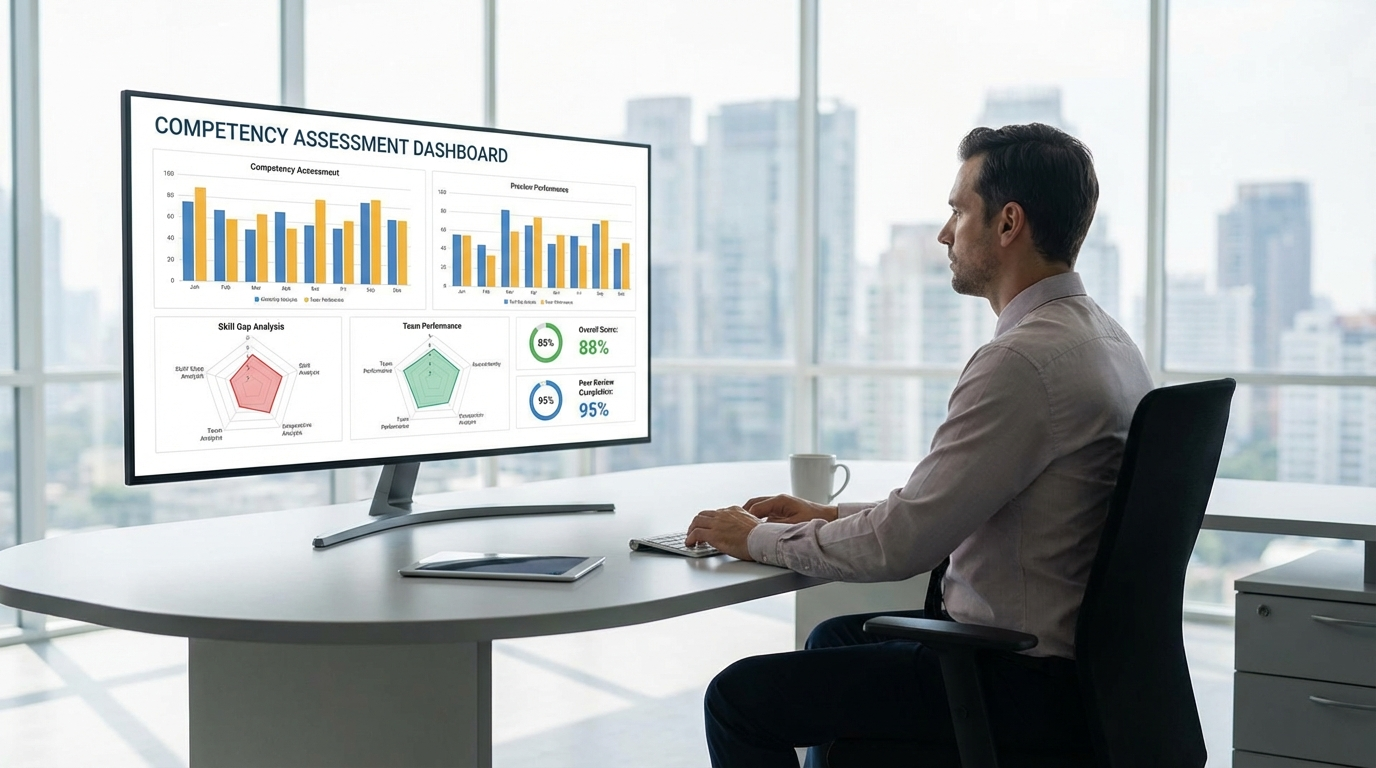
Yes. Dashboards allow tracking by learner, by team and by site. Managers can observe sessions live and use replays for one-to-one debriefs — a key element highlighted in our case studies.
Always ask for four things: cost per learner actually trained, not per licence; engagement metrics (completion rate, not just enrolments); evidence of impact (before-and-after figures on business indicators); and the underlying teaching method (practice versus theory). The gap between an AI avatar interview simulator and a simple chatbot is as wide as the gap between a flight simulator and a video tutorial.
The best investment is not always the cheapest. It is the one that produces a measurable change in how your teams work. A programme at €15 per learner that changes nothing costs far more than one at €250 that lifts customer satisfaction by 20%.
To build your business case, draw on documented results and calculate your projected ROI. And start with a pilot — it is the surest way to validate the approach before committing a rollout budget.
Would you like a tailored quote for your customer relations training programme? Get in touch with Face Up for a bespoke assessment.