
Two days of classroom training on customer relations. Three weeks later, most of the content has gone. That is not a motivation problem, nor a reflection on the trainer. It is the Ebbinghaus forgetting curve, documented for more than a century: without spaced repetition, the brain discards the bulk of what it has learned.
For interpersonal skills, the problem is sharper still. These are behavioural skills: they take root through repeated practice, not through passive listening. An employee can understand the principles of active listening perfectly well and still never apply them in front of a customer in a hurry.
Microlearning and blended learning are answers to that reality. They do not replace in-depth training — they extend it and reinforce it over time.
Microlearning breaks learning into short capsules of three to ten minutes, each focused on a single objective. One capsule equals one skill equals one exercise. No 45-minute module covering six different themes.
In customer relations training, microlearning takes several forms: a three-minute video illustrating a reformulation technique, a quick quiz on good practice when handling a complaint, a short simulation of a customer exchange on one specific point, or a one-page summary of an argument.
Retention through spaced repetition. Instead of one intensive day every six months, the employee practises for five minutes a day. For long-term retention, regularity beats intensity. Delayed assessments show markedly better results with this format.
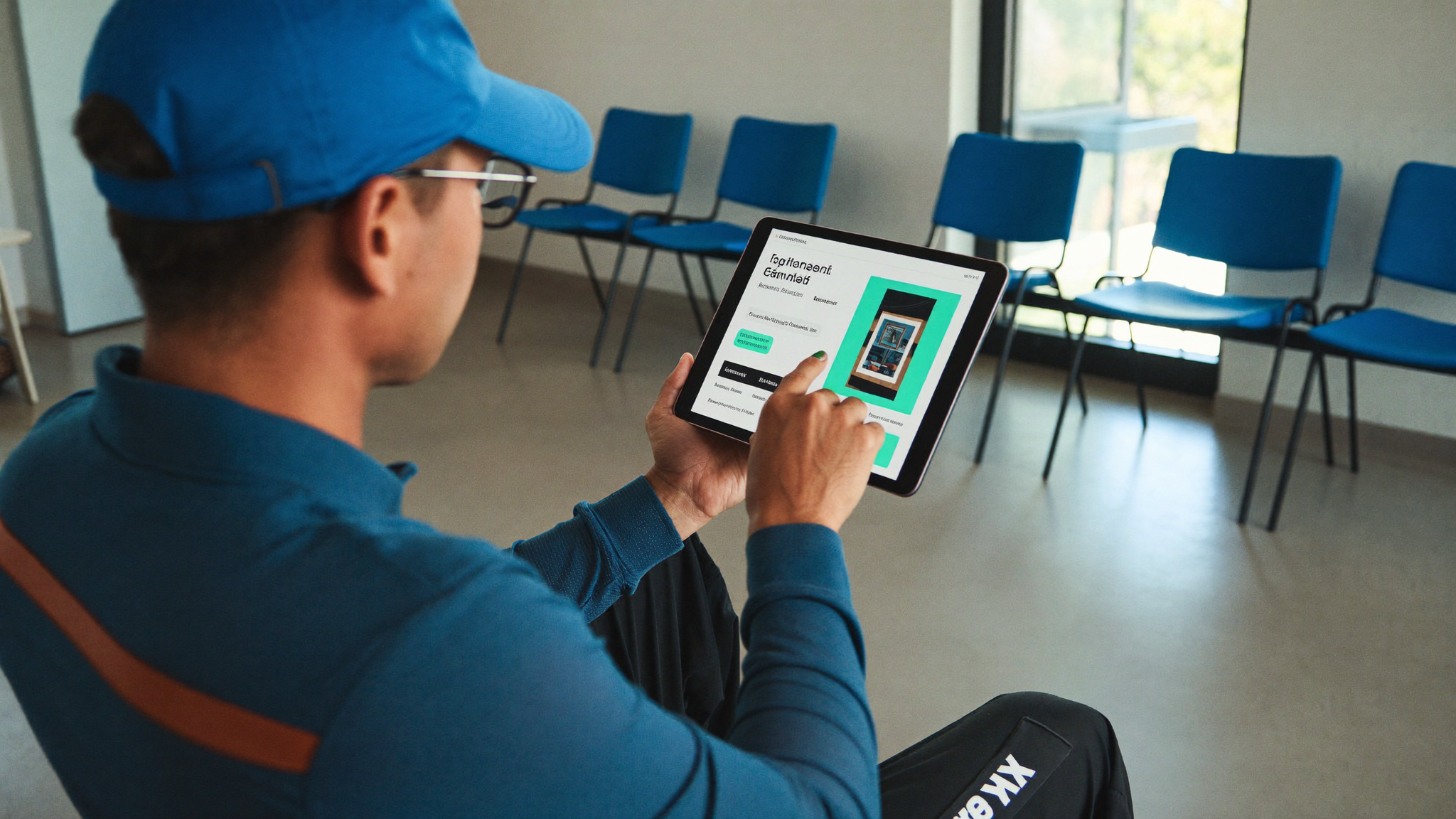
Compatibility with frontline work. A reception agent cannot leave their post for two hours. But they can spend five minutes between customers on a targeted capsule. Microlearning fits into the gaps of the working day.
Personalised progression. Each employee moves at their own pace, on the skills where they most need to improve. A salesperson who is confident on greeting customers but struggles with objection handling can focus on exactly that.
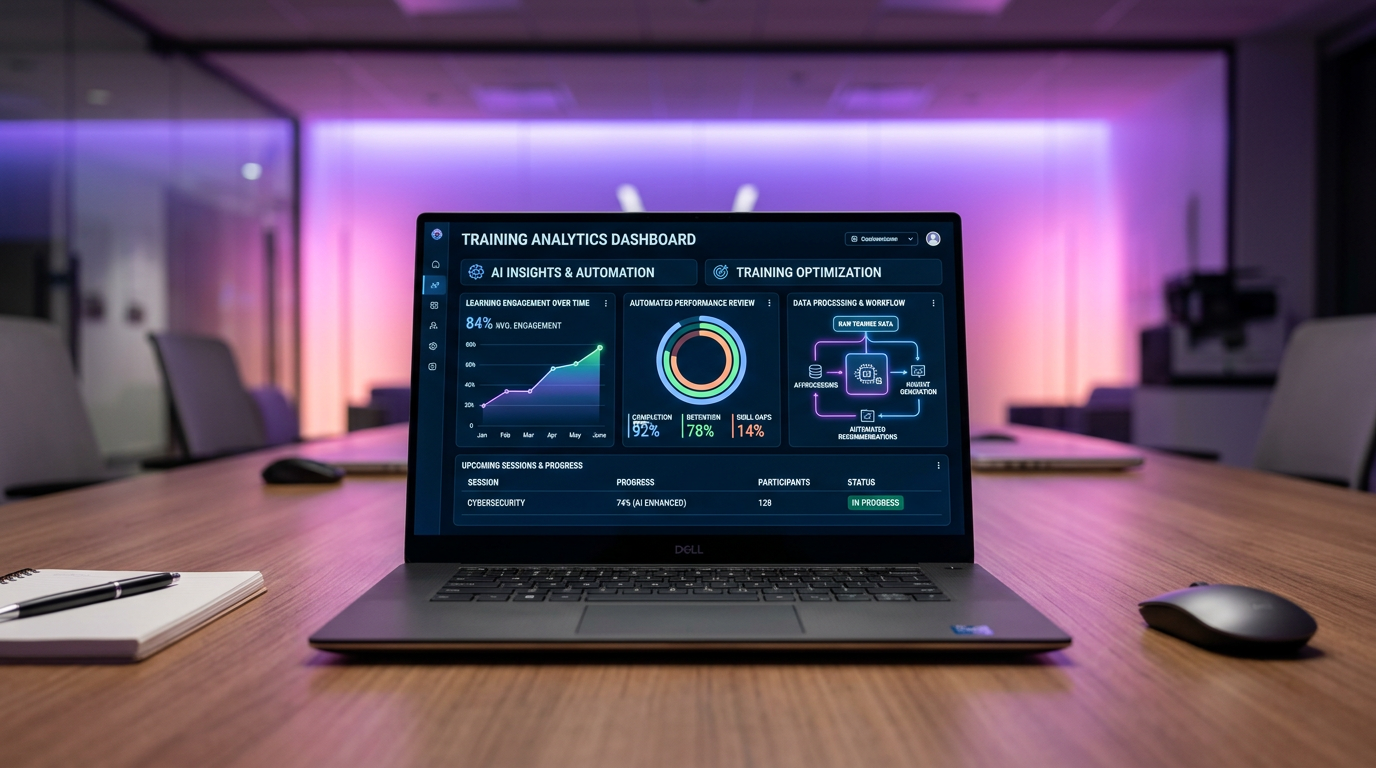
Continuous measurement. Every capsule generates data: completion rate, scores, time spent. The training manager steers progress in real time rather than waiting for the annual review.
Microlearning does not suit everything. Complex skills that need extended context — a full commercial negotiation, crisis management — call for longer formats. The risk of an all-capsule approach is fragmentation: fragments of knowledge with no overall picture.
Microlearning is a complement, not a substitute. It excels at reinforcement, revision and updating. It requires a foundation built beforehand — in the classroom, through longer e-learning, or in structured initial training.
Blended learning combines in-person and remote formats within a single coherent path. The point is not to add a bit of digital to look modern. It is to assign each format to what it does best.
In customer relations training, a typical blended path looks like this: an e-learning module for the theoretical fundamentals, then an in-person session for supervised practice, then AI simulations for individual rehearsal, then microlearning to embed the learning, and finally a group debriefing session.
In-person training remains irreplaceable for certain kinds of learning: group dynamics, peer feedback, handling emotion in the moment. Role-plays between participants, observed and debriefed by a trainer, produce realisations that are impossible to reproduce alone in front of a screen.
Asynchronous e-learning (online modules, videos, quizzes) suits factual knowledge: procedures, products, regulation. The learner moves at their own pace, revisits anything unclear, and validates what they have retained through tests.
AI simulations close a major blind spot: individual, repeated practice. A trainer cannot take 30 learners through 10 different scenarios one by one. AI conversational simulations make that possible, with personalised feedback and multimodal analysis covering content, tone and body language.
Microlearning comes after the main training to maintain and reinforce what was learned. Spaced reminders, mini-exercises and weekly challenges extend the impact of the initial programme.
A poor blended path stacks formats with no logic. A good one orchestrates a clear progression with an objective at every stage.
The fundamental rule: each stage must have a precise learning objective and a format suited to it. Do not put online what needs human interaction. Do not spend a day in a classroom on theory that can be consulted online.
The sequence matters as much as the content. Typically: discovery (e-learning), then understanding (in person), then practice (simulation), then embedding (microlearning), then assessment (certification). Each stage prepares the next and builds on the one before.
AI avatars let learners practise realistic customer conversations on demand, without tying up a trainer. The learner works against a virtual customer whose personality, difficulty level and scenario are all configurable.
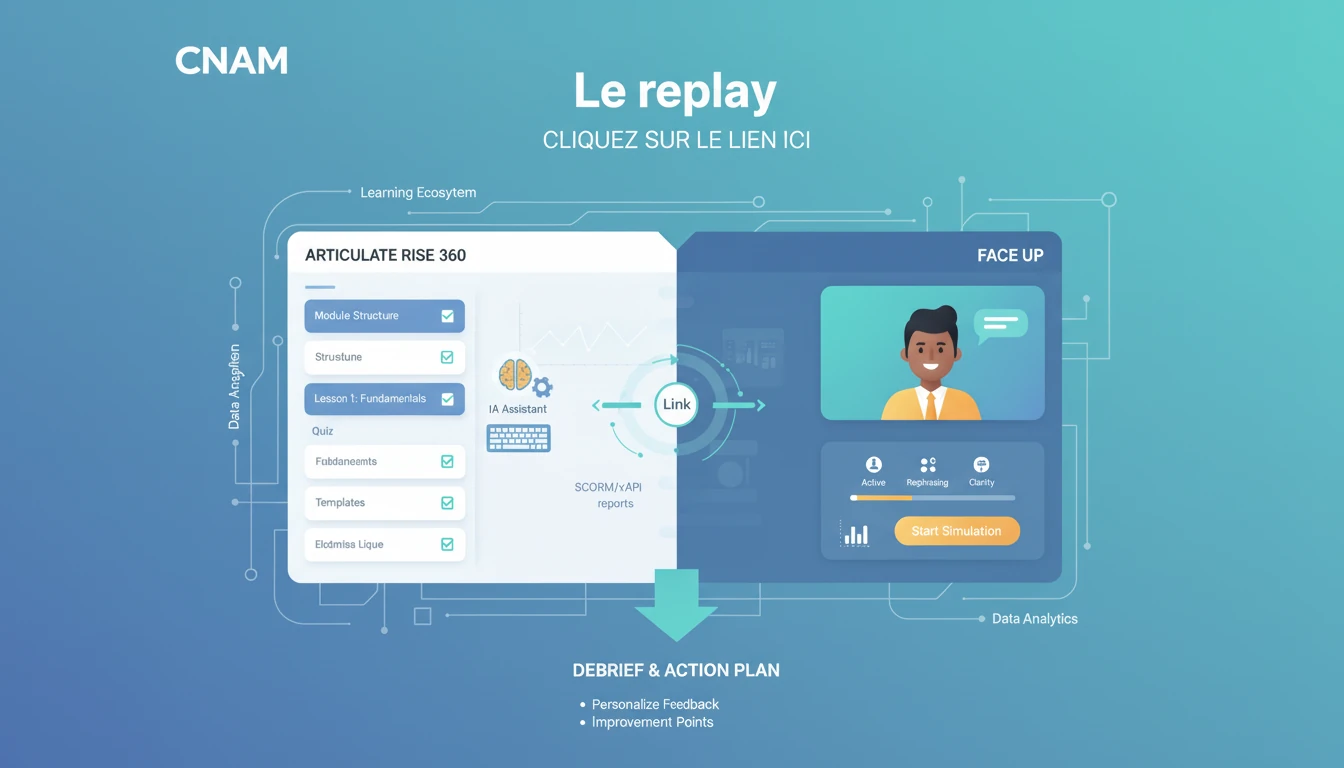
Face Up takes that logic further with conversational learning: every simulation is followed by an actionable debriefing covering both substance (relevance of the answers, adherence to the process) and delivery (tone, body language, use of silence). The trainer can observe live or through replay, with timestamps on the key moments.
This format suits microlearning particularly well: a five-minute simulation on one specific point — reframing a price objection, greeting an unhappy customer, closing a conversation — slots easily into the working day.
Social learning draws on the interaction between learners: discussion forums, sharing good practice, peer feedback on simulations. In a customer relations path, experienced staff pass their techniques on to newcomers.
The format works well alongside in-person training. A dedicated group chat or channel keeps the conversation going between sessions, lets people share situations they have met on the job, and sustains the learning momentum.
Points, badges, leaderboards, challenges: gamification lifts engagement without turning training into a superficial game. The trick is to gamify practice, not theory. Earning points for watching a video is worthless. Climbing a leaderboard based on simulation performance is another matter.
The gamification mechanics that work best in customer relations training are weekly challenges ("this week, use the mirroring technique in three conversations"), visible progression (a skills bar), and recognition of progress (badges unlocked after completing a difficult scenario).
A blended path needs an LMS (Learning Management System) to orchestrate the different formats, track progress and automate reminders. Modern platforms such as 360Learning, Moodle and Docebo let you combine e-learning, simulations and assessments in a single path.
Face Up integrates natively with the main LMS platforms. Simulation sessions appear as activities within the LMS path, and results flow automatically into progress reports. No juggling between platforms. That is a decisive advantage when you roll out a programme at scale.
Moving from an entirely in-person format to a blended path cannot be imposed by decree. Trainers have to adapt their stance: less top-down delivery, more facilitation and debriefing. Learners have to build new habits: logging in regularly, practising independently, acting on feedback.
Change management is often the deciding factor. Start with a pilot and a willing team. Measure the results. Communicate the wins. Widen the rollout gradually. A forced deployment without buy-in produces rejection, however good the underlying design.
Each format generates different data. For microlearning: daily completion rate, score progression, consistency of use. For in-person sessions: immediate satisfaction, active participation, quality of interaction. For simulations: performance scores, progress by competency, number of sessions completed.
The ultimate indicator remains impact on the ground. Are customer satisfaction scores improving? Is first-contact resolution rising? The ROI of the programme comes from cross-referencing learning data with business indicators.
A blended path is never finished. Usage data reveals what works and what needs adjusting. An e-learning module with a high drop-out rate is too long or not engaging enough. A simulation everyone passes first time is too easy. An in-person session people ask for again deserves more space.
The strength of blended learning is its modularity. You can replace one element, add a stage or shorten a module without rebuilding the whole path. That agility is what lets you keep improving the effectiveness of the training.
Do not try to digitise everything at once. Start by identifying the sharpest pain point. If your teams forget the fundamentals between in-person sessions, add microlearning. If your trainers cannot give every learner individual practice, bring in AI simulations. If frontline teams cannot be released for full days, break the path into short sequences.
Blended learning is not a technology question. It is a learning design question: putting the right format at the right moment for the right objective. Technology is a means, not an end.