
The question of training format has never mattered more than it does today. Since 2020, remote delivery has embedded itself in learning practice, and most organisations have discovered that some courses work perfectly well at a distance. But for soft skills, the answer is far less obvious.
Behavioural skills — communication, emotional intelligence, leadership, stress management — rest largely on human interaction, on reading body language and on emotional experience. Are those dimensions compatible with a screen in between? The answer, as so often in learning design, is: it depends. Here is on what.
Classroom delivery remains the reference format for soft skills training, and for good reasons. First, the richness of non-verbal communication: in a room, the trainer picks up micro-expressions, posture and tension in the voice, and adjusts in real time. Participants, for their part, perceive the interaction as a whole — which matters enormously when the subject is communication or conflict management.
Second, group dynamics. In-person sessions generate a collective energy that remote delivery struggles to reproduce. Role-plays in breakout groups, spontaneous debriefs over coffee, informal exchanges between participants — all of it contributes meaningfully to learning. Research by Brandon Hall Group suggests learners retain around 75% of what they actively practise in a group, against 10% of what they read and 20% of what they watch on video.
Third, emotional intensity. A face-to-face simulation produces stress comparable to the real thing, which activates the mechanisms of emotional memory. Running a difficult performance conversation with a colleague sitting opposite you does not land the same way as doing it through a screen.
In-person training carries significant logistical constraints. Diaries have to be aligned across participants who are often geographically scattered, rooms booked, trainers moved to site, and travel and accommodation paid for. For multi-site or international organisations, those constraints quickly become prohibitive.
The classroom is also limited in volume of practice. A day in a training room typically allows four to six simulations per participant. That is not enough to embed reflexes. Learning science is clear that spaced repetition is a major driver of retention, and an intensive day followed by nothing for six months produces little that lasts.
Finally, post-training follow-up is usually the weak link. Once participants are back in the flow of work, how do you make sure they apply what they learnt? How do you measure their progress? This is where digital formats add genuine value.
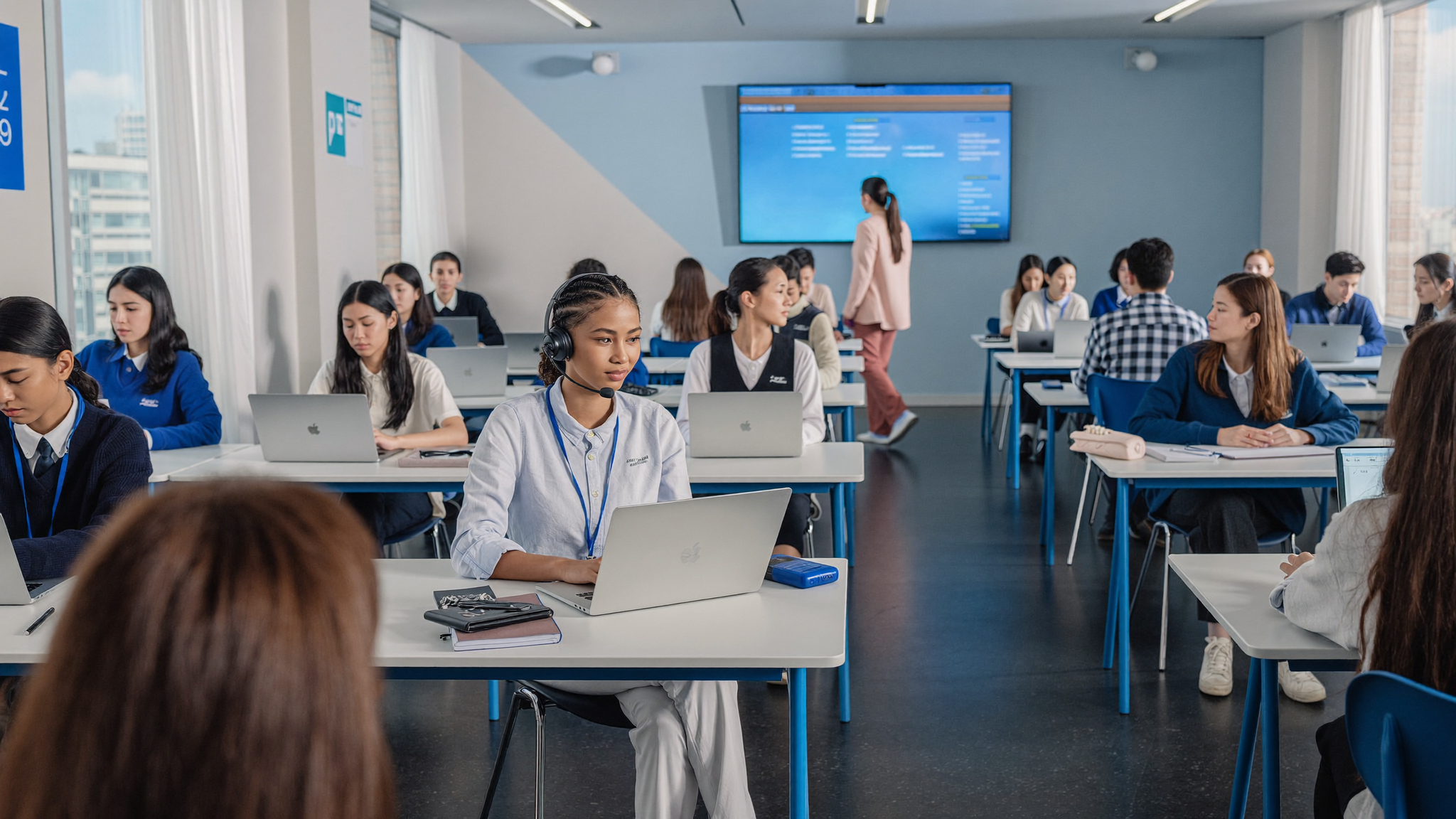
Some components of soft skills training adapt well to synchronous remote delivery — live, over video. Conceptual input — frameworks, communication models, stress management techniques — transfers efficiently at a distance. So do group discussion, case analysis and reflective exercises, provided the facilitator is fluent with the tooling: breakout rooms, collaborative whiteboards, live polls.
Remote delivery has advantages of its own. It widens access: someone based in a regional office gets the same session as colleagues at head office. It offers flexibility that makes scheduling easier — short sessions of 90 minutes to two hours spread over several weeks often outperform a single compressed day. And it allows replay: recorded sessions become revision material.
Simulations and role-plays over video lose much of their effect. The absence of physical presence, connection lag, cameras switched off, the domestic setting — all of it dilutes the intensity of the experience. Participants engage less, the facilitator has less purchase on the dynamic, and feedback loses precision, since full posture cannot be read through a webcam.
The cognitive fatigue that comes with video calls — the well-documented "Zoom fatigue" — is not a detail. After 90 minutes on video, attention drops sharply. For soft skills, which demand high emotional engagement, that fatigue is particularly costly.
Exercises that depend on fine sensory perception — reading body language, working on the voice, managing physical space — are markedly degraded remotely. If your primary objective is to develop face-to-face interpersonal skills, a fully remote programme will fall short.
Asynchronous e-learning — online modules available at any time — plays a complementary role in the range of methods available for soft skills. It cannot form the core of a behavioural development programme; nobody develops emotional intelligence by watching videos. But it serves three essential functions.
Function 1: awareness and baselining. Ahead of a practice session, whether in a room or on a simulator, an e-learning module lets the learner meet the key concepts, complete a self-assessment and identify where they need to improve. They arrive prepared, which protects the time available for practice.
Function 2: recall and consolidation. After a practice session, short recall modules spaced over time strengthen retention — the spacing effect at work. A weekly quiz, a three-minute video built around a real case, a short reflective exercise: these formats keep learning active between sessions.
Function 3: reference and transfer support. Job aids, checklists and decision trees available online form a toolkit the learner can consult in the moment. Before a difficult conversation, they can revisit a sheet on de-escalation techniques. Before a presentation, a guide to persuasive communication.
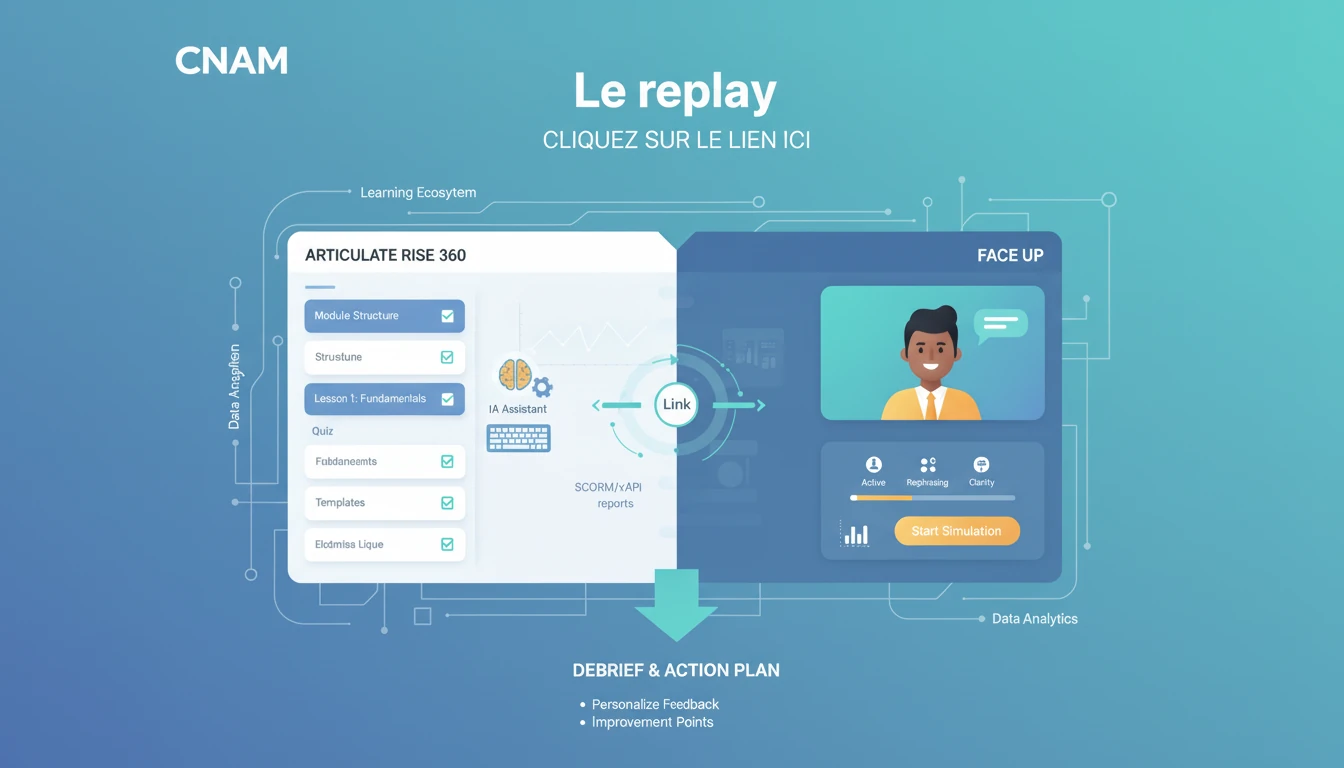
Simulators built on artificial intelligence represent a third route, combining the strengths of the classroom — practice, interaction, emotion — with those of remote delivery: reach, scalability, repeatability. The principle is straightforward: the learner interacts with an AI character playing a realistic role — a difficult customer, a colleague in conflict, a hesitant prospect — and receives personalised feedback on how they handled it.
This approach solves several problems at once. It enables practice at scale: each learner can run as many simulations as they want, without depending on a trainer's or a peer's availability. It provides multimodal feedback — on content (what you said), on tone (how you said it), and potentially on posture and expression. And it guarantees consistency across training situations while still adapting to each learner's level.
At Face Up we have found that programmes combining in-person work with an AI simulator produce the best outcomes. The classroom supplies the emotional intensity of the group and the richness of collective debriefing. The simulator supplies volume of practice, repetition and individualised feedback. It is that combination which has delivered a 50% reduction in onboarding time and 95% learner satisfaction among our clients.
Blended learning is the pragmatic answer to the in-person versus remote debate. Rather than picking a single format, the point is to sequence the modalities, giving each the role it performs best.
Here is a blended structure that has proved itself for soft skills.
Week 1 — Discovery (asynchronous e-learning, 2 hours): introduction to the concepts, self-assessment, worked examples on video, baselining quiz. The learner gets familiar with the target skills at their own pace.
Week 2 — Immersion (in person or live remote, one day): group simulations, role-plays with the facilitator, collective debriefing, joint definition of good practice. This is the high point of the programme.
Weeks 3 to 6 — Practice (AI simulator plus micro-learning, 30 minutes a week): individual practice on progressively harder scenarios, spaced recall, short application exercises. The learner embeds what they have learnt through repetition.
Week 7 — Consolidation (live remote, 2 hours): collective review, sharing of real situations from the field, group coaching, individual action plan.
Weeks 8 to 12 — Transfer (on the job plus digital follow-up): application in real situations against behavioural objectives, short follow-up touchpoints such as a manager check-in or flash coaching, and final assessment.
This 12-week programme amounts to roughly 15 hours of active learning, distributed to respect what learning science tells us about spacing, active retrieval and application in context. Total cost comes in below a conventional two-day classroom course, for markedly better results in transfer and retention.
Four criteria should guide your choice of format.
1. The nature of the skill. Skills that rest on direct interaction — negotiation, conflict management, face-to-face customer relationships — need a strong in-person or simulator component. More reflective skills — emotional intelligence, stress management, decision-making — sit more comfortably in a mix of remote delivery and coaching.
2. The size and spread of the population. For 15 managers on one site, an intensive in-person format makes sense. For 500 frontline staff across 30 sites, only a digital programme with occasional group milestones is viable. Large-scale deployment demands scalable formats.
3. The budget available. In-person delivery costs three to five times more per learner than remote, before travel. AI simulators sit between the two, with a unit cost that falls steeply as volume rises. Any ROI calculation should weigh not just the cost of the training but the results it produces.
4. The organisation's learning culture. A business used to doing everything in a room will not switch to fully digital overnight. The transition needs to be gradual, starting with blended formats that introduce digital components step by step.
The first mistake is transposing a classroom format to video without adapting it. A day in a training room does not become a day on a video call. Remote formats require shorter, more interactive sessions, with frequent breaks and varied activities.
The second is treating e-learning as sufficient. Learning platforms are full of "soft skills" modules that are really lectures dressed up as video. Watching content passively does not develop behavioural skills. Every asynchronous module needs to be connected to a period of active practice.
The third is neglecting managerial support. Whatever format you choose, without active backing from the direct line manager, transfer into the job will be limited. Build the manager into the design: a briefing before the training, a debrief afterwards, behavioural objectives to observe.
The clear trend is convergence. The boundaries between in-person and remote are blurring, thanks to technologies that bring the digital experience closer to the human one. Advances in AI in understanding language, emotion and behaviour make increasingly realistic simulation possible.
The typical soft skills programme of the near future will probably combine in-person group sessions for human connection and debriefing, individual sessions with AI characters for intensive practice, and short digital formats for continuous reinforcement. The trainer becomes an architect of learning journeys and a facilitator of debriefs, rather than a transmitter of knowledge.
For organisations looking to get ahead of these trends, the task is not to pick a format but to build a learning ecosystem in which each modality does the job it does best. That is precisely the vision we pursue at Face Up with our conversational learning platform.