
A soft skills training module should not be judged by the quality of its slides, but by what participants do differently three weeks later. That is exactly where most modules fail: learners leave convinced, sometimes enthusiastic, then fall back into their old habits at the first tense conversation. The reason is structural. Interpersonal skills are not knowledge: they cannot be transmitted, they have to be built through practice. Here is a 6-step method for designing a module that actually changes behavior, with one concrete example running through the whole article: learning to deliver difficult feedback.
The most common flaw fits in one sentence: designing a soft skills training module as if it were a knowledge module. Slides, concepts, a video, a final quiz. That format works fine for learning a procedure or a regulation. It fails for behavior, because a behavior is a reflex triggered under pressure — and reflexes are only built through repeated practice in realistic situations.
Take difficult feedback. Anyone can understand in ten minutes that you should rely on facts rather than judgments. But understanding is not enough: facing an employee who gets defensive, stress takes over and old habits return. That is why the most effective soft skills training methods all share the same foundation: little theory, lots of practice, systematic debriefing. The 6 steps below turn that foundation into a design method.
One module = one objective. It is the most profitable framing rule there is: a module that targets feedback, listening and conflict management all at once will change none of the three. Two well-designed hours on a single behavior beat a scattered full day.
"Raising managers' awareness of feedback" is not an objective: it is a wish. A behavioral objective describes what the participant will be able to do, in which situation, and to what standard. For our running example: "by the end of the module, the participant conducts a difficult feedback conversation based on specific facts, describing their impact and formulating a clear request, without judging the person, in under ten minutes."
The mechanism is simple: an observable objective makes everything else designable. It dictates the content of the input, the practice scenarios and the debriefing criteria. If you cannot observe the objective, you can neither train it nor assess it.
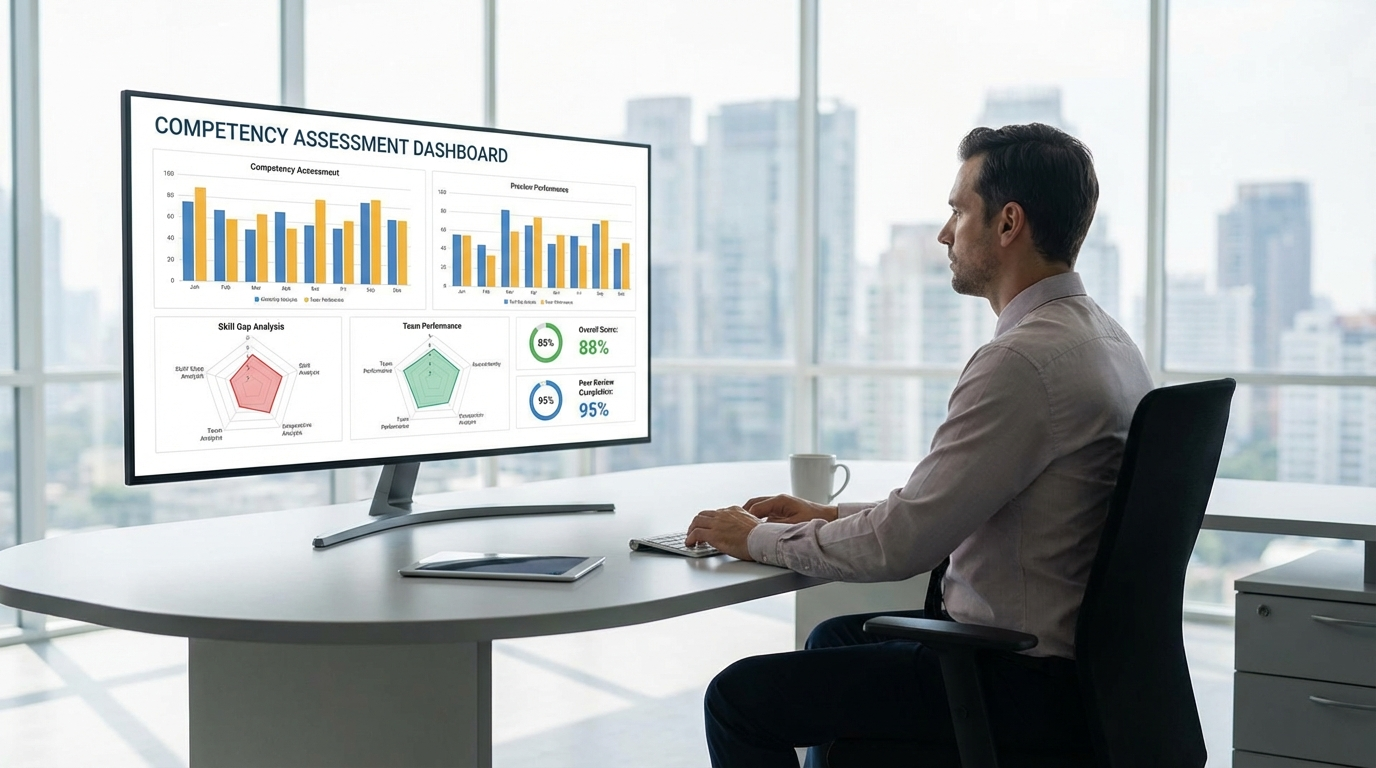
Before training, measure. A ten-minute diagnostic role play puts each participant in the target situation and reveals their actual level — often very different from their self-assessment. Some already structure their facts but avoid making the final request; others judge without realizing it.
This diagnostic serves two purposes. It calibrates the module's difficulty: there is no point re-explaining a framework the group already masters. And it creates the baseline that will let you prove progression at the end — the most convincing argument you can bring to leadership.
Complete the diagnostic with the manager's perspective. One simple question — "in which situation does your team member lose their footing?" — is often enough to steer the module's scenario toward the cases that really matter in the field, rather than generic situations.
The theoretical input should fit within 20% of the module's time. Not because theory is useless, but because its role is limited: providing a simple framework that practice will then install. For difficult feedback: a three-part structure (facts, impact, request), the three classic traps, one commented demonstration. That is all.
If your input exceeds one hour in a full-day module, the problem is not the content — it is the design. A good test: script your input as if it were a short e-learning module. The exercise forces you to separate the essential from the comfortable.
At least 60% of the time. This is where behavior is built: every participant has to live the target situation — not watch it, not debate it. And live it several times, because the first attempt mostly serves to meet the difficulty; reflexes start shifting on the second and third run.
In the classroom, peer role play works, but the math is stubborn: in a one-day session with twelve participants, each person practices once, twice at best. AI roleplay removes that constraint: each learner practices with a realistic counterpart, as many times as needed, away from the group's gaze. Ten minutes is enough for a complete run and its debriefing, which makes it possible to multiply repetitions without extending training time. The two formats combine well — we cover where to place role play in a program in a dedicated article.
A role play without a debriefing is an experience; with one, it becomes learning. The structure fits in three questions: what happened (facts, not impressions), what worked, and what will you do differently next time. Self-analysis comes first: a participant who identifies their own sticking point will fix it faster than after ten pieces of advice.
The trainer's feedback then anchors on specific moments of the session — "when he challenged the number, you shifted from fact to judgment" — and sticks to one strength and one priority. A list of ten criticisms produces zero change.
Without reactivation, the forgetting curve does its work: a few weeks after the module, only a vague impression remains. Schedule short, spaced follow-ups: at day 7, a ten-minute practice session on a variant of the scenario; at day 21, a field challenge — give one real piece of feedback this week and note what happened.
This spacing logic is what separates an isolated module from a soft skills training program spread over several weeks: the module installs the reflex, the program anchors it.
Two mistakes come up in the vast majority of modules:
Two more traps deserve a mention: the vague objective ("improve posture and presence"), which makes the module impossible to assess, and the one-off session with no follow-up, which guarantees forgetting. In both cases the remedy is in the method: go back to step 1 or step 6. One indicator never lies: if your module can be followed passively from start to finish, it will change no behavior. For the broader picture of what works, see our complete guide to soft skills training.
An effective soft skills training module can be recognized by its structure: an observable behavioral objective, a starting diagnostic, 20% input, 60% role play, systematic debriefing and spaced reactivation. The content matters less than this mechanism — it is what turns a good intention into a reflex. Conversational learning solutions like Face Up make steps 4 and 6 realistic at scale: ten-minute practice sessions with AI personas, followed by an immediate debriefing, repeatable every week. To place the module within the bigger picture of practice-based training, read our complete guide to roleplay training.