
The manager's role has changed profoundly in recent years. The days when technical expertise alone was enough to lead a team are gone. Organisations now expect their managers to demonstrate human leadership: the ability to bring people together, motivate them and support them through constant change.
The evidence is hard to ignore. Gallup research attributes 70% of the variance in team engagement directly to the manager. And people rarely leave a company — they leave a manager. That reality puts managerial soft skills at the centre of HR strategy.
For L&D leaders, training managers in behavioural skills is no longer a nice-to-have. It is a strategic lever for retention, performance and cultural change. But which skills should come first? And how do you structure a programme that produces real results?
A manager with strong emotional intelligence recognises their own emotions, regulates them and understands what their people are feeling. This capability shapes the quality of their decisions, their handling of tension and their ability to build trust.
In practice, managerial emotional intelligence means staying composed in a crisis, adapting communication to the person in front of you and defusing conflict before it escalates. Teams led by emotionally intelligent managers consistently report higher engagement.
Managers communicate constantly: one-to-one feedback, team meetings, presentations to the executive team, informal exchanges in the corridor. The quality of their interpersonal communication determines how clear their messages are, whether the team buys in and how credible they appear to their own leadership.
Training managers in communication means teaching them to give constructive feedback, to listen actively, to adjust their register and to read and manage non-verbal signals. These are skills built through repeated practice, not through theory.
Every manager eventually faces tension inside their team: disagreements between colleagues, resistance to change, frustration over workload. How they handle these situations determines the team's cohesion and its productivity.
Managers trained in conflict management spot the early signals, intervene at the right moment and use mediation techniques to reach outcomes all parties can accept.
There is no single effective leadership style. The best managers adapt their approach to the context, to how autonomous the individual is and to the nature of the task. This is the principle of situational leadership set out by Hersey and Blanchard.
Training in situational leadership means helping managers recognise when to direct, when to coach, when to support and when to delegate. This behavioural flexibility is one of the hardest capabilities to acquire — and one of the most powerful once mastered.
Managers sit on the front line of organisational pressure. They absorb stress coming down from leadership while shielding their teams from it. Without skills in stress management and resilience, that buffer role quickly becomes unsustainable.
Training managers in resilience means giving them concrete techniques for regulating emotion, practical methods for prioritising and the ability to sustain their energy over time. A resilient manager is a manager who lasts.
Feedback is the most powerful development tool a manager has. Yet most managers avoid difficult feedback conversations altogether, or handle them clumsily, creating confusion and demotivation.
An effective programme teaches a structured feedback method: describe the observed facts, explain the impact, state a clear expectation and agree an action plan together. This skill develops only through repeated practice in realistic role-play scenarios.
Delegating well is not simply handing out tasks. It means transferring responsibility while keeping the boundaries clear, adjusting the level of supervision to the individual and resisting the urge to control everything.
Managers who delegate well free their own time for higher-value work while building their team's autonomy and capability. It is a virtuous circle that compounds collective performance.
An effective soft skills programme for managers is not a one-day awareness session. It runs over time and combines several complementary learning methods.
A typical path has three phases. The diagnostic phase assesses each manager's current skills through self-assessment, 360-degree feedback and initial role-play. The development phase combines classroom work, individual coaching and hands-on practice across several weeks. The embedding phase secures transfer into real situations through refresher sessions, peer coaching and progress tracking.
Managerial soft skills are not learned from a book or a passive e-learning module. They develop through repeated exposure to situations that closely resemble the real thing.
That is why the most effective programmes build in realistic role-play and simulation. The manager practises supporting a struggling team member, announcing a reorganisation, running a performance conversation or chairing a tense meeting. Repetition in a safe setting turns theoretical knowledge into behavioural reflex.
AI-based simulators add a further dimension to management development. Managers can practise as often as they like, whenever they like, without needing to book a trainer or an actor.
With avatars whose personalities can be configured, a manager can rehearse a feedback conversation with someone who takes criticism badly, a performance discussion with someone who pushes back, or an objectives negotiation with an analytical profile. The AI analyses each exchange and delivers a detailed debrief on content, tone and the stance the manager took.
A first-time manager does not need the same thing as an experienced director. A well-designed programme segments its participants and matches content to each person's level of managerial maturity.
The first step is to assess each manager's skills to identify their strengths and priority development areas. A personalised development plan will always outperform a standardised course.
A two-day workshop with no follow-up rarely produces lasting change. Learning science is consistent on this point: behavioural skills require regular practice over weeks, often months.
Programmes that work build in spaced refresher sessions, practice exercises between sessions and a coaching or mentoring system to support transfer into real situations.
Training managers in soft skills inside an environment that does not value those skills creates a dissonance that cancels out the benefit. If the company rewards numbers alone and never looks at management quality, trained managers will quickly revert to old habits.
A successful programme goes hand in hand with a change in evaluation criteria, visible support from senior leadership and a culture that genuinely recognises the value of interpersonal skills.
One of the main challenges with manager soft skills training is measuring results. Unlike technical training, where you can assess whether a procedure has been learned, behavioural skills reveal themselves through indirect effects.
The most useful indicators include movement in team engagement scores, turnover within the teams concerned, how employees rate the quality of their appraisal conversations, and the number of conflicts escalated to HR. For a full approach to calculating ROI, these indicators need to be defined before the programme starts, not after.
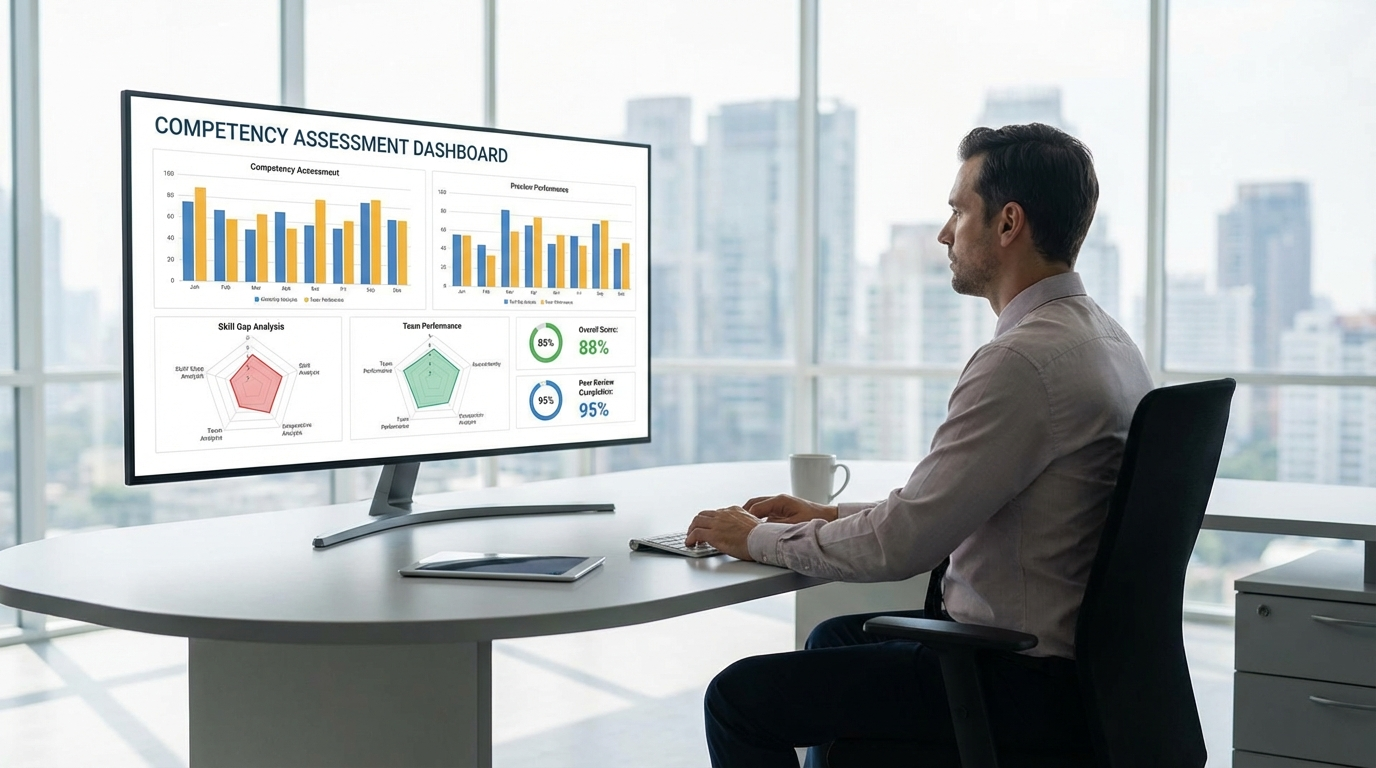
Soft skills assessment tools also make it possible to track each manager's individual progress between the initial diagnostic and later reviews. That objective evidence strengthens the programme's standing with senior leadership.
The right format depends on how many managers you are training, how geographically dispersed they are and what budget is available. Blended learning generally combines the best of both worlds.
Face-to-face remains irreplaceable for group interaction, peer role-play and building cohesion among the management population. Remote learning, enriched by AI conversation, multiplies opportunities for individual practice and keeps training going between classroom sessions.
For a large-scale rollout, combining an in-person launch, continuous digital practice and intermediate group sessions gives the best balance between learning effectiveness and cost per manager trained.
Training managers in soft skills is a strategic investment that feeds directly into team engagement, talent retention and collective performance. The most effective programmes share three characteristics: they are personalised to each manager's level, they run over time with regular follow-up, and they put practice at the centre of the design.
The arrival of AI simulators opens new possibilities by making intensive, personalised practice available at any time. Combined with quality human support, these tools turn management development from a one-off event into a continuous process.
To explore the full range of soft skills training approaches, read our complete guide. And if your priority is the customer relationship specifically, see our dedicated guide to customer relations management training.