
Your soft skills pilot has produced excellent results with a first cohort. Participants are satisfied, managers can see behaviour changing, performance indicators are improving. The next question is unavoidable: how do you reproduce those results across the whole organisation? Scaling is the moment of truth for any training programme. Here is the methodology for getting it right.
What works for 20 people does not necessarily work for 2,000. Large-scale rollout of a training programme raises problems that simply do not exist at pilot size. Behavioural skills amplify those problems, because they rest on interaction, practice and personalised feedback — three things that are hard to industrialise.
The first challenge is consistency of quality. How do you guarantee that every session, run by a different facilitator on a different site, delivers the same experience and the same outcomes? The second is logistics: coordinating the diaries of hundreds of people across multiple sites while keeping the impact on operations to a minimum. The third is measurement: collecting, consolidating and analysing training data at scale so the programme can actually be steered.
The principle is to train a group of internal facilitators first — train the trainer — who then take the programme out to their own teams. This is the most economical model at scale. It creates an internal network of champions who keep the programme alive well beyond the initial engagement.
The conditions for success: rigorous selection of internal facilitators, a comprehensive and standardised training kit, initial support from the external provider, and an internal certification process. The risks: dilution of the message and of quality at each level of the cascade, and dependence on the availability and motivation of internal facilitators.
The programme is delivered by a team of professional facilitators, internal or external, who travel to each site. This model gives better consistency of quality, but generates substantial logistical costs and longer rollout timelines. It suits programmes that call for deep pedagogical expertise, such as leadership development or stress management.
Combining digital modules available to everyone with targeted in-person sessions offers the best trade-off between quality and scalability. Conceptual input and individual exercises are delivered online, while group sessions focus exclusively on practice and feedback. This model cuts the amount of classroom time required — and with it the logistical cost — without sacrificing learning quality.
For very large or highly dispersed organisations, a fully digital rollout has become a viable option thanks to advances in technology. Conversational simulation platforms built on artificial intelligence now let learners practise complex interpersonal situations with realistic AI characters. The advantage: every employee can train at their own pace, at any time, with personalised feedback and precise measurement of their progress.
Before launching the rollout, analyse the pilot results rigorously. Which elements of the programme produced the strongest results? What adjustments did participants and facilitators suggest? Is the return on investment in line with expectations? Document precisely what worked and what needs improving.
Build a solid evidence pack: participant testimony, assessment data, before-and-after performance indicators. That pack is what wins the backing of the executive team and of operational managers — two conditions without which no rollout succeeds.
The pilot programme is probably not deployable as it stands. Identify the elements that need adapting to work at scale. Can the deep personalisation that made the pilot strong be maintained? Will the tools you used cope with ten times the number of users? Are the learning methods reproducible without loss of quality?
This is the point at which technology becomes critical. Any digital solution that complements or replaces in-person interaction should be tested at target scale. Check the capacity of your LMS, the bandwidth available on each site, and whether the tools work on the equipment your frontline teams actually use.
A large-scale rollout is not just a training project; it is an organisational change project. It requires several stakeholders to be aligned. The executive team has to carry the strategic message. HR and the learning function have to run the logistics. Line managers have to free up time for their teams and commit to post-training follow-up.
Build a dedicated internal communication plan. Explain the why before the how. Share the pilot results. Give the floor to pilot participants who can speak to the value of the programme. Employee buy-in is a decisive success factor — and it is built beforehand, not on the day of the session.
Sequencing has to reconcile three constraints: strategic urgency (deploy fast enough to generate impact), operational capacity (do not disrupt the business), and learning quality (keep conditions conducive to learning).
A pragmatic approach is to deploy in waves, starting with the most strategic or the most willing populations. Each wave produces feedback that can be used to adjust the programme before the next one. For frontline and customer service teams, schedule sessions outside peak activity. For managers, favour short formats spread over time rather than long sessions that wreck their diaries.
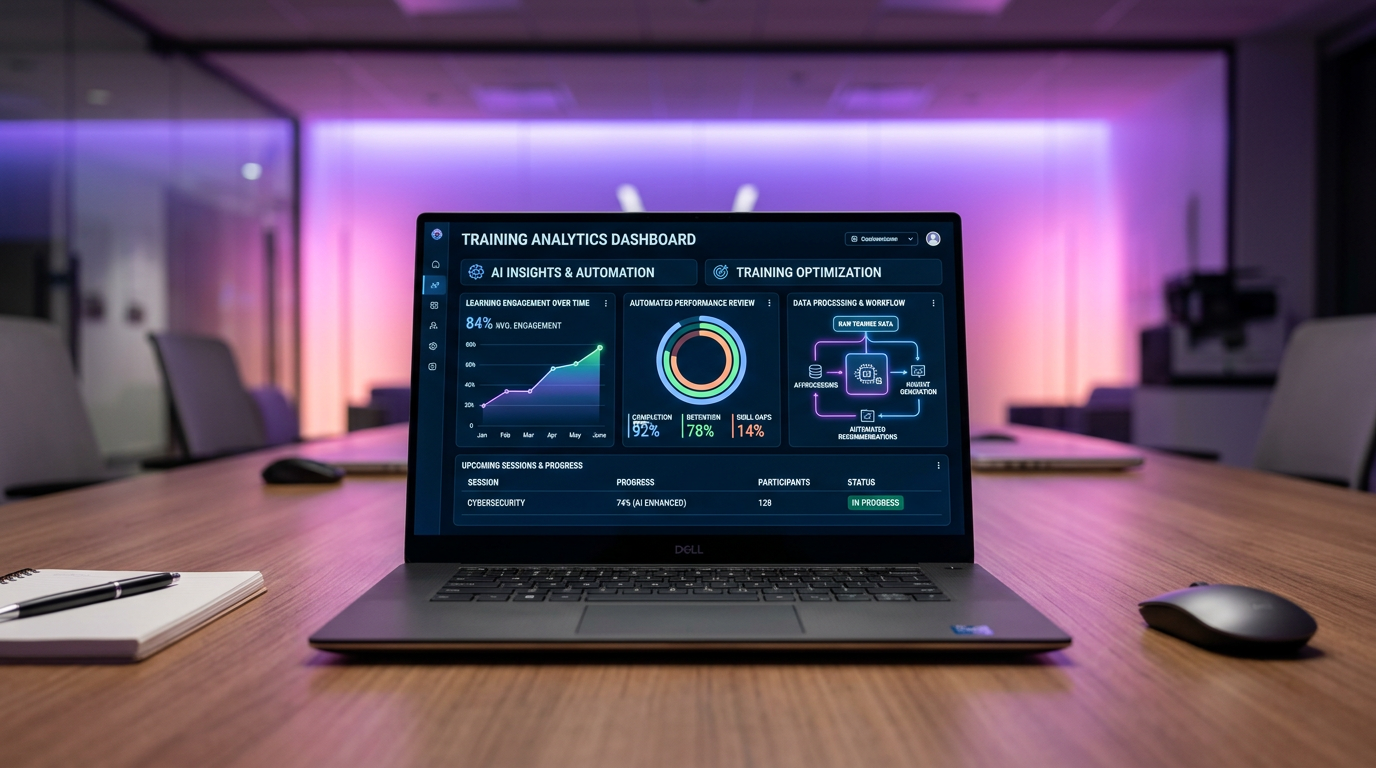
The rollout itself needs tight management. Put in place a tracking dashboard that consolidates the key indicators in real time: participation rates, assessment scores, participant satisfaction, qualitative feedback. That dashboard is what lets you spot friction early and act before it compromises the programme.
Appoint a dedicated rollout project lead with a clear mandate and the means to act. The role is crucial: it holds together facilitators, logistics, managers and the learning function. Without central coordination, a rollout fragments and quality degrades.
The initial rollout is only the beginning. To embed the skills developed, put a continuous reinforcement mechanism in place. That might mean quarterly refresher sessions, peer communities of practice, regular challenges on the digital tools, or individual coaching for those who need it.
Measure impact at several levels: immediate satisfaction, skill acquisition, transfer into the job, and effect on business indicators. Compare rollout results against pilot results to check that scaling has not degraded quality. Adjust the programme continuously on the basis of that data.
Without visible, sustained commitment from the top, a rollout loses legitimacy and priority. People need to understand that this soft skills programme is not an isolated initiative but a strategic priority. Sponsorship shows up as regular communication, senior leaders attending opening sessions, and soft skills development objectives written into annual reviews.
Managers are the programme's indispensable relay on the ground. Their role is to encourage participation, make it easy to apply what has been learnt day to day, and recognise progress. Train them first, so they understand the programme and can support their teams. A manager who has genuinely bought in makes a decisive difference to the impact of the training.
No rollout plan survives contact with reality unchanged. Build in room to manoeuvre: catch-up sessions, alternative formats for isolated sites, adaptations for teams on shift patterns. Rigidity is the enemy of large-scale deployment.
Technology is not optional at scale; it is a necessity. Conversational learning platforms make it possible to maintain the quality of individual practice without multiplying the number of facilitators. Communication skills can be practised through AI simulations available around the clock, complementing group sessions.
Learning analytics supply the data the programme needs to be steered: identifying people who are struggling, comparing results between sites, correlating with operational indicators. Without that data, steering at scale becomes an exercise in intuition.
The temptation to generalise a promising pilot quickly is strong. But a programme that has not been stabilised, documented and tested on a second validation group produces inconsistent results at scale. Take the time to consolidate before you deploy.
Training people in soft skills means asking them to change behaviours that may have been entrenched for years. That kind of transformation cannot be decreed; it has to be supported. A rollout without genuine change management — communication, support, recognition — will run into resistance that undermines the results.
Managing schedules, rooms, equipment, registrations and cancellations across hundreds of sessions is a considerable logistical challenge. Organisations that underestimate it end up with cancelled sessions, unbalanced groups and frustrated employees. Invest in a training management tool suited to your volume.
A rollout does not end with the last session. Without follow-up and reinforcement, newly acquired skills erode within weeks. Behavioural skills fade quickly when they are not practised regularly, so plan the follow-up when you design the rollout, not afterwards.
Sales teams need short formats that fit the rhythm of their work. Long sessions that take them away from customers for several days generate resistance. Favour daily or weekly micro-sessions, complemented by AI simulations they can run between meetings.
People going through onboarding are a particularly receptive audience. Build the soft skills programme into the induction journey so that good reflexes form from the outset. That is usually more effective than trying to change habits already settled in experienced employees.
Managers need a specific programme that goes beyond simple attendance. Their role as relays requires them to master not only the skills being taught but also the feedback and coaching techniques that make their teams' learning stick.
Deploying soft skills training at scale is an ambitious project that demands rigorous methodology, attentive management and the right tools. The six phases set out in this guide are a proven framework for scaling without sacrificing quality.
The key is the balance between standardisation, which guarantees consistency, and personalisation, which keeps the content relevant. Technology — conversational AI learning in particular — now makes it possible to reconcile the two at a controlled cost. The organisations that do this best are those that treat rollout not as a one-off event but as the start of a continuous dynamic of behavioural skills development. Preparation is what decides the outcome, from choosing the right programme to funding it effectively.