
Banking and insurance are going through a deep transformation. As everyday services move online, whether transfers, digital applications or chatbots, advisers are freed from transactional work and refocused on higher-value advice: savings, mortgages, protection, long-term investment and wealth planning. That shift demands relational skills far beyond what processing a file ever required.
For training providers working with financial services, this is both a challenge and a substantial opportunity. Banks and insurers are investing heavily in their advisers' relational capability, provided the programmes on offer reflect the realities of the sector. This guide sets out the priority behavioural skills and the training approaches that work best with this audience.
For decades the bank adviser was first and foremost a technician: processing operations, checking documents, applying procedures. Today customers handle the large majority of routine transactions themselves through banking apps. When they come into a branch or book an appointment, it is for complex matters that call for a proper conversation.
That implies a complete change of posture: from the adviser who "processes" to the adviser who listens, understands and supports. The emotional stakes are higher too, because the subjects involved (borrowing, savings, inheritance, retirement) reach straight into people's personal lives.
In a sector where products are broadly comparable from one institution to the next, the quality of the relationship is the first differentiator. Customers overwhelmingly stay with their main bank because of the relationship with their adviser rather than because of pricing.
In insurance the dynamic is the same: the moment of truth is not the sale but the claim. An adviser who handles a claim with empathy and speed keeps that customer for years. A cold, administrative response produces a cancellation within months.
The first skill to build is the ability to go beyond the customer's stated request. Someone asking about a mortgage is expressing a technical need, but behind it sit personal stakes: a life plan, financial anxiety, a need for reassurance. The adviser who can explore those dimensions builds durable trust.
Interpersonal communication in a banking context requires a delicate balance between professionalism (rigour, compliance) and relational warmth (empathy, approachability). Training advisers to hold that balance is a challenge that practice-based approaches solve far better than theory modules.
Bank advisers face emotionally charged situations: a declined loan, an unauthorised overdraft, fraud on an account, the death of an account holder. Each one calls for precise relational handling, finding the right words, striking the right tone, and managing your own emotions in the face of a distressed customer.
Conflict management in financial services carries an extra dimension: the regulatory frame. The adviser has to handle the customer's emotion while staying within the rules on duty of care, know-your-customer checks and suitability. It is this double constraint, relational and regulatory, that makes sector-specific training essential.
Banking and insurance are closely supervised, whether by financial regulators or under the Insurance Distribution Directive. Advisers have to sell, but within a strict ethical frame. The key skill is proposing solutions that fit the customer's profile rather than pushing products. The sector calls this customer-centred advice, or suitability.
Training advisers into that posture requires practice scenarios where they have to navigate between a commercial target and the customer's interest. Take an older customer who wants to put their savings into a high-risk product: how does the adviser handle it? Role-play allows those dilemmas to be worked through in a safe setting.
What makes soft skills training work in banking and insurance is the relevance of the scenarios. Generic situations such as "greeting an unhappy customer" are not enough. Scenarios have to reflect the actual job: a wealth discovery meeting, delivering a loan refusal, supporting a customer in problem debt, responding to a complaint about charges.
Providers who specialise their scenarios by sub-sector, whether retail banking, private banking, general insurance, life and long-term savings, or health cover, create markedly higher perceived value. The adviser recognises the situation and transfers the learning into daily work far more easily.
Financial services lend themselves particularly well to blended learning. Classroom days, or virtual classrooms, set the fundamentals, allow group practice and surface experience from the field. Digital modules between sessions provide regular individual practice.
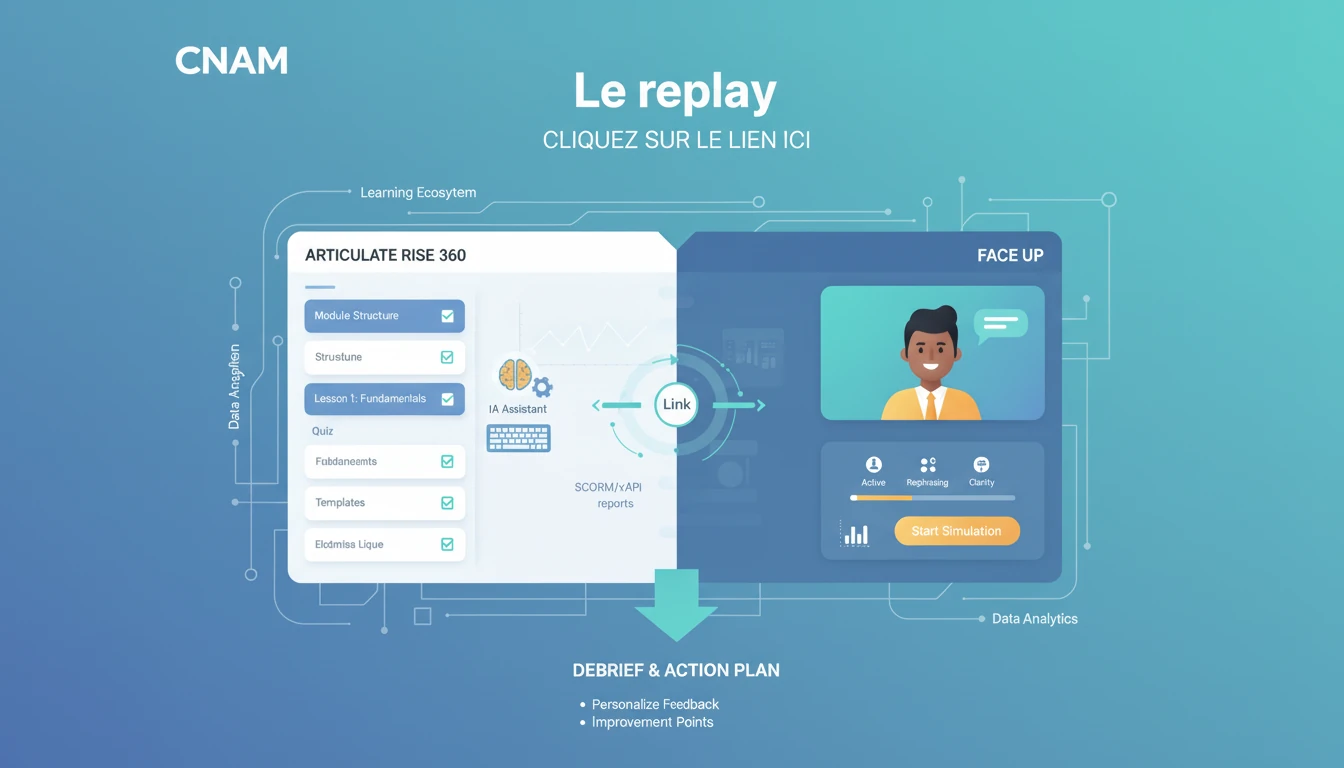
Conversational learning platforms add a further dimension: the adviser can practise with a customer avatar, an anxious retiree, a young first-time buyer, a business owner in a hurry, under conditions close to the real thing. Face Up offers this kind of practice built around banking scenarios, with a detailed debrief on both the substance and the delivery of the conversation.
In branch networks, the branch manager is central to developing advisers' skills. Training branch managers in individual coaching, including joint listening, post-appointment debriefs and constructive feedback, multiplies the impact of the initial training.
Networks that make manager coaching systematic see their advisers' relational skills progress considerably faster than those relying on one-off courses. Coaching turns every customer interaction into a learning opportunity.
Outcome indicators in banking and insurance are unusually well structured: NPS, complaint rates, customer attrition, cross-holding ratios. Well-designed soft skills training moves all of them.
A banking network that trained 200 advisers in relational skills tracked those indicators over 12 months: NPS rose, complaint volumes fell and cross-holding improved, with the gains comfortably exceeding the cost of the programme. That is the shape of the return on investment worth measuring, over a full year rather than at the end of the course.
One aspect of the return is routinely underestimated: reduced compliance risk. An adviser with strong relational skills handles duty of care better, documenting conversations, reformulating the customer's needs and checking that they have understood. That significantly reduces the risk of commercial disputes and regulatory sanction.
For training providers, this argument carries real weight with compliance and risk functions inside financial institutions. Soft skills training is not only a commercial performance tool, it is a risk management tool.
Banking and insurance are fertile ground for soft skills training. Digital transformation is refocusing advisers on high-value advice, where relational skills decide between retention and attrition. Providers who offer programmes specialised by sub-sector, with realistic scenarios and spaced practice, are answering strong and measurable demand.
For other sector applications, see our guide to relational skills for field teams and customer service, which covers further sectors where the relationship carries the business.