
When people talk about customer relations training, they usually picture a call centre. That is far too narrow. Customer relations happens wherever an employee interacts with a customer, a user, a patient or a passenger. And every context demands its own set of skills.
A station information agent deals with urgency and collective stress. A bank adviser balances regulatory compliance with building trust. A retail sales assistant has to create desire while answering a genuine need. A contact centre adviser juggles the script, the knowledge base and the emotion of the customer on the other end of the line.
The core competencies — listening, empathy, communication — are universal. How they are applied varies enormously from one sector to the next. That is why training has to be contextualised.
In rail, air and urban transport, customer relations plays out under particular conditions: heavy passenger flows, disruption (delays, cancellations, strikes), collective stress and a wide mix of profiles — tourists, commuters, passengers with reduced mobility.
A front-line or information agent has to combine technical knowledge (timetables, connections, fares), verbal and non-verbal communication in a noisy environment, and the ability to handle unhappy customers when a train has been cancelled twenty minutes ago.
During disruption, the priority is one-to-one crisis communication: delivering bad news with empathy, offering alternatives, staying calm in the face of aggression. Agents also need to handle multiple channels — face to face at the desk, over the public address system, on information screens and, increasingly, through digital channels.
Results at Eurotunnel show a 35% improvement in passenger satisfaction after a training programme built around simulations of disrupted situations. The key is to rehearse agents on the most stressful scenarios before they happen for real.
In banking and insurance, customer relations sits inside a strict regulatory framework: duty of care, anti-money laundering, data protection, MiFID II requirements for investment products. Advisers have to work within the rules and build a lasting relationship of trust at the same time.
Rapid digitalisation is reshaping the branch adviser's role. Everyday transactions have moved online. The adviser now concentrates on high-value advice: life events (buying a home, retirement, inheritance), wealth management, support for business customers.
Training bank advisers has to combine interpersonal skills with regulatory knowledge. The adviser needs to uncover the customer's needs through structured questioning, paraphrase to confirm understanding, present a suitable solution with a compliant rationale, and handle objections without pushing the sale.
Results in the banking sector show a significant improvement in compliance rates when training pairs regulatory content with simulation practice. Advisers absorb the rules into the conversation naturally, instead of experiencing them as constraints disconnected from the job.
Retail faces a double challenge: competition from e-commerce and rising consumer expectations around experience. Customers who make the trip to a store are looking for what digital cannot offer — personalised advice, the chance to try the product, human contact.
The sales assistant is the brand's first ambassador. How they greet customers, identify needs and propose the right solution determines not only today's sale but long-term loyalty.
Training retail staff covers a broad spectrum: greeting and first contact, needs discovery, product argumentation, objection handling, add-on selling and loyalty building. Omnichannel capability is increasingly critical: the assistant needs to process an online return in store, look up cross-channel customer history and handle click and collect.
Results in retail show a direct impact of training on onboarding and customer loyalty. Retailers that invest in customer relations training cut staff turnover and improve in-store conversion.
Contact centres — whether phone-based or multichannel customer service operations — concentrate the challenges of volume: hundreds of interactions a day, scripts to follow, productivity targets to hit (average handling time, first-contact resolution).
The risk is dehumanisation: an adviser reciting a script stops listening and showing empathy. Training has to strike the balance between respecting the process and sounding like a real person.
In a contact centre, the key skills are time management (answering efficiently without rushing), command of the tools (CRM, knowledge base), adapting tone to the channel (phone, chat, email), and emotional resilience in the face of repeated difficult calls.
Microlearning suits this context particularly well: short modules between calls allow regular practice without denting productivity. AI simulations offer targeted practice on the most complex call types.
In hotels and restaurants, every interaction shapes the overall guest experience. From the welcome at reception to room service, from the restaurant floor to complaint handling, service quality is judged at every touchpoint.
The sector faces high turnover and recruitment difficulties. Training therefore has to be fast — seasonal staff arrive days before opening — and effective, because every mistake turns into a negative review online.
Service excellence rests on a few fundamentals: a warm, personalised welcome, anticipating needs, resolving problems discreetly, and turning a complaint into an opportunity to build loyalty. Cross-cultural awareness matters just as much in a sector serving an international clientele.
For fast deployment at scale, digital solutions complement on-the-job mentoring effectively. A new starter can practise the standard situations in simulation before ever facing a real guest.
Generic content does not work. "Greeting a customer" does not mean the same thing for a hotel receptionist and a station agent. Training has to use scenarios anchored in the reality of the job: the vocabulary of the sector, the situations that come up again and again, the specific points of friction.
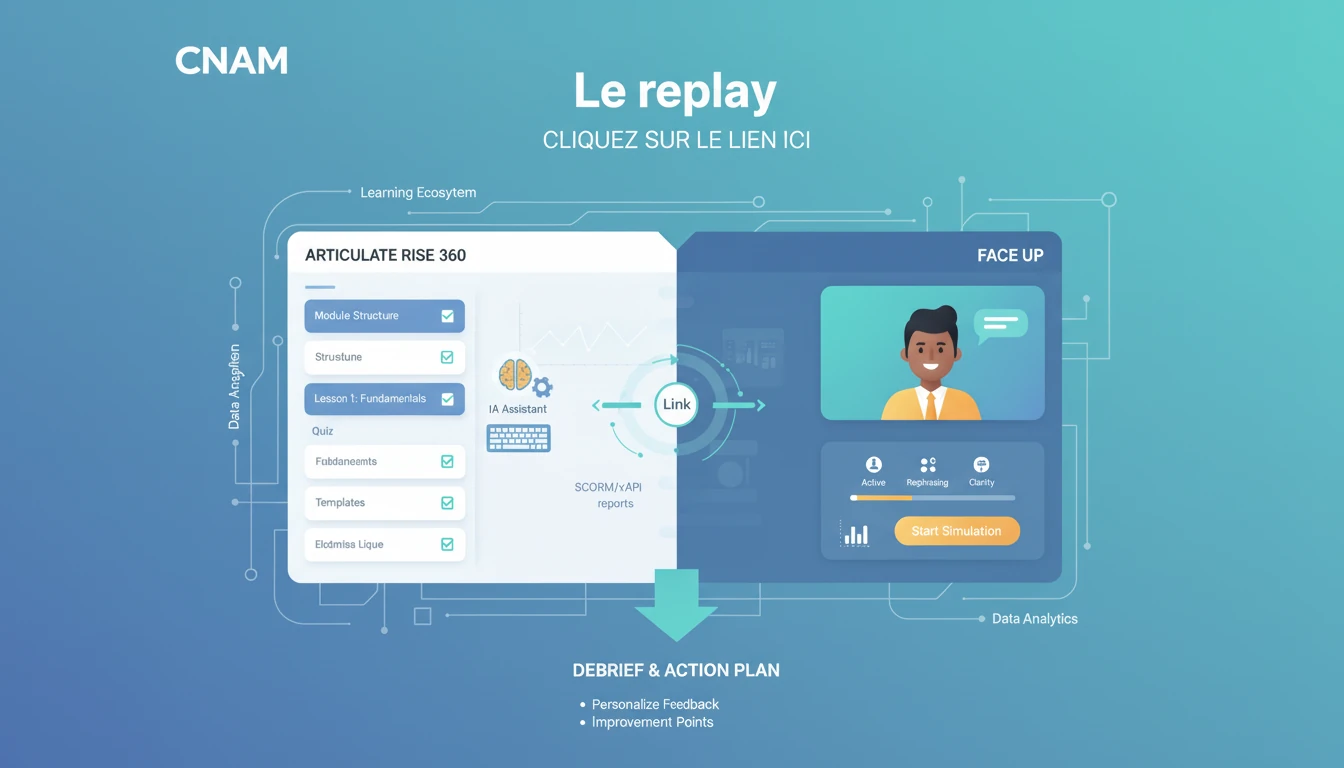
Face Up provides a catalogue of ready-made scenarios by sector (transport, banking, retail) and a no-code authoring tool that lets trainers build their own scenarios from their real case studies. The AI characters are configured with the personalities and typical behaviours found in each context.
Beyond the sector, training has to match each learner's level. An experienced employee does not need the same modules as a new recruit. Assessment grids make it possible to place each person accurately and offer them a pathway that fits.
Blended learning provides the necessary flexibility: e-learning fundamentals for beginners, advanced role plays for experienced staff, complex-situation simulations for experts.
The best training content comes from the front line. Managers, experienced employees and quality leads hold the good practice specific to their context. The most effective teaching approach is often to structure and distribute that internal knowledge rather than import generic external content.
The Face Up authoring tool lets trainers and subject-matter experts turn their case studies into interactive simulations, with no technical skills required. That is the trainer-first principle: giving learning professionals full control over the content.
Whatever the sector, some profiles should be the priority for customer relations training: new starters in direct contact with customers (our clients see onboarding time cut by 50%), employees moving into roles with a stronger relational component, and teams facing change — a new offer, a new process, new regulation.
The return on investment is clearest where the relational stakes are highest. Identify your customer moments of truth, train the teams who live them every day, and measure the impact. Customer relations training is not a cost — it is an investment whose return shows up in satisfaction, loyalty and revenue.