
Roleplay — also called role play or scenario-based practice — is the most effective method for building interpersonal skills. The reason fits in one image: you don't learn to swim by reading a swimming manual. You learn by getting in the water. Running an annual review, defusing a conflict, negotiating a price: these situations call for reflexes, not just knowledge. And reflexes are built through practice, never through theory alone.
Yet roleplay remains underused in corporate training. Too heavy to organize, uncomfortable for participants, hard to standardize: the objections are well known. They are also falling away, largely thanks to AI roleplay, which lets people practice on demand with realistic counterparts — no group session, no professional actor required.
This guide covers the whole subject: definition and the learning science behind it, available formats, strengths and limits of in-person role play, what AI changes, how to build roleplay into a module or a program, which skills to work on, and how to measure progress. By the end, you will know exactly where and how to deploy roleplay in your training paths.
A roleplay is a staged conversation in which the learner plays their own professional role opposite a counterpart who plays a character: an unhappy customer, a demotivated team member, a job candidate, a tough buyer. The goal is not acting. It is practicing a behavior under near-real conditions, then drawing lessons you can apply the next day.
The method is not new: Jacob Moreno's psychodrama dates back to the 1920s, and business schools and training providers have used role play for decades. What is new is the ability to deploy it at scale, for every learner, without multiplying classroom days.
Role play in training does not work by magic. Four well-documented learning mechanisms explain its effectiveness.
You don't improve by vaguely repeating a task. You improve by working on one precise move, with a clear goal and feedback on every attempt: that is deliberate practice, described by psychologist Anders Ericsson in his research on expertise. Roleplay applies it to interpersonal skills. Instead of "communicating better", you practice rephrasing an objection, asking an open question, announcing an unpopular decision. One move at a time.
Without feedback, practice reinforces bad habits just as much as good ones. The debriefing that follows each scenario turns experience into learning: what worked, where it broke down, what to try on the next attempt? The closer the feedback is to the action, the more useful it is — one hot debrief is worth ten delayed evaluations.
A behavior observed once is forgotten. A behavior repeated becomes a reflex. That is the whole difference between knowing you should let an angry counterpart finish speaking and actually doing it when tension rises. Repetition anchors the move until it stays available under stress, right when you need it.
People only dare to experiment when mistakes carry no consequences. Roleplay creates a space where failing is allowed, even useful: every miss reveals a precise point to work on. This safety conditions everything else. A participant who feels judged protects themselves instead of learning.
Three main formats coexist in training. They don't compete: they answer different needs. One useful clarification before choosing: role play trains behaviors in front of a human counterpart, while simulation reproduces a system or a process — the differences between simulation and role play are worth clarifying before designing anything.
Two learners play the scene, often in front of the group, sometimes in breakouts with an observer. It is the simplest and cheapest format. Its limit: the counterpart is not believable. A colleague playing a difficult customer is still a colleague — they overact or underact, and the scene quickly turns into a scripted exercise.
A professional plays the character. Realism goes up a notch: a good actor holds the role, pushes back, improvises, applies real pressure. It is the reference format for high-stakes moments — crisis situations, sensitive interviews, executive committees. Its cost and logistics, however, reserve it for a few key moments per year.
The learner speaks out loud with an AI persona playing the character: it answers, objects, gets irritated or shuts down depending on what the learner says. Understanding what AI roleplay is and how it works helps see what changes: always available, a counterpart that never tires, a systematic debriefing. The detailed comparison of AI roleplay versus traditional role play shows the two formats complement each other more than they compete.
Classroom role play has real strengths. Physical presence engages the whole body: posture, eye contact, use of space. Group dynamics create moments of truth that no remote format reproduces. And an experienced trainer adjusts difficulty in real time, which remains precious.
But four structural limits hold back its effectiveness:
These barriers are analyzed in detail in our article on the limits of in-person role play. They don't disqualify the format: well prepared and well framed, it remains a highlight of any program. Our method for running a role play training session shows how to get the most out of it: precise briefing, written roles, equipped observers, structured debriefing.
AI roleplay removes precisely those four barriers. Alone in front of the screen, learners dare: no group watching, no fear of ridicule. They start over as many times as needed — the second attempt is often the one where things click. The counterpart holds its role consistently: same persona, same level of difficulty for everyone. And every session ends with a debriefing, without mobilizing anyone.
The underlying mechanism is conversational learning: you learn by holding conversations, as in real life, not by clicking through quizzes. The learner speaks, and the persona reacts to what was actually said — not to a fixed script. Interrupt it, and it hardens. Ask good questions, and the conversation opens up. That action-reaction loop is what builds reflexes.
Two objections come up often. "Talking to an AI feels artificial": experience shows the opposite — past the first minute, learners forget the setup and defend their point of view as in a real exchange, precisely because the counterpart responds coherently to what they say. "My teams won't dare": it is the group that intimidates, not the screen. In practice, the absence of witnesses is exactly what gets the most reserved profiles to take the plunge — the very people who dodge role play in a classroom.
That is the approach behind Face Up: spoken scenarios of ten minutes maximum, followed by a debriefing that points to the key moments of the conversation. In practice, AI roleplay examples for team training range from a difficult feedback conversation to handling a customer complaint, and the AI roleplays product page shows how it works in detail.
The remaining question is where each format fits. The comparison of AI scenarios, virtual reality and classroom training helps you decide based on budget, learner volume and stakes.
An isolated role play produces a memory. A role play built into a learning path produces a skill. The difference lies in the design.
The winning sequence has three parts: a short input (the model, the framework, best practices — 20% of the time), the roleplay itself (60%), then debriefing and consolidation (20%). The roleplay doesn't illustrate the content: it is the content. Our method for designing a soft skills training module breaks this down step by step.
Interpersonal skills are built over time. One proven format: short, regular cycles, for instance a 12-week soft skills training program where each week alternates input, practice and debriefing. Regularity beats intensity: ten sessions of ten minutes outperform a single full day.
The critical point is how the formats fit together: in-person sessions to launch the dynamic and handle complex cases, AI roleplay for repetition between sessions. Our guide on integrating role play into a soft skills program offers concrete blueprints, and the complete guide to soft skills training puts it all into an overall strategy.
Roleplay training applies wherever the skill lives inside a conversation. Four families cover most needs.
A concrete example: difficult feedback. The learner must tell a well-liked team member that their recent work has slipped. The persona minimizes, then justifies, then takes offense. The learner practices sticking to the facts without attacking the person, absorbing the emotional reaction, and closing on a dated commitment. Ten minutes of conversation, three skills trained — and a scenario that can be replayed until the moves feel natural.
These situations draw on what we call behavioral skills: active listening, assertiveness, emotion management, questioning. Our behavioral skills training guide maps the territory, with examples of key behavioral skills in the workplace to help you prioritize. The common principle: these skills cannot be transmitted, only built — which is the whole point of our article on developing behavioral skills through practice. And to see where role play sits among the most effective soft skills training methods, a full comparison is available.
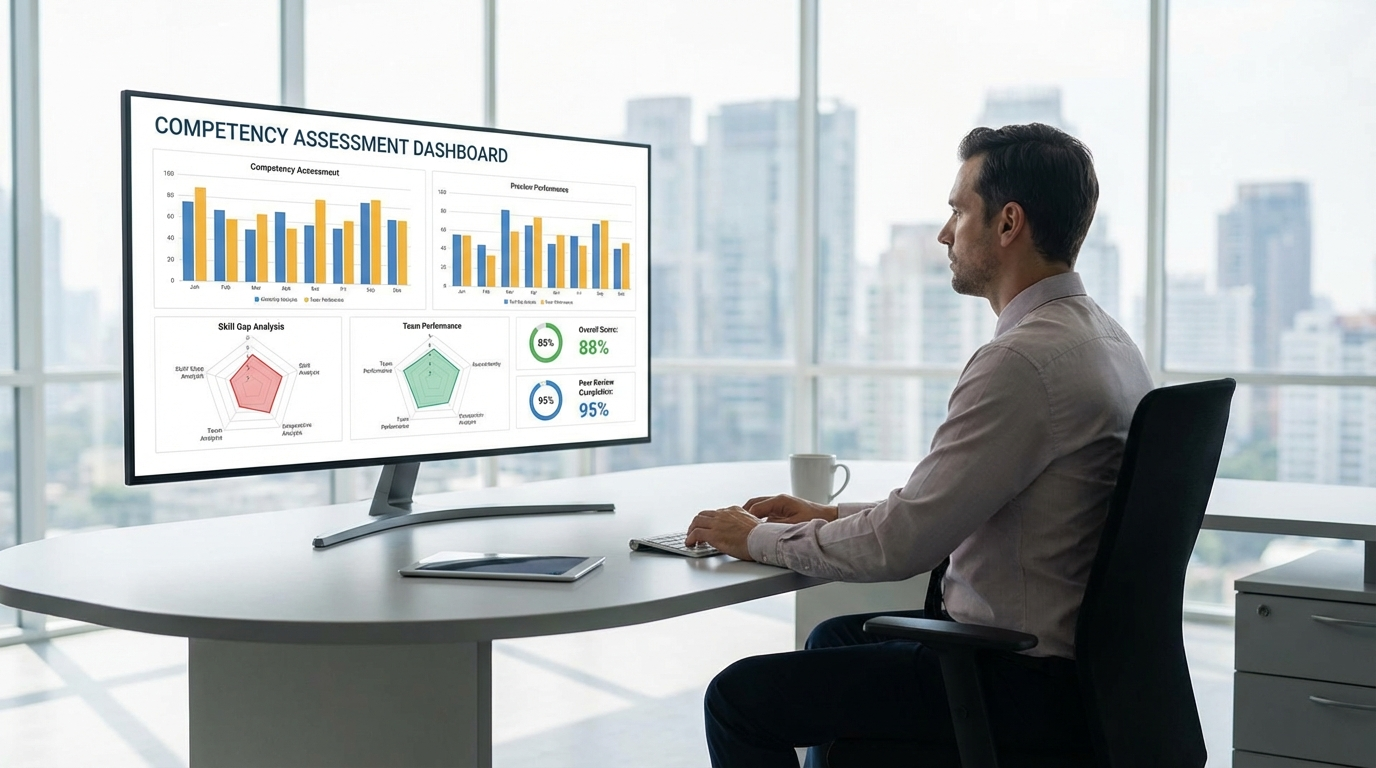
"That went well" is not an evaluation. To measure the effect of a roleplay, you need observable criteria defined before the session: did the learner let their counterpart finish their sentences? Did they rephrase before answering? Did they ask open questions? Framed this way, criteria can be counted — and what can be counted can be compared from one session to the next.
The debriefing structures this measurement in three steps: what the learner felt (self-assessment), what objectively happened (the facts, the key moments of the conversation), and what they will do differently next time (the commitment). In an AI roleplay, the debriefing draws on the full conversation, which makes it possible to quote precise moments rather than impressions.
Three levels of indicators complement each other. Participation first: number of sessions completed, replay rate on a given scenario. In-scenario performance next: scores on the observable criteria, gap between two attempts. Transfer to the field last: movement in business indicators such as customer satisfaction, conversion rate or team climate. That third level takes longer, but it is the one that convinces leadership.
At program level, progress shows through repetition: the same scenario replayed three weeks apart, assessed against the same criteria. Our method to evaluate and measure soft skills details usable rubrics and indicators.
Roleplay is not one facilitation technique among others: it is the most reliable way to turn interpersonal knowledge into reflexes. Its mechanics — deliberate practice, immediate feedback, repetition, psychological safety — are well established. What changes in 2026 is access: AI roleplay makes practice available on demand, with zero logistics, and lets in-person sessions focus on what they do best.
The right question is no longer "should we use role play in training?" but "how do we weave it into our programs?". Start small: one scenario, ten minutes, one debriefing. Face Up's conversational scenarios are a good place to test the method with your teams — and to see, by the second attempt, what repetition changes.