
Most onboarding programmes concentrate on the technical and operational: internal tools, business processes, the org chart, quality procedures. That covers an essential part of joining a company, but it misses a dimension that matters just as much — the soft skills a person needs to perform in the role.
A new joiner who has mastered every tool but cannot handle a difficult exchange with a customer, communicate effectively with colleagues or adapt to the culture will underperform for a long time. Research consistently shows that onboarding which includes soft skills cuts ramp-up time by half and materially improves one-year retention.
Even so, this dimension is routinely neglected. L&D teams sometimes assume soft skills are picked up on the job, or that recruitment has already screened for them. In practice, even the most talented people need structured support to build the relational reflexes specific to their new working context.
Every organisation has its codes, its vocabulary, its unwritten communication norms. A new joiner has to decode them quickly to settle in. How do you address a senior colleague? What level of formality is expected? How do departments talk to each other?
Building an interpersonal communication module into onboarding lets the new joiner read those codes early and avoid the missteps that slow down their social integration into the team.
In public-facing roles, the ability to handle interactions with customers or service users is a critical skill from day one. The new joiner needs the basics of welcoming people, active listening and defusing difficult situations before they are even autonomous on the technical side of the job.
That is especially true for front-of-house agents, customer advisers, shop-floor sales staff and bank advisers — roles where managing the customer relationship is the core of the daily work.
The first weeks in a new role are inherently stressful. The new joiner has to absorb a large volume of information, build new working relationships and prove themselves, all in an environment they do not yet know.
Training new joiners in emotional intelligence and stress management from the start of onboarding gives them concrete tools to get through that adjustment period more calmly and more effectively.
Joining an established team calls for specific relational skills: introducing yourself well, reading group dynamics, finding your place without disturbing existing balances, and being willing to ask questions and ask for help.
Onboarding that includes collaborative activities and team-based role plays makes that social integration easier and lays the groundwork for effective collaboration within the first few weeks.
The first fortnight combines the classic orientation — tools, processes, team — with an introduction to the key relational skills of the role. For a customer-facing job, that means the basics of welcoming people, service posture and a first set of simple role plays.
This phase relies on active teaching methods: shadowing experienced colleagues in real situations, role plays on basic scenarios, and debriefs led by the buddy or the line manager.
Once the technical basics are in place, the programme steps up the behavioural side. The role plays get harder: an unhappy customer, an objection to handle, a meeting to run, a project to present to an internal stakeholder.
This is where AI simulators add particular value. The new joiner can practise at their own pace, repeat the difficult scenarios as often as they need, and improve without an audience. Automatic analysis of each session pinpoints exactly what to work on next.
The final phase of onboarding manages the move to full autonomy. The new joiner is now working live but still has close support: observation by the manager, one-to-one coaching sessions, review of situations they have actually handled, and agreement on what still needs work.
This consolidation phase is essential. Without it, what was learned during onboarding erodes quickly under everyday pressure. Structured follow-up with regular check-ins confirms that the skills really are turning into durable habits.
For an agent joining a transport network, a hospital or a local authority, soft skills make up a large share of the job itself. They have to welcome, inform, direct and sometimes calm people down, all professionally and with genuine care.
An effective onboarding programme for these profiles includes graded customer-service simulations from the first week. The new joiner starts with simple situations — a standard information request — before progressing to harder ones: an aggressive customer, a complaint, a passenger with a disability. That progressive approach is how organisations such as Getlink halved the onboarding time for their agents.
Onboarding a bank adviser combines regulatory compliance with relational skill. The adviser has to master the products, the procedures and the rules, and also know how to run a discovery conversation, manage the client's expectations and handle objections with tact.
Training programmes for bank advisers show that building role plays into onboarding significantly accelerates the acquisition of that dual technical and relational competence.
In retail, speed to competence is a direct commercial issue: every day a salesperson is not fully operational is revenue left on the table. Onboarding has to be as efficient as possible.
The strongest programmes for retail sales staff combine product learning with simulated selling exercises from the very first days. The new salesperson practises greeting, advising and closing in a safe environment before facing real customers.
AI applied to training changes onboarding by making intensive practice possible from day one. A new joiner can work through dozens of scenarios independently, get immediate feedback and progress at their own pace without permanently occupying a trainer or a buddy.
This answers a very practical constraint: trainers and buddies rarely have the bandwidth to support every new joiner intensively. Simulators fill that gap by providing a practice partner available around the clock.
To work, the soft skills element of onboarding has to sit inside the employee's overall pathway, which is usually managed in the company LMS. The most mature solutions integrate natively with platforms such as 360Learning, Moodle or Docebo, giving a single view of both technical and behavioural progress.
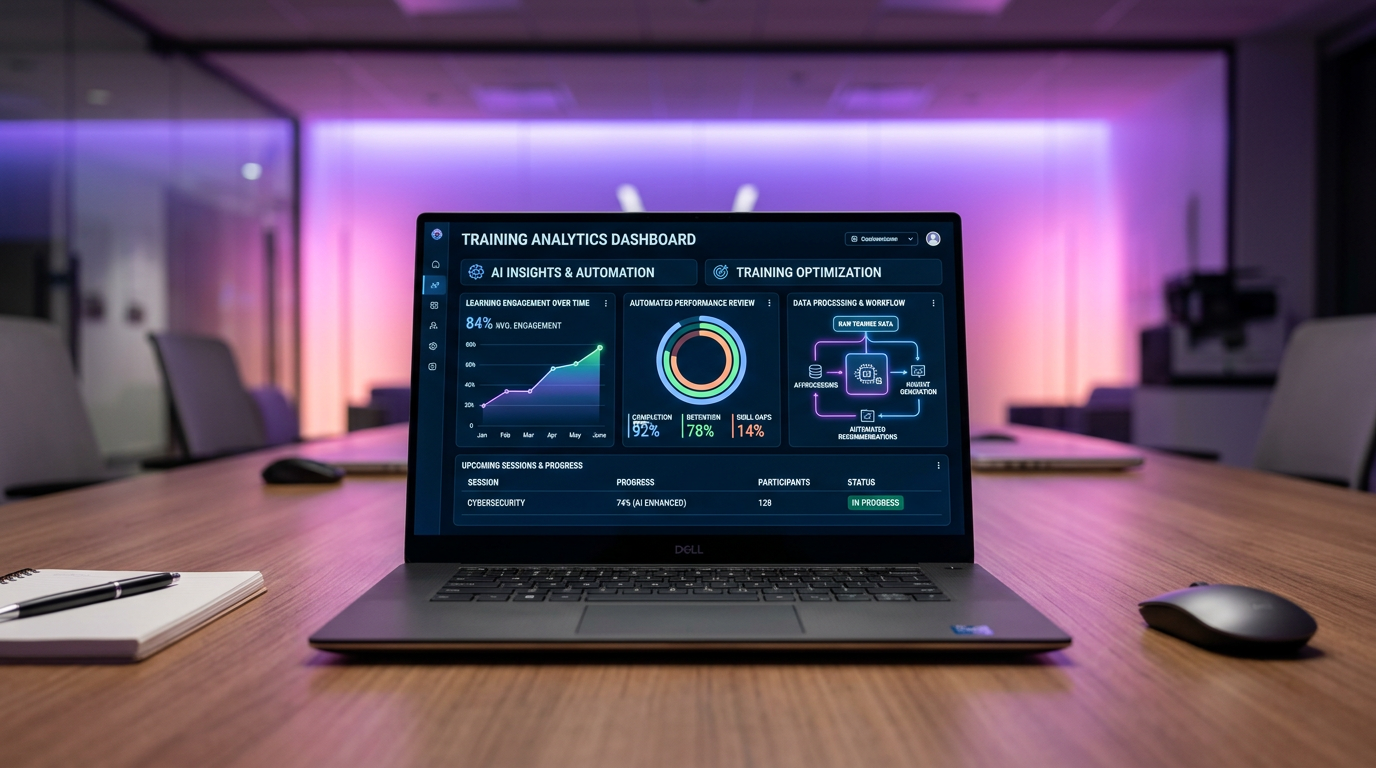
Skills assessment tools let you track each new joiner's progress across the different dimensions of their role. The manager and the L&D team can see in real time who is progressing well and who needs additional support.
That visibility lets you adjust the programme as it runs and tailor support to individual needs, rather than pushing everyone through an identical standard path.
The effectiveness of an onboarding programme that includes soft skills shows up in a handful of key indicators. Time to productivity is the most telling: how many weeks before the new joiner reaches a satisfactory level of performance? Retention at six months and at one year is another powerful signal, because good onboarding significantly reduces early turnover.
Other indicators fill out the picture: how satisfied the new joiner is with their integration, the quality of their first customer or internal interactions, and their manager's assessment of their soft skills at set points through onboarding. For a complete approach to measurement, see our guide to calculating the ROI of soft skills training.
The most frequent mistake is trying to cover everything too quickly. A new joiner saturated with information retains almost nothing. Far better to sequence onboarding, introducing skills progressively and starting with the ones most critical to the role.
Teaching the technical first and the soft skills afterwards creates an artificial split. In the reality of the job the two are interwoven. A strong onboarding programme integrates them from the outset by having people practise technical skills in realistic relational contexts.
Onboarding does not end when the probation period does. Behavioural skills keep developing over months, even years. A mentoring or coaching programme that extends support beyond formal onboarding maximises the return on that initial investment.
Building soft skills into onboarding is not an added cost. It is an investment that pays back quickly through faster ramp-up, lower turnover and performance reached sooner.
The most advanced organisations treat onboarding as the first episode in a continuous development path. Managers trained in soft skills are central to that, as the first coaches their new joiners will have.
To explore the full range of levers for developing behavioural skills, read our complete guide to soft skills training. And for service-sector organisations, see how to train field and customer service teams in the soft skills that matter.