
Which competencies do the best customer-facing teams actually develop? Whether the role is a transport agent, a bank adviser or a shop-floor salesperson, the same skills come up again and again in the frameworks of organisations that post the highest satisfaction scores. Here is the common foundation to master, with practical training angles for each one.
The greeting shapes the whole interaction. In under ten seconds, a customer forms an opinion about the quality of service they are about to receive. It comes down to eye contact, a smile, open body language and the first words spoken.
In transport, teams often work to a simple sequence: smile, greet, thank, close. In banking, it is the handshake and the invitation to sit down. In retail, it is eye contact and the opening line.
What separates a good greeting from a mechanical one is authenticity. The agent has to match their energy to the customer in front of them: someone in a hurry expects efficiency, someone hesitant expects reassurance. That adaptive capacity is precisely what customer relations training should be developing.
Active listening is not simply hearing what the customer says. It is a deliberate process: staying quiet, observing, rephrasing and confirming your understanding before you answer.
The most common failures in customer relations come from poor listening: answering too quickly, interrupting, assuming the need instead of checking it. The result is a customer who feels misunderstood, even when the solution offered is objectively correct.
For a deeper look at this skill, see our dedicated article on active listening and empathy in customer relations.
Rephrasing is the natural extension of active listening. It means playing back, in your own words, what the customer has expressed, so that mutual understanding is confirmed.
Three forms are useful in customer-facing work: mirror rephrasing ("If I have understood correctly, you would like to…"), summary rephrasing ("So in short, your main need is…") and reframing ("What you are describing is really a need for…").
Rephrasing reassures the customer and heads off costly misunderstandings. It matters most in banking conversations, where the financial stakes leave no room for approximation.
Guiding a customer means steering them towards the solution that genuinely suits them, taking their constraints and preferences into account. That is the definition of consultative selling, as opposed to hard selling.
Good guidance rests on a clear grasp of the need — which is why it depends on listening and rephrasing — and on real command of the available range of solutions. The agent has to be able to explain plainly why a given option fits and what the trade-offs are.
In retail, guidance can happen in thirty seconds. In banking and insurance, it takes a structured meeting of thirty to sixty minutes. Training methods need to reflect those contextual differences.
Closing is routinely neglected in training. Yet it is the last thing the customer remembers about the interaction. A good close recaps what has been agreed, confirms the next steps and leaves the door open.
The ideal formula combines three elements: a recap ("So we have agreed that…"), a commitment ("I will take care of it by tomorrow") and an opening ("Do come back to us if you need anything").
Beyond these five pillars, the cross-cutting skill that makes the difference is adaptability. The same agent may face a furious customer, then a confused one, then someone who simply wants a quick piece of information. Switching register without any drop in quality is what sets the best apart.
To build that adaptability, practice scenarios are particularly effective, because they expose the learner to a wide range of profiles and contexts. Role-play with structured feedback then embeds the right reflexes.
These skills are not acquired by reading a handout. They require repeated practice under conditions close to the real thing, with precise, constructive feedback.
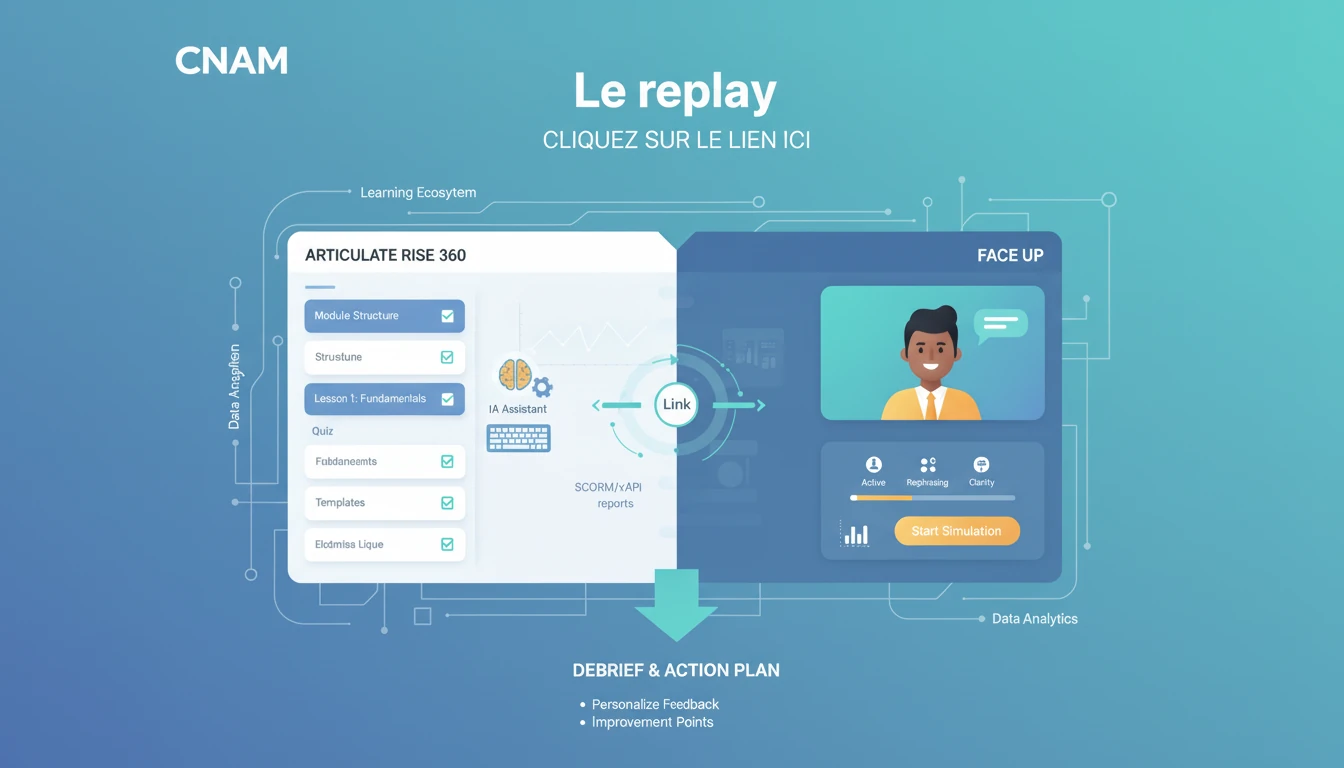
That is exactly what Face Up offers: AI simulations where learners practise against realistic avatars in scenarios calibrated with your own trainers. Every session ends with an actionable debrief that identifies strengths, areas to work on and concrete alternative phrasings.
For an overview of the pedagogical approaches available, see our guide to customer relations training methods. And to track how your teams progress, read how to assess and certify these skills.
Want to build these competencies across your teams? Write to us at contact@face-up.fr