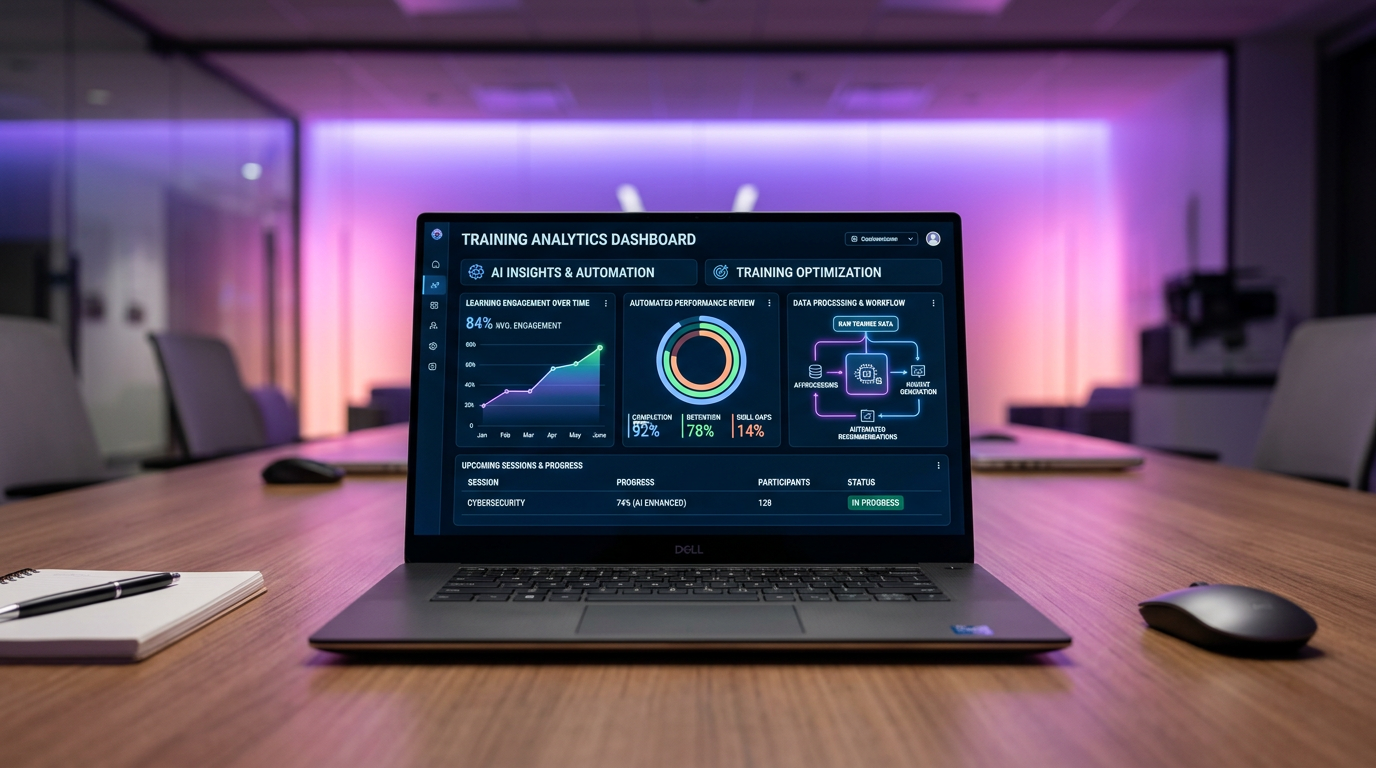

AI roleplay or traditional role play in the classroom: which method should you choose to train your teams' people skills? Every training department now faces the question. On one side, in-person role play, the trusted classic of behavioral training for decades. On the other, conversational practice with an AI persona, available on demand and without an audience. Rather than a plea for one or the other, here is an honest comparison, criterion by criterion — with, at the end, a clear conviction: the two formats do not compete, they complete each other.
Traditional role play physically brings together a learner, a partner — trainer or peer — who plays the counterpart, and often a group that watches. The scene is followed by a collective debriefing led by the trainer. It is the historic format for training people skills: sales, management, customer relations.
AI roleplay keeps the same teaching principle — learning by practicing a conversation — but replaces the human partner with an AI persona. The learner talks by voice with a calibrated character, an unhappy customer or a demotivated employee for instance, then receives an individual, structured debriefing. For a detailed walkthrough of the mechanism, see our article AI roleplay: definition and how it works.
In-person practice offers the richness of a complete human being: posture, eye contact, silences, micro-expressions. But that realism depends entirely on the partner's acting skills. A colleague who plays an angry customer badly, laughs at the wrong moment or breaks character ruins the exercise. An AI roleplay lacks the body language of a face-to-face human, but it holds its role without ever cracking: the persona stays demanding, consistent and credible from the first learner to the last. Verdict: in-person wins on non-verbal cues, AI roleplay wins on consistency.
A classroom role-play day adds up the trainer, the room, travel and everyone's time. Above all, in a group of twelve, each participant actually practices only twenty to thirty minutes; the rest of the time, they watch. The cost per minute of actual practice is therefore high. AI roleplay works on a license basis: the marginal cost of one more session is close to zero. Ten practice runs cost barely more than one. For a constrained training budget, the difference is structural.
Training fifteen managers in person is easy. Training five hundred across three countries means months of logistics, calendars, and quality that varies with each facilitator. AI roleplay deploys instantly: same scenario, same persona, same level of challenge for everyone, in parallel. Scaling up degrades neither the quality nor the consistency of the practice — a decisive point for large organizations and multi-site training providers.
It is the best-documented weakness of classroom role play: acting in front of peers is intimidating. Many participants play it safe to get it over with; others simply refuse to expose themselves. The exercise then measures theatrical ease more than actual people skills. We analyze this bias in depth in our article on the limits of in-person role play. Facing an AI persona, the audience disappears: learners dare to test a risky approach, fail, and try again. The practice scenario becomes a rehearsal space again, not a stage.
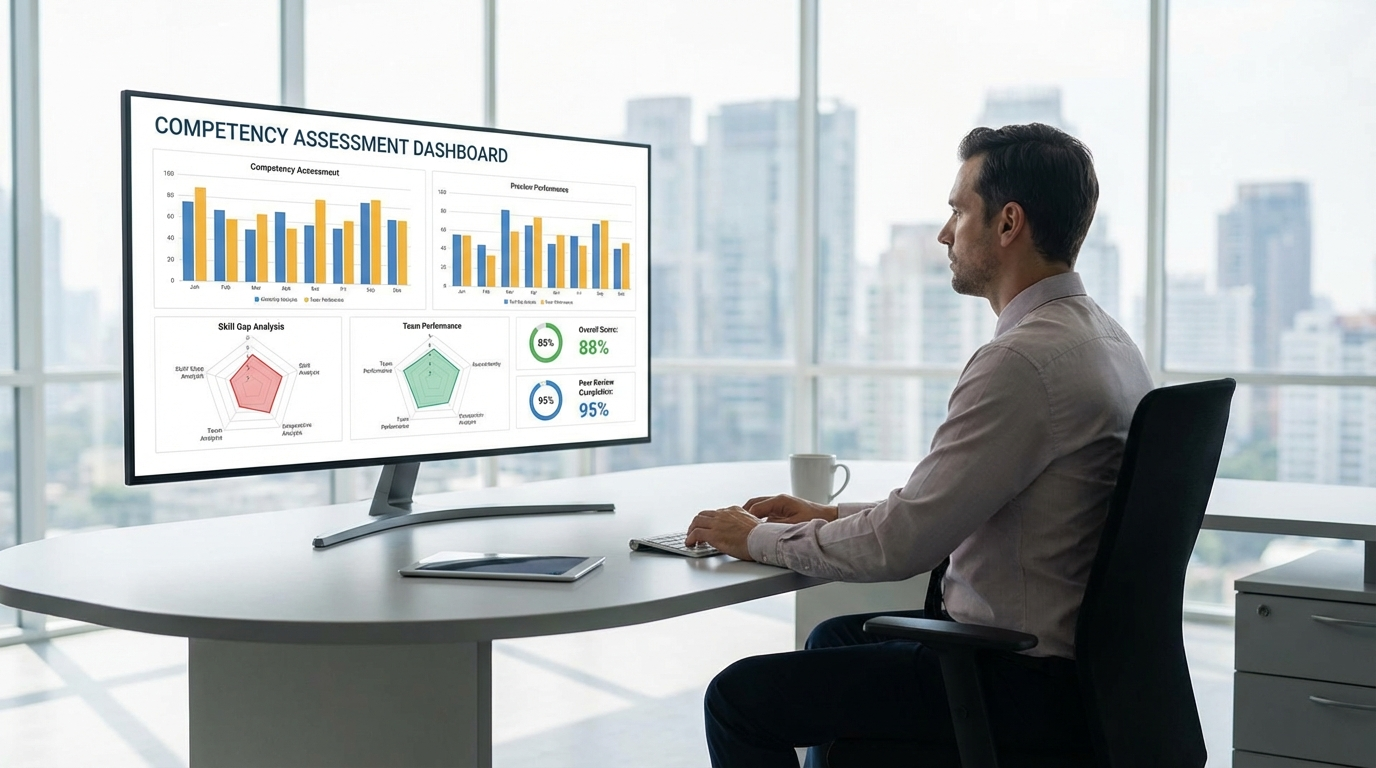
In the classroom, feedback depends on the observer: their reading grid, their end-of-day fatigue, their relationship with the learner. Two participants behaving identically can receive very different comments. The debriefing of an AI roleplay applies the same criteria to every session, for every learner. The result: data that is comparable across people and over time — a real measure of progress that the classroom alone cannot produce.
In-person training is an event: a date, a place, an invitation. If the need arises three weeks later — a delicate interview, an unexpected negotiation — you wait for the next session. AI roleplay is available continuously: you practice the night before the meeting, between two calls, in ten minutes. That availability makes spaced repetition possible — the mechanism that anchors reflexes for good.
In summary, the scorecard reads as follows:
In other words: to create measurable practice volume, AI dominates; to test the human relationship in all its depth, in-person remains the reference. That observation naturally points to what comes next.
An honest comparison has to say it plainly: traditional role play remains superior on several fronts.
One useful clarification: role play and simulation do not cover exactly the same thing either — we sort out the terms in our article on simulation vs role play: the differences.
The right question is not which one to choose, but which one for what. The most effective setup observed in the field sequences the two formats.
Upstream, AI roleplay. Each learner completes three to five practice conversations before the classroom day. They discover the scenario, fail without consequences, adjust thanks to the debriefing, and build their first reflexes. Conversational learning solutions such as Face Up structure this practice with short sessions and a consistent debriefing.
In the classroom, the trainer. They arrive with the debriefing data: they know precisely where each participant struggles. Classroom time — scarce and expensive — focuses on non-verbal work, complex cases and validation, instead of being consumed by first attempts. Field feedback on programs combining AI scenarios, VR and classroom training converges: each format performs better when the other has prepared the ground.
This sequencing also transforms the participant's experience. They no longer walk into the room to endure their first attempt in front of the group: they arrive prepared, with precise questions. Discomfort drops, and the level of the exchanges rises.
Concretely, a typical four-week sequence looks like this: week 1, kickoff and a first individual practice conversation with debriefing; weeks 2 and 3, two or three spaced repetitions of the same scenario, each with a precise improvement goal; week 4, a classroom day focused on the complex cases surfaced by the debriefings, then validation by the trainer. Practice volume per learner is multiplied by four or five, without adding a single classroom day to the program.
AI roleplay and traditional role play do not play the same role. The first excels at repetition, cost, scalability, feedback consistency and availability. The second remains irreplaceable for non-verbal work, group dynamics and final validation. The organizations that progress fastest do not choose: they have people practice upstream with AI and validate in person. To build that kind of program end to end, read our complete guide to roleplay training — and to move from principle to practice, take inspiration from our 7 AI roleplay examples to train your teams.