
To develop behavioral skills in a team, the classroom is not where it mainly happens: it happens through repeated situations that are lived, debriefed and replayed. That is counter-intuitive for many organizations, which keep buying days of theory and hoping behaviors will change. Yet the mechanism for acquiring a behavior is well known and documented — and it looks far more like learning a sports move than learning a calculation rule. The good news: this mechanism can be managed, provided each step is respected. This article details that mechanism, the ways to create risk-free practice opportunities, the decisive role of debriefing and of the manager, and how to measure progress.
A behavior is acquired through a four-step cycle: trial, feedback, adjustment, repetition. The learner attempts the behavior in a situation — leading a difficult conversation, handling an objection. They receive precise feedback on what worked and what failed. They adjust one point, just one, on the next attempt. Then they repeat, until the behavior becomes available without conscious effort: a reflex.
Every link matters. Without a trial, there is only declarative knowledge — you know the method but cannot perform it, as we explain in our guide to behavioral skills training. Without feedback, each trial reinforces existing flaws with growing confidence. Without a targeted adjustment, feedback remains a good intention. And without repetition, the gain evaporates within weeks. It is exactly the cycle through which you learn a tennis serve: nobody expects to master it by attending a lecture on serving.
Two practical points. The adjustment must be single: working on three points at once guarantees fixing none, because conscious attention can only follow one instruction during action. And spacing matters as much as repetition: five attempts spread over three weeks anchor more than five attempts in a single day, because each return forces the behavior to be reactivated — and that reactivation is what consolidates it.
The 70-20-10 model popularized by the Center for Creative Leadership holds that professional learning comes 70% from practice, 20% from social interactions (feedback, peer exchanges) and 10% from formal training. An honest caveat: these figures come from self-reported surveys of executives, not from a scientific law. Read them as an order of magnitude, not an exact split.
But the order of magnitude is robust, and its consequences are heavy: most development happens in practice and feedback, not in classroom delivery. The operational conclusion is not "drop formal training", but "organize the remaining 90% instead of leaving it to chance". Concretely: build practice into the program itself, and equip the feedback. Our comparison of the best soft skills training methods shows that the most effective formats are precisely those that embed all three components. One more pitfall: reading the model as if the three blocks were independent. In reality they reinforce each other — formal training provides the vocabulary and criteria that make practice analyzable, and feedback only has value if it bears on real attempts.
The job itself offers practice, but with real stakes: you do not experiment with a new negotiation posture on your biggest account. You need training spaces where mistakes cost nothing. Three questions help evaluate a practice space: can the learner fail without consequences? Can they retry immediately? Do they get precise feedback after each attempt?
Role playing between colleagues in a classroom remains a good starting point: the situation is acted out, the trainer observes, the group debriefs. Its limits are well known: each person gets one or two attempts per day, the colleague playing the counterpart rarely portrays a difficult interlocutor convincingly, and the group's gaze inhibits precisely those who most need to try, fail and try again. To get the most out of it, favor short, replayable scenarios over long case studies: three ten-minute passes are worth more than a single one-hour session.
AI roleplay removes those three limits: the learner practices alone, as many times as they want, opposite a counterpart who improvises and holds the role — including a hostile one. Mistakes are free, retries are immediate. Conversational learning solutions like Face Up frame the exercise in sessions of ten minutes maximum followed by a debriefing, which makes it possible to fit real repetition into a packed calendar, between two meetings. Another advantage: difficulty can be tuned finely. You start opposite a cooperative counterpart and end opposite a bad-faith customer — a gradation impossible to guarantee when a colleague plays the part.
Practice alone is not enough: without structured feedback, it can even entrench bad reflexes. The debriefing is where the attempt becomes learning. An effective structure has three steps: the facts ("at what precise moment did the exchange tip?"), the analysis ("what triggered that reaction?"), the commitment ("what will you do differently next time?"). A hot debrief, right after the session, locks in the insight; a cold debrief a few days later consolidates it and prepares the next attempt. One simple quality test: leave with a single behavior to change, phrased in observable terms — not a list of ten tips. Example: after a simulated feedback conversation, the observation "you stacked three criticisms without letting the person react" leads to the commitment "next attempt, I stop after the first fact and ask a question". Precise, observable, actionable. Who debriefs? The trainer, a peer with an observation grid, or the tool itself in the case of AI roleplay — what matters is that the feedback comes fast and rests on facts.
This is the link most often missing. Training builds the reflex in a protected environment; the manager transfers it into the real world. Three habits are enough, provided they are regular: agree with the team member on one target behavior per week ("this week, you restate before answering"), observe them in a real situation — a client meeting, a team discussion — and give brief, factual feedback the same day. Ten minutes per week per person. That is the "20" in 70-20-10, and it is what separates a well-rated training course from a behavior actually changed six months later. Some teams turn it into a ritual: five minutes at the end of the weekly meeting for everyone to name their target behavior for the week. The cost is zero, the consistency effect considerable.
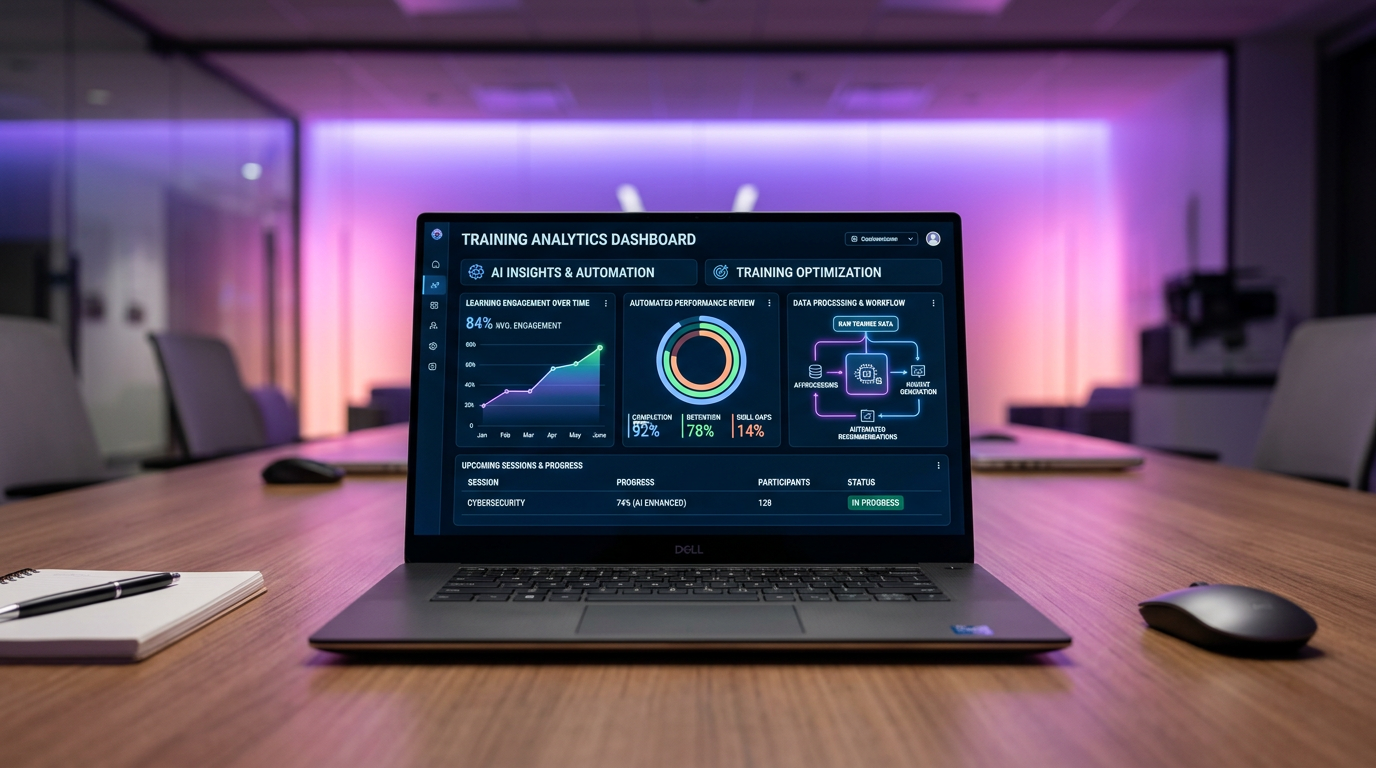
Behavioral progress is measured on facts, not impressions. The protocol has three building blocks: a grid of observable behaviors defined upfront ("restates before answering", "names the disagreement without downplaying it"), a before/after assessment on the same role-played situation, and a frequency check in the field — does the target behavior show up more often than a month ago? Our article 10 key behavioral skills examples provides ready-to-use observable behaviors for building those grids, and our guide on how to evaluate and measure soft skills details the full protocols. One caution: measuring too early is discouraging. First attempts are often worse than the usual behavior, because the new move is not yet fluid — the normal dip of any learning curve. The before/after comparison becomes meaningful from the third or fourth repetition. Documented progress in observable behaviors is also, for funders and sponsors, far stronger evidence of acquisition than a satisfaction questionnaire.
Developing behavioral skills means organizing a cycle: trial in a protected setting, demanding debriefing, targeted adjustment, spaced repetition, and managerial follow-through in the field. Each link is simple; it is their sequence that produces progression. It is also the best budget argument: for the same number of hours, shifting lecture time toward debriefed practice improves transfer without increasing cost. To embed this cycle in a complete program, week after week, build on our 12-week soft skills program model; and for the training method that carries the whole system, read our complete guide to roleplay training.