
A trainer watches a role play: the participant explains their idea, but they speak too fast and the other person takes nothing in. The trainer has two options. One is to penalise — "that didn't work, you were too quick" — which discourages. The other is to build: "your ideas were good, but the pace stopped them landing. Slow down and pause between points and it will come across." The second is constructive feedback. For training providers, it is far more than a pedagogical nicety: it is the tool that produces the observable progress a quality audit demands. Feedback delivered well creates three things: awareness ("I can finally see what I'm doing"), direction ("this is how to improve") and motivation ("this is achievable"). Together, that is measurable change. This article explains how to build constructive feedback into your programmes as a measurement mechanism.
Many programmes assume awareness is enough: "right, I talk too fast, I know that now. I'll watch it." In practice, without structured feedback the intention fades within a week and the old reflexes return. But if someone gives you feedback at the precise moment ("you just sped up, there, in the simulation"), with a direction ("try counting silently between sentences"), and then asks you to try again immediately, the awareness sticks. Learning research is consistent on this: feedback delivered close to the moment of practice sharply reduces the number of repetitions needed to embed a new behaviour. That acceleration is exactly what an auditor is looking for — evidence that the training is actually taking hold.
Every piece of feedback given and received is a record. In your training file, those records tell a story: day one, the trainer notes "visible stress, interrupts". Feedback follows. Day two: "interrupts less, breathes between sentences". Day three: "genuinely listening now, reformulates before answering". That trajectory does not need a thick dossier; it lives in the trainer's notes. An auditor reading it sees progress day by day. It is far more credible than "score before 2/10, score after 8/10".
Feedback starts with a fact, not an interpretation. Not: "you're defensive." Instead: "when I said your approach was causing a problem, you looked down, your tone changed and you started speaking faster." Objective observation is measurable because it describes behaviour rather than character. An auditor reads that and thinks: fine, that is observable. They read "you're defensive" and think: that is an opinion. So train your trainers to observe, not to judge. Another example: "you were right, and you said it well, but you didn't listen when the other person objected. You carried straight on with no pause." That is factual, and it is measurable.
Feedback should name the competence it relates to. Not: "that was much better." Instead: "your interpersonal communication is sharper: you genuinely listened before answering, and you asked a clarifying question. That is exactly what we are working on." That link makes the feedback relevant to the participant. They understand it is not a vague criticism but a targeted observation about the skill being developed, so their brain files it as useful and retains it better.
Incomplete feedback: "when you say that in an aggressive tone, it stings." Complete feedback: "when you say that in an aggressive tone, it stings. Tomorrow, try this: before you speak, take a breath, play back what you have just heard, then answer. It restores some emotional distance. Do you want to try it again now?" The difference is that the complete version says what to do, how to do it, and offers immediate practice. That is what actually creates change. To an auditor, it is not merely interesting; it is the signature of effective training, where the trainer does not just spot mistakes but corrects them in the moment.
Every day, the trainer records: date, participant, observation (what they saw), feedback given (what they said), reaction (did the participant understand? did they try?). For example:
The log is not a burden if it stays quick: three or four lines per participant per day is enough, and it takes ten minutes. By the end of the week you have a record of progress for every participant. For an audit file, that is gold.
How do you get from "Clara has improved her listening" to "Clara gains two points on active listening"? Score the change as you observe it, each time you give feedback. Day one: "listening almost absent, interrupts. 1/5." Day three: "listening improving, asks a clarifying question. 3/5." The score reflects exactly what was observed on the day. There are no surprises when the final assessment arrives: it confirms the trajectory you have already documented.
Role play (5-10 min) → immediate debrief (5-10 min) → structured feedback (3 min) → a second attempt practising the improved point (5-10 min). That loop produces fast learning. The debrief asks the participant: "what happened? How did it feel?" The feedback names the observation, links it to the competence and proposes a way forward. The second attempt embeds the change. Repeated across five days, these loops create dense, documented, observable progress.
Be careful: the same feedback does not work for everyone. Someone defensive needs you to start with the positive. Someone anxious needs reassurance that this is fixable. Someone confident needs pushing. Hence the importance of individual feedback rather than a general remark to the room. "Clara, your listening is improving, keep going. Marc, you listen well, now work on the clarity of your delivery." Everyone has their own path. Document those differences: they are the mark of a properly individualised programme, and that is what auditors expect.
When an auditor reads "Clara has improved her listening" in a file, it falls flat. When they read the log — "14 March, Clara interrupts, feedback: pause between sentences, retry successful. 15 March, Clara asks a clarifying question. 16 March, reformulates before answering" — they see that someone genuinely observed and genuinely coached. That is the difference between passive training (you teach, people learn or they do not) and active training (you observe, you guide, you correct live). Auditors are looking for the second.
If feedback is a one-way remark ("you talk too fast"), it is mechanical. If it is a dialogue ("do you notice that you speed up when you are stressed?" "Yes, definitely." "What helps you slow down?" "Taking a breath first." "Try that."), it becomes co-constructed learning. The participant becomes an actor rather than a recipient. That dynamic is the signature of the best programmes. Capture the dialogue in the log: it is the evidence of pedagogical engagement that audits reward.
Weak feedback: "you were better today." It is vague, it is not actionable, and it looks like something you could have invented. Strong feedback: "when you declined the client's request, you explained your reasoning before saying no, and that changes everything. People take a refusal much better when they hear the why first." It is specific, it is observable, and so it is credible.
Feedback given three days after the role play loses most of its impact, because the brain has lost the context. "Just in time" means immediately after the scene, while the participant can still remember the reflex they had and mentally replay it. That is when feedback sticks. If your programme is too fragmented for just-in-time feedback, rethink the structure. It matters that much.
Incomplete feedback: I state my observation and walk away. How did the participant receive it? Well? Badly? No idea. Complete feedback: I state my observation, I ask how they take it, I propose a way forward, and we run it again. It takes longer, but it produces certainty: they have understood, and it is actionable. For an audit file the difference is enormous. "The trainer said something" is not the same as "the trainer checked understanding and application".
A grid simplifies the trainer's job: it lists the dimensions to cover (listening, clarity, emotional control and so on) and reminds them what to look for. For example:
The trainer ticks what they observed and jots down two or three lines. Five minutes instead of twenty minutes of deliberation.
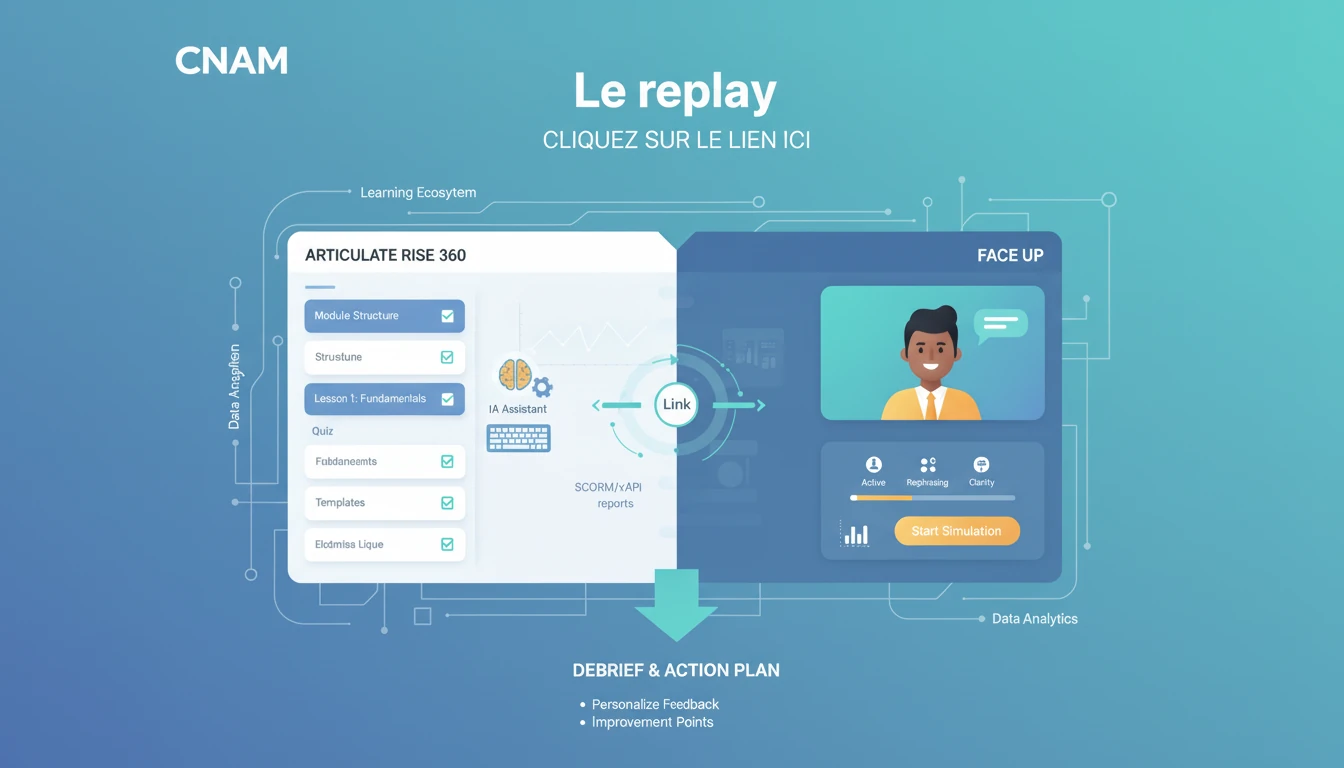
Feedback given only out loud disappears. Feedback jotted down ad hoc becomes spreadsheet noise. Feedback captured in a dedicated platform — even a simple form feeding a sheet — is structured, archived and usable. The trainer enters notes day by day, the system accumulates them, and progress becomes visible. After five days you can see the curve: where Clara stood on day one, where she stands on day five. That is the backbone of the final file. For providers training a hundred or more people a year, this systematisation changes everything: it makes compliance sustainable rather than a periodic scramble.
Constructive feedback is not a pedagogical detail; it is a measurement mechanism. Built in properly, it produces three things: awareness ("I can see what I'm doing"), direction ("this is how to improve") and change ("I'm trying it again right now"). Documented day after day, it forms an incontestable record of progress. The three key elements: objective observation, a link to the competence, a way forward. The three records to keep: the progress log, the feedback grid, and the participant's second attempt. To automate this capture of progress, integrated tracking tools shift the workload: the trainer concentrates on the pedagogy while the tool documents. That is what makes compliance sustainable — when measurement becomes a habit rather than an administrative task.