
Simulation vs role play: in many training programs, the two terms are used interchangeably. Yet they describe two distinct exercises, with different goals, design rules and use cases. Confusing them produces fuzzy sessions: a role play with no observation criteria, or a simulation so theatrical it no longer proves anything. This article sets clear definitions, details the concrete differences, explains when to use each, and gives a four-block method for building a simulation that actually develops interpersonal skills.
Before comparing, let's set the terms. Both exercises belong to the same family — active, learn-by-doing pedagogy — but they do not pursue the same goal.
A simulation reproduces a real professional context — an annual review, a customer complaint, a price negotiation — with an observable objective. Learners play their own job, facing a situation they will genuinely encounter, and must produce a specific behavior: rephrase an objection, reframe a derailing conversation, close an agreement. That behavior is assessed against criteria defined in advance. The underlying mechanism is transfer: the more the practice situation resembles the work situation, the more reliably the learned behavior fires at the right moment, in the real office, facing the real customer.
Role play assigns roles to participants — sometimes far from their job, sometimes fictional. A manager plays the employee they are about to review; a salesperson plays the customer on the receiving end of their own pitch. The context can be stylized, even imaginary. The primary goal is not always to assess a precise behavior: it is often to experience an interaction from the inside, build empathy, and trigger realizations. Inherited from Jacob Moreno's work on psychodrama, role play is first and foremost an exploration tool — which does not prevent it, when well designed, from serving training too.
Here are the five dividing lines that let you name — and therefore design — the exercise you are preparing correctly:
In practice the border is porous: every simulation involves some acting, and every role play puts someone in a situation. What really separates them is fidelity to reality and the presence — or absence — of observation criteria.
Choose a simulation when the goal is to train or assess a precise professional behavior: preparing a round of annual reviews, validating a sales training program, certifying an interpersonal skill before a new role. It is the format for performance stakes, the one that produces evidence. At IAE Lille, for instance, students practice customer relations in realistic conditions before facing real counterparts.
Choose a role play when the goal is to shift perspective: letting a manager feel what an employee experiences in a review, defusing team tensions by reversing roles, opening a sensitive topic through a fictional detour. It is the format for realizations, the one that unlocks postures before techniques are trained.
A simple test to decide: ask yourself what you want to be able to say after the sequence. He can run a reframing conversation calls for a simulation with criteria. He understood what a customer bounced from one department to another feels calls for a role play. For training organizations, the nuance has very concrete consequences: a criteria-based simulation produces progression evidence you can use in a certification file, whereas a role play mostly documents a learning experience.
The two also combine very well in sequence: a role play to open up and make people feel, then simulations to train and measure progression, session after session. For the facilitation itself — briefing, observation, debriefing — follow our method on how to run a role play in training, and draw on these role play scenarios for soft skills so you never start from a blank page.
A good scenario describes the context with job-specific details: who the counterpart is, what the history of the relationship is, which numbers are on the table. Credibility drives engagement — a vague situation produces vague acting. Then add a stake: something to win, protect or lose. Without tension, there is no behavior to observe, only a polite conversation. Finally, define the role by the job (you are meeting an unhappy key account) rather than a bolted-on identity: learners should remain themselves — that is the condition for transfer.
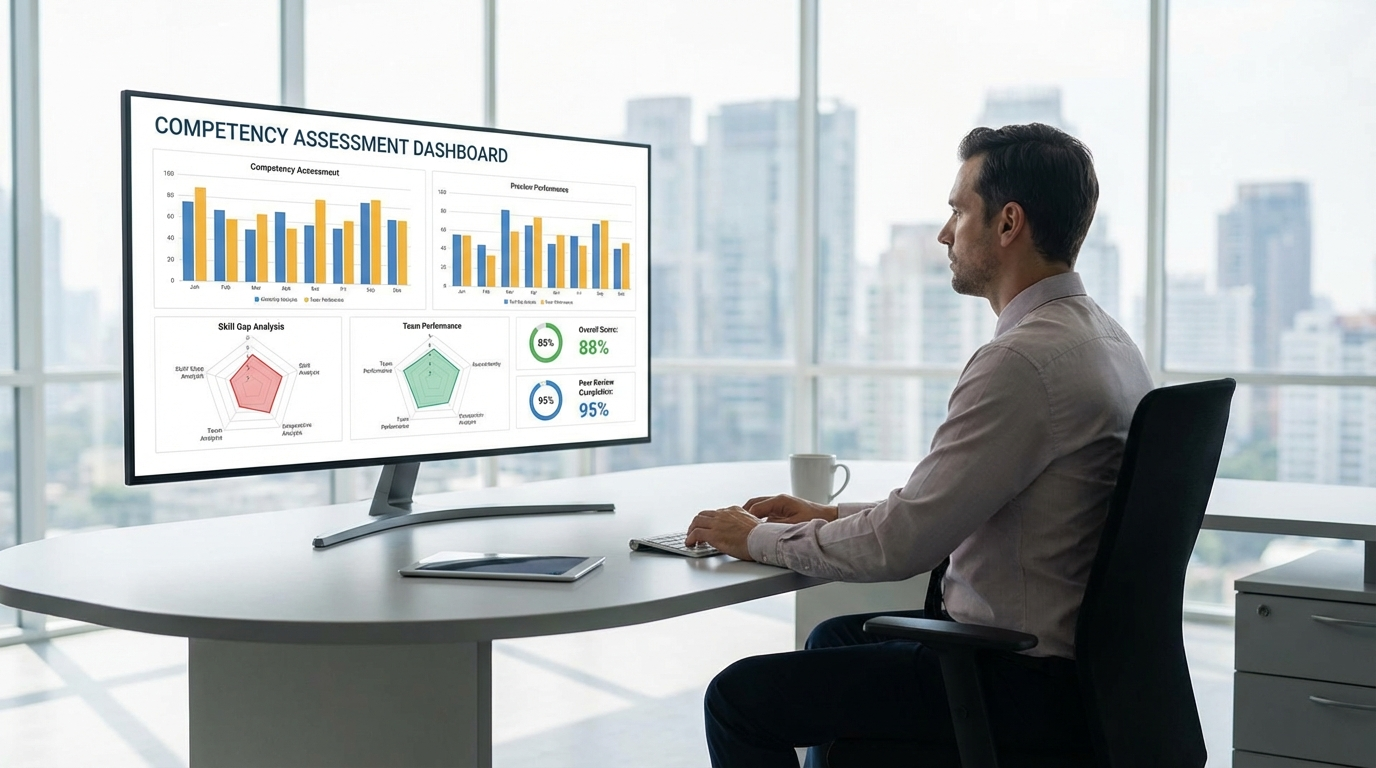
Three to five observable behaviors are enough: rephrases the request before answering, states the agenda at the start of the meeting, proposes a dated next step. Shared with observers before the scene, these criteria turn an impression (that was good) into data (4 criteria out of 5 met). They make progression measurable from one session to the next — and make two learners' runs on the same situation comparable.
The debriefing is where the learning actually happens. Right after the scene, have the learner speak first (what did you try? what worked?), then the observers, grid in hand, and only then the trainer. End with a concrete commitment: the behavior the learner will test in a real situation within the week. Plan a debriefing at least as long as the scene itself: that ratio is what separates a training exercise from mere entertainment. Without this last block, the simulation remains a nice moment — not a lever for progression.
The classic simulation happens in a classroom. Group dynamics are precious there, but the format has well-documented blind spots — very little practice time per person, group-induced embarrassment, variable feedback — which we detail in the effectiveness limits of in-person role play. Video calls lighten the logistics, at the cost of some body language. The third path is conversational learning with an AI persona playing the counterpart. The simulation becomes repeatable at will, in 10-minute sessions, with a standardized debriefing against the same criteria on every run — the approach behind tools like Face Up. It does not replace the group; it finally provides what the group lacks: individual practice volume. To orchestrate all three formats within a single program, see how to integrate role play into a soft skills program.
Simulation and role play are not rivals: they answer two different questions. Role play explores (what is the other person experiencing?), simulation trains (am I able to do it?). Naming the exercise correctly means designing it correctly: real context, stakes and observable criteria on one side; freedom, perspective-shifting and open debriefing on the other. And whatever format you choose — classroom, remote or AI — the rule stays the same: little theory, lots of practice, demanding debriefings, and repetition over time. To place both exercises within the full landscape of practice-based methods, continue with the complete guide to roleplay training.