
Branch advisers no longer spend their days opening accounts and selling loans. Digitalisation has moved everyday transactions to mobile apps and self-service machines. The client who walks through the branch door now expects personalised advice on the moments that matter: buying a property, starting a business, planning for retirement, managing wealth.
At the same time, regulatory requirements have kept tightening: MiFID II, the duty to advise, anti-money laundering obligations, data protection under GDPR, and the rules on distributing insurance products under IDD. The adviser has to deliver a high-quality client relationship and operate inside a demanding legal framework at the same time.
Training bank advisers in customer relations means helping them reconcile those two demands — without letting compliance kill the human relationship.
In bancassurance, uncovering client needs is not merely good sales practice — it is a regulatory obligation. The adviser must document the client's needs, financial situation, risk profile and objectives before recommending any product.
The difficulty is turning that obligation into a natural conversation. A questionnaire recited mechanically irritates the client. A fluid exchange that covers the same ground with listening and empathy builds trust. The key skill: asking the right questions, in the right order, with the right intent.
Presenting a financial product means striking a balance between commercial conviction and regulatory transparency. The adviser must explain the product's features, benefits and risks clearly, without playing down the risks or burying the client in technical jargon.
Verbal communication is central here: choosing the right words to make complex concepts accessible (effective annual rate, risk premium, death and disability cover), adapting to the client's level of knowledge, and checking understanding without being patronising.
"It's too expensive", "I'll think about it", "my neighbour got a better rate": objections in bancassurance are predictable, but they require precise answers. Handling objections in a banking context calls for both interpersonal skills (staying open, understanding the real objection) and technical ones (arguing with figures, comparing objectively).
A well-trained adviser distinguishes the genuine objection (the client really is hesitating) from the pretext (they simply do not want to say no). That distinction changes the approach entirely: in the first case, reassure and make the case; in the second, explore what is actually holding them back.
Unlike retail, where an interaction may be a one-off, a banking relationship plays out over years. The adviser looks after the same portfolio of clients for a long time. Every interaction sits within a history. The relationship quality of today determines the trust — and the revenue — of tomorrow.
Omnichannel relationship management matters more every year: clients reach their adviser by phone, email, secure messaging and in branch. Consistency of message and continuity of relationship across those channels are skills that need to be trained.
The most common trap is training compliance on one side and customer relations on the other, as if they were unrelated subjects. The result: advisers who switch between "compliance mode" (reciting obligations) and "sales mode" (selling), with nothing joining them up.
Effective training integrates both dimensions into every exercise. Client discovery is simultaneously a commercial act and a regulatory obligation. The product presentation is both a pitch and pre-contractual disclosure. Simulations must reflect that reality: the scenario includes the regulatory constraints, and the assessment covers both dimensions.
An adviser's portfolio spans very different profiles: the young professional opening a first account, the couple buying their first home, the business owner who needs financing, the retiree protecting their savings. Each profile calls for a different relational approach.
Role plays and simulations have to cover that range. An adviser who only ever practises on straightforward profiles will be lost in front of a demanding wealth client or a business owner in difficulty. The scenario catalogue must reflect the real complexity of the job.
Bank advisers work to commercial targets. The temptation is to prioritise the short-term sale over the appropriate advice. Training must reinforce the conviction that good advice generates more value over time than a forced sale — for the client and for the bank alike.
Simulation scenarios should include situations where the best advice is not to sell: the client does not need the product, their situation does not allow for it, or another product would suit them better. Marking those decisions positively strengthens professional ethics.
AI simulations make it possible to create realistic scenarios in which the adviser has to manage the relationship and meet regulatory obligations at once. The client avatar asks awkward questions ("my neighbour told me this investment returns 8% with no risk"), testing the adviser's ability to inform without promising and to advise without manipulating.
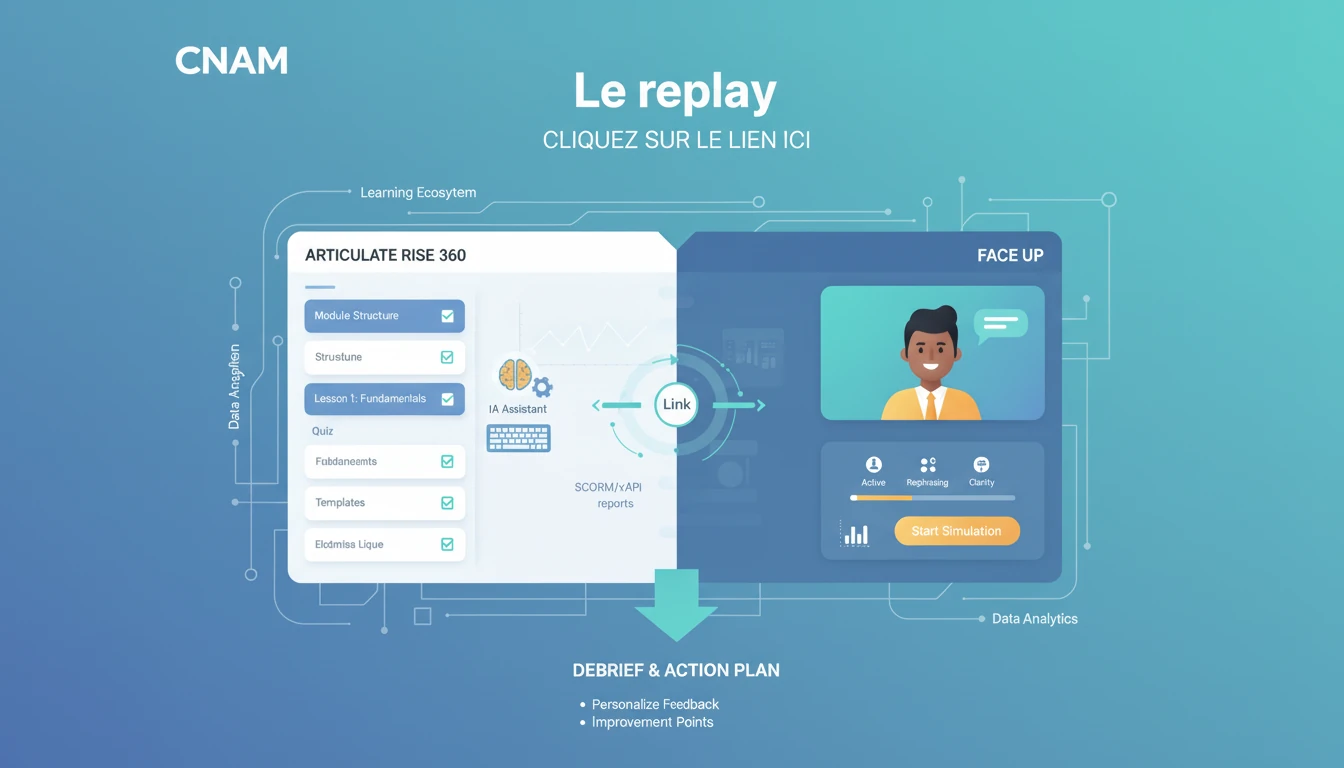
Post-simulation analysis assesses both dimensions: relationship quality (empathy, listening, clarity of explanation) and compliance (discovery questions asked, risks mentioned, pre-contractual information given). That dual assessment sits at the heart of the Face Up approach.
Bank advisers have crowded diaries: client appointments, commercial targets, reporting. Blended learning adapts to those constraints: e-learning for regulatory updates, microlearning for relational technique, AI simulations for individual practice, and in-person sessions for debriefing and sharing what works.
LMS integration lets you track each adviser's progress and confirm that learning paths are completed within regulatory deadlines. That is itself a compliance matter: the regulator can demand proof that advisers have been trained.
Skills assessment in bancassurance carries a regulatory dimension. Advisers must demonstrate competence to sell certain products, from insurance to financial instruments. An internal certification path, built around active teaching methods and simulation-based assessment, gives the whole scheme more rigour.
Face Up simulation reports provide documented evidence of training and assessment — directly usable during compliance checks or internal audits.
Feedback from the banking sector shows compliance rates improving when training includes simulated practice. Advisers who train on scenarios that build in regulatory constraints naturally carry the right reflexes into their commercial conversations.
An adviser who listens, explains clearly and recommends appropriately builds trust. Client satisfaction surveys show a direct correlation between perceived relationship quality and loyalty to the bank. In a market where switching banks has never been easier, the quality of advice is a decisive differentiator.
Advisers who are competent and confident in their own ability stay longer. Training reduces the stress that comes with commercial pressure by giving people concrete tools to perform without forcing anything. The return on investment includes lower recruitment and onboarding costs.
A customer relations programme for the banking sector rests on four pillars: simulation scenarios that build in the regulatory constraints specific to the role; a progressive path running from client discovery through argumentation and objection handling to closing; an assessment system that measures relationship quality and compliance together; and long-term follow-up to embed the reflexes and keep pace with regulatory change.
Face Up offers a catalogue of banking scenarios (welcoming clients in branch, selling a mortgage, handling a complaint, advising on savings) and an authoring tool that lets training managers build scenarios matched to their own products, client base and regulatory framework.