
In a customer interaction, the words themselves account for only a fraction of the message. What separates a transactional exchange from a memorable experience is the adviser's ability to genuinely listen — not simply hear. Active listening, a concept formalised by the psychologist Carl Rogers, means making yourself fully available to understand the other person's message, in both substance and delivery.
In customer-facing work, that skill has a direct and measurable effect. Organisations whose teams practise active listening see customer satisfaction improve markedly, complaints fall and first-contact resolution rise. Yet too many training programmes stop at theory — "reformulate", "don't interrupt" — without ever having people practise those reflexes in realistic conditions.
The first pillar is presence. In a world of constant interruption — notifications, open-plan noise, multitasking — giving a customer your full attention has become a genuine differentiator. It means holding eye contact face to face, resisting the pull of a second screen, and adopting open body language that signals engagement.
Reformulating is not parroting. It is showing the customer that their message has landed, by giving it back in your own words. "So if I've understood correctly, you've spotted a gap between the amount taken and the amount you were quoted — is that right?" This simple technique cuts misunderstandings and builds trust immediately.
Open questions invite the customer to say more. Instead of "Is the problem resolved?" (a yes/no answer), try "How have things been since we last looked at this?" Questions of that kind surface implicit needs the customer would never have raised unprompted.
Acknowledging the customer's emotion — frustration, worry, impatience — without judging or minimising it. "I can understand why this is frustrating" is not an empty formula when it is said sincerely. It is a powerful signal that says: your experience of this matters.
Knowing when to say nothing is an underrated skill. Leaving a pause after the customer has spoken gives them room to finish their thought, say the thing they were hesitating over, or simply feel heard. The strongest advisers have mastered this productive silence.
Empathy goes further than listening. It means putting yourself in the customer's position to understand their situation, their constraints and their emotions. In customer-facing work, two complementary forms of empathy are worth distinguishing.
Cognitive empathy allows you to understand the customer's point of view rationally. "This passenger has a train in ten minutes and is stressed because they can't find their platform." That understanding points straight to the right response: fast information, a reassuring tone, clear directions.
Emotional empathy allows you to feel what the customer feels. It shows in tone of voice, facial expression and word choice. An empathetic adviser does not tell a distressed customer "that's the procedure" — they adapt the response to the emotional context.
One caveat: professional empathy is not sympathy. The point is not to suffer alongside the customer, but to understand their difficulty well enough to answer it properly. That distinction is essential to protecting the mental health of front-line teams — a subject conventional training too often ignores.
You can explain the principles of active listening in thirty minutes. But between knowing and doing there is a gulf, and most training fails because it never crosses it. An e-learning module with a quiz asking "which is the correct reformulation?" does not build a reflex. It builds knowledge — which is a radically different thing.
To embed these skills you need repeated practice in realistic conditions. That is precisely the principle behind learning through simulation: putting the learner into credible scenarios where they have to deploy active listening and empathy under pressure, with immediate feedback on how they performed.
Role play with structured feedback is particularly effective for these skills. Whether it is run by a trainer or an AI avatar, it lets people rehearse the difficult situations — the customer in a hurry, the unhappy customer, the confused customer — until the right response becomes automatic.
How do you know whether your teams are genuinely listening? Several indicators track progress:
First contact resolution (FCR) is an indirect but powerful measure. Good active listening identifies the real problem on the first exchange, avoiding the back-and-forth.
Post-interaction satisfaction (CSAT) reflects the perceived quality of the listening directly. Customer verbatims mentioning "listened to me", "understood my problem" or "put themselves in my shoes" are reliable markers.
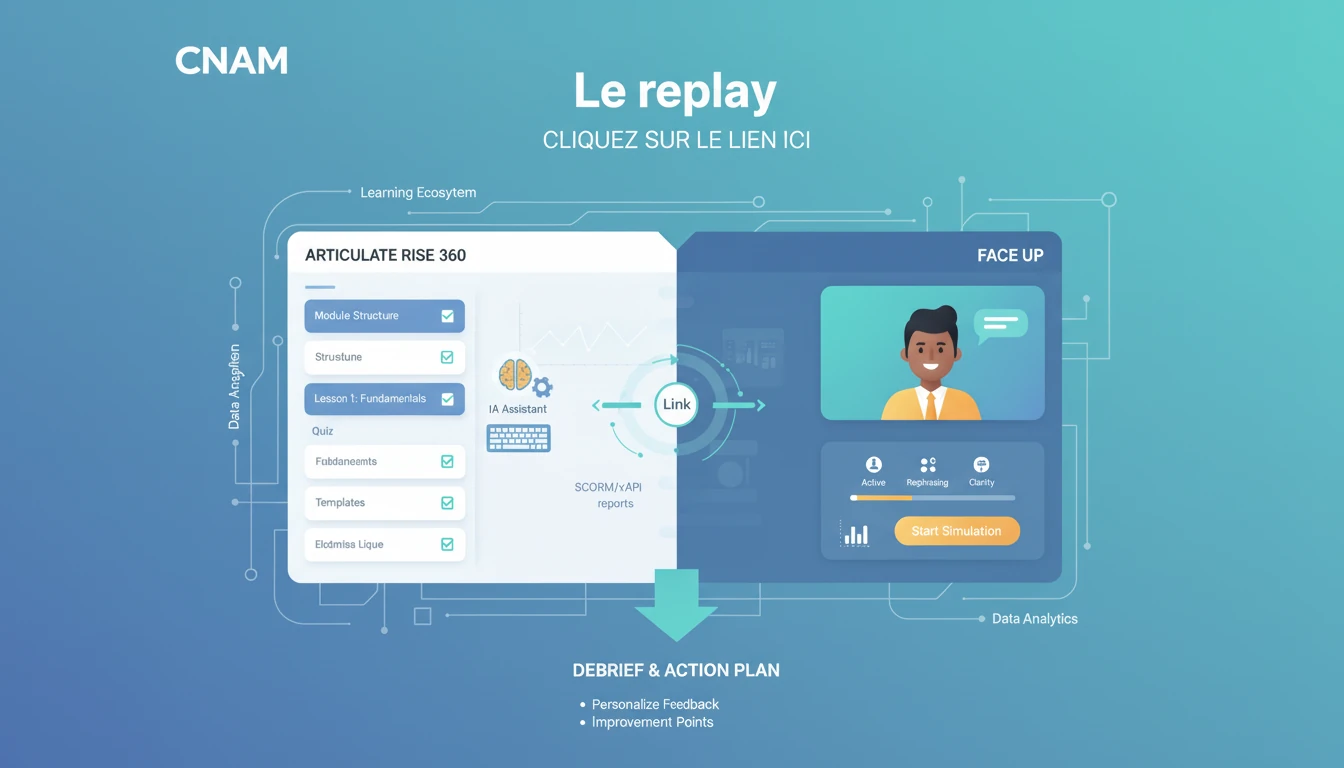
Conversation analysis makes it possible to assess active listening objectively: the adviser/customer talk ratio, the number of reformulations, the presence of open questions, the acknowledgement of emotion. Platforms such as Face Up build in this multimodal analysis — content, tone, posture — to give trainers and learners feedback they can act on.
Active listening adapts to the channel. Face to face, body language does much of the work: posture, eye contact, nodding. On the phone, tone of voice and verbal signals ("I see", "understood") replace the visual cues. In writing — email, chat, social media — listening shows in the precision of the answer and in picking up the customer's own words.
Every channel has its traps. On the phone, silence can read as disinterest. On chat, a slow reply creates anxiety. Face to face, a wandering gaze betrays inattention. Training teams in active listening across every channel has become essential in an omnichannel world.
Take a concrete example in banking. A customer calls to dispute a payment they do not recognise. They are worried — their details may have been stolen. An adviser without active listening goes straight into procedure: "Give me your account number and I'll check." The result: the customer feels handled as a case file.
An adviser trained in active listening starts by validating the emotion: "I understand why that's worrying — let's check it together right now." Then reformulates: "You've spotted a payment of X on [date] that you don't recognise, is that right?" Only then do they move into the procedure. Same technical outcome, radically different customer experience.
To develop active listening and empathy across your teams in a way that lasts, work in three phases:
Phase 1 — Awareness (2 hours): an interactive workshop on the mechanics of listening, the cognitive biases that interfere with attention, and the measurable effect of empathy on customer satisfaction. The aim is to establish the "why".
Phase 2 — Intensive practice (4-8 hours): simulation sessions on progressively harder scenarios. Start with simple cases (a customer with a factual question), then build in complexity (an emotional customer, an ambiguous situation, an impossible request). Using AI simulation multiplies the opportunities to practise without tying up trainers permanently.
Phase 3 — Anchoring and follow-up (ongoing): short microlearning sessions spaced over time to maintain the reflexes. Analysis of real interactions to identify where to improve. Individual and group debriefs.
Active listening and empathy are not vague "soft skills" — they are core professional competencies built through deliberate practice. And like any competency, they need structured, regular, measured training before they become genuine professional reflexes.