
Public speaking is one of the most sought-after skills in business, and one of the most feared — fear of speaking in front of an audience consistently ranks among the most widespread anxieties at work. For training providers, that makes it a large market with one defining characteristic: the skill is only learnt through repeated practice. Soft skills programmes built around intensive exercises produce markedly better results than theory-led approaches.
Effective speaking starts with how the talk is structured. The PREP method (Point, Reason, Example, Point) gives a simple, powerful framework for organising ideas. Every talk should answer three questions: what is my main message? Why should this audience care? What do I want them to do next? That structural clarity is the foundation every other speaking skill rests on.
Content accounts for only part of a talk's impact. Eye contact, posture, gesture and movement in the room carry as much information as the words. Experienced trainers work on these alongside content, because it is their consistency that creates credibility. Multimodal analysis now makes it possible to assess these dimensions objectively, where human feedback often stays approximate.
Nerves are not a problem to eliminate but energy to channel. Diaphragmatic breathing, positive visualisation and physical grounding techniques significantly reduce performance anxiety. But it is rehearsal in realistic conditions that builds lasting confidence. The more a learner practises in a safe environment, the more reflexes they develop to protect them on the day.
Watching yourself on video is a powerful accelerator. But video feedback without a framework is often counterproductive — the learner fixates on cosmetic details rather than on the levers that actually matter. Structure the debrief around three or four precise criteria: clarity of message, verbal fluency, physical presence, and interaction with the audience.
Start with short exercises — a 60-second pitch — before moving to longer formats such as a ten-minute presentation. That progression builds confidence without overwhelming the learner. Simulations across varied scenarios — project presentation, client meeting, conference talk — prepare people for the range of real professional contexts.
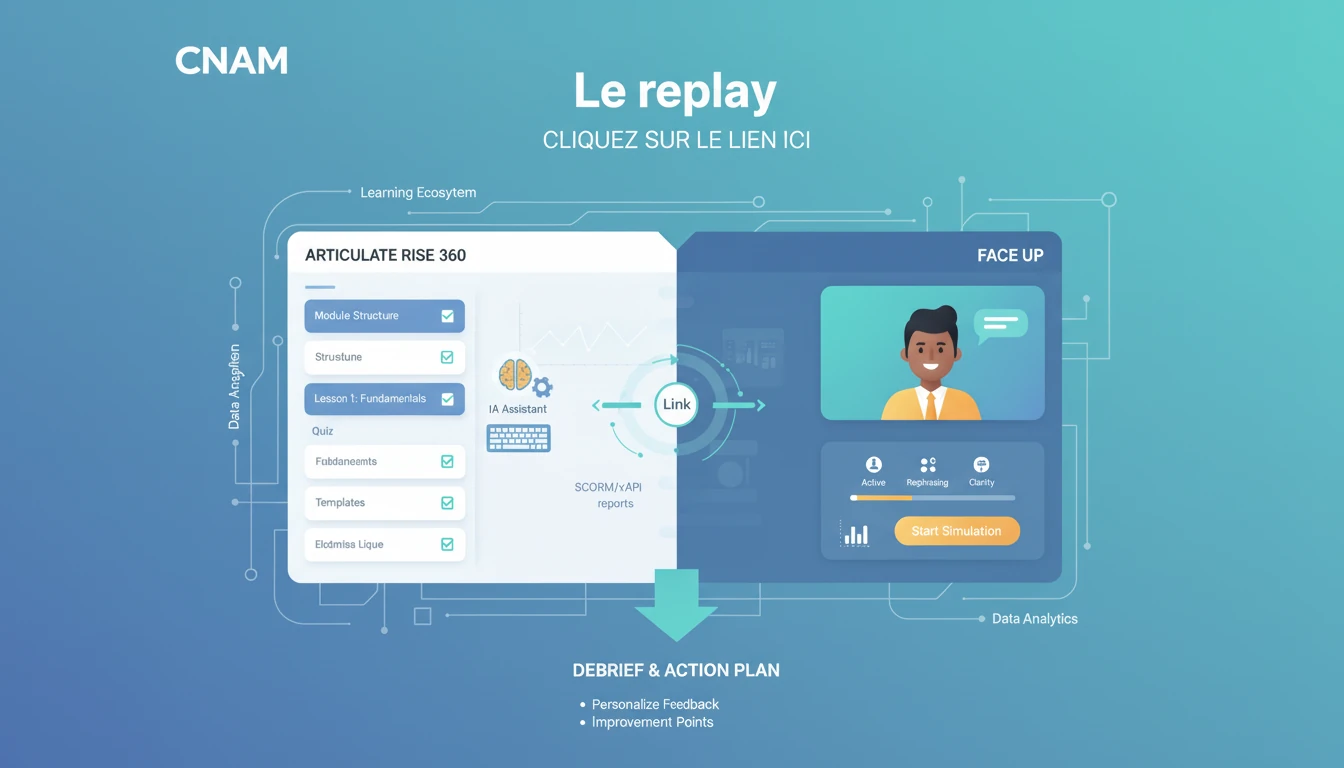
Conversational learning platforms are reshaping public speaking training. The learner rehearses in front of an AI avatar that reacts in real time to what they say, asks unsettling questions or plays a demanding audience. The decisive advantage: they can repeat the exercise as often as they need, without tying up a trainer or a group. Face Up lets you build these tailored practice scenarios, with an automatic debrief analysing both substance and delivery in each attempt.
An effective public speaking programme combines three modes: group sessions for the theoretical framing and the energy of a cohort, individual simulator practice for sheer volume of repetition, and personalised coaching sessions for fine adjustments. This blended format optimises trainer time while maximising learner practice time.
Intensive one-day formats produce an immediate effect that rarely lasts. Favour journeys spread over four to six weeks, with two or three practice sessions a week. That rhythm gives the brain time to consolidate learning between sessions. Neuroscience is clear that spaced repetition is the key to embedding behavioural skills.
To measure progression, define precise criteria: verbal fluency (filler words, purposeful pauses), structure of the talk (a real opening, transitions, a conclusion), non-verbal impact (eye contact, open gesture), and handling of interaction (quality of answers to questions). Automated session analysis scores each criterion objectively and makes the progression curve visible.
The real validation of public speaking training happens on the job. Put a three-month follow-up in place: has the participant spoken up in contexts they used to avoid? Does their manager see a difference? This field evidence complements training metrics and strengthens your quality certification file.
Speaking in public draws heavily on emotional intelligence: self-awareness (recognising what you feel in front of an audience), emotional regulation (managing nerves), empathy (reading the room), and social skills (adapting your delivery in real time). Training people to speak without working on these emotional dimensions produces speakers who are technically correct but disconnected from their audience.
Public speaking training is a strong market for providers, provided the programme is built around intensive practice. Conversational learning tools multiply practice time several times over compared with traditional formats. To broaden your offer, explore the best methods for teaching soft skills in the workplace.