
A soft skills training program spread over several weeks produces more change than a two-day seminar — at equal budget, and often at a lower one. This is not a hunch, it is a documented effect: interpersonal skills are anchored through spaced repetition, not through one-off intensity. The challenge is moving from principle to action plan. This article lays out a concrete 12-week model: the week-by-week sequence, who does what, the budget, and the metrics that prove the program works.
These three words are often used interchangeably. They actually describe three distinct levels, and the confusion gets expensive at design time.
Keep the hierarchy in mind: the module installs a reflex, the program builds a skill, the pathway develops a profile.
The intensive seminar has everything going for it: simple logistics, a sense of occasion, calendars blocked once and for all. It has a single flaw: its effects do not last.
The reason is called the forgetting curve. Without reactivation, most of what was learned fades within a few weeks — a phenomenon documented since Ebbinghaus and confirmed by every delayed assessment. Two intense days produce a spike of enthusiasm, a few good resolutions, then a gradual return to the starting level. Six-month evaluations confirm it time and again: without a reactivation plan, participants themselves struggle to name three ideas from the seminar.
The opposite effect is called spacing: the same amount of practice, distributed over time, produces far more durable anchoring. Each reactivation forces the brain to rebuild the reflex, and that rebuilding is precisely what anchors it. Twelve sessions of thirty minutes beat one session of six hours. It is the principle shared by the soft skills training methods that actually work, and the reason why roleplay training is practiced in short, regular sessions rather than as an annual marathon.
Here is a proven model for a management, sales or customer relations program. Adapt the content to your context, keep the mechanics.
Two framing parameters before rolling it out. Cohort size first: eight to fifteen participants — enough to create group momentum, few enough to debrief each person individually. The sponsor next: a twelve-week program crosses three months of calendar hazards, and without a sponsor protecting the weekly slot, it erodes. Secure that commitment before week 1, not after the first drop-off.
Each participant goes through a short diagnostic role play on the program's target situations. Three goals: establish the real starting level (often far from self-assessments), define two or three individual behavioral objectives, and get managers on board — a program whose managers do not even know it exists loses half its effect. Ten minutes per person is enough: the goal is not a fine-grained evaluation, but a comparable baseline for everyone. This is also the window to lock in the metrics that will judge the program in week 12.
One module every two weeks — short input, practice, debriefing — and, between modules, a weekly ten-minute practice session done independently: a role play targeting the behavior of the fortnight. AI roleplay is the simplest way to hold this rhythm without mobilizing a trainer every week: the learner practices with a realistic persona and receives an immediate debriefing. The in-person module keeps what independent practice cannot do: the first guided practice and the collective debriefing.
The input phase is over; now comes volume and difficulty. Scenarios gradually harden: more closed-off counterparts, tougher objections, combined stakes — a corrective conversation that turns into a negotiation, a complaint that escalates into a conflict. Progressive difficulty is the key mechanism of this phase: a reflex only becomes reliable if it holds when the situation gets complicated. To pick the right exercise format at each level, the difference between simulation and role play is worth understanding.
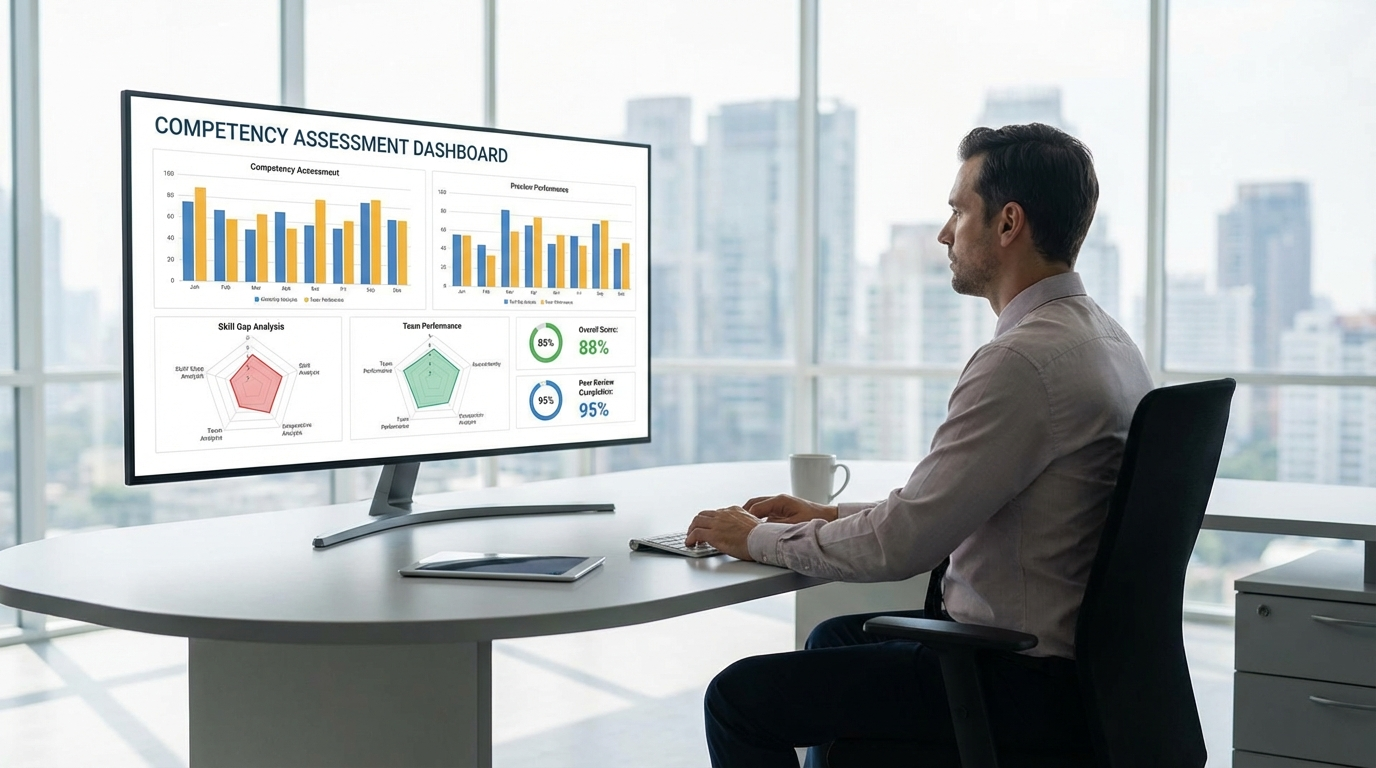
Each participant goes through a role play comparable to the initial diagnostic, assessed against the same criteria. The gap between the two measurements is the program's proof of progression — a far stronger argument than a satisfaction survey. The last two weeks also set up what comes next: a monthly practice ritual, real-situation challenges, a formalized manager relay.
A program spread over time redistributes the roles compared with the classic seminar.
Add a fourth, often forgotten actor: the sponsor. They are the one who arbitrates when operations demand "a pause" in week 6. Their answer decides the practice rate — and therefore the final result.
A useful counter-intuition: a 12-week program does not necessarily cost more than a two-day seminar. The main cost driver — trainer days, rooms, travel, time away from production — is concentrated on three or four in-person highlights; the weekly practice happens independently, at low marginal cost. You shift the budget from logistics to practice, which is exactly where behavior change happens. Concretely, for twelve participants: two and a half days of in-person time spread across the quarter instead of two consecutive days, one hour of virtual classroom, and the weekly independent practice. The coordination overhead is real but marginal compared to the opposite risk: a forgotten seminar costs 100% of its budget.
On the metrics side, four levels to track:
A successful soft skills training program is not a stack of modules: it is a spacing machine. Diagnostic, short inputs, weekly practice, increasing difficulty, compared assessment — the 12-week model organizes that machine in a format calendars can accept. The practical condition is making weekly practice genuinely feasible: ten-minute role plays done independently and debriefed immediately, which is what conversational learning solutions like Face Up are built for. To build each brick, start with the module design method, then decide where to integrate role play at each stage of the program.