Active listening sits at the heart of most corporate soft skills programmes. Yet one question stops training providers in their tracks during quality assurance audits: how do you prove that a learner actually listens better after the training? This is not a feeling, it is a measurable skill. Your audit file has to show it.
Auditors ask a blunt question: what evidence do you have that the learner listens better? Not vague testimonials, evidence. This is where most providers stumble. Here is how to structure your file.
1. Define what "listening better" means
Before you can prove anything, define a measurable objective. Active listening means:
- Summarising what you hear without distorting it
- Asking relevant clarifying questions
- Picking up on what is left unsaid, and on emotion
- Adapting your response to the context
Your programme should target one or more of these components. If you are aiming at "identifying emotions", you are not measuring the same thing as "summarising without distortion".
2. Assess before the training (pre-test)
You cannot prove progression without a starting point. Put a measurable pre-test in place:
- Role play: present a dialogue or a video. The learner summarises what they heard.
- Assessment grid: did they paraphrase without adding interpretation? (yes / no / partly)
- Record: keep the written or audio trace.
Do not settle for asking learners whether they think they listen well. Self-assessment is not evidence.
3. Measure during the training
Build in structured moments of observation:
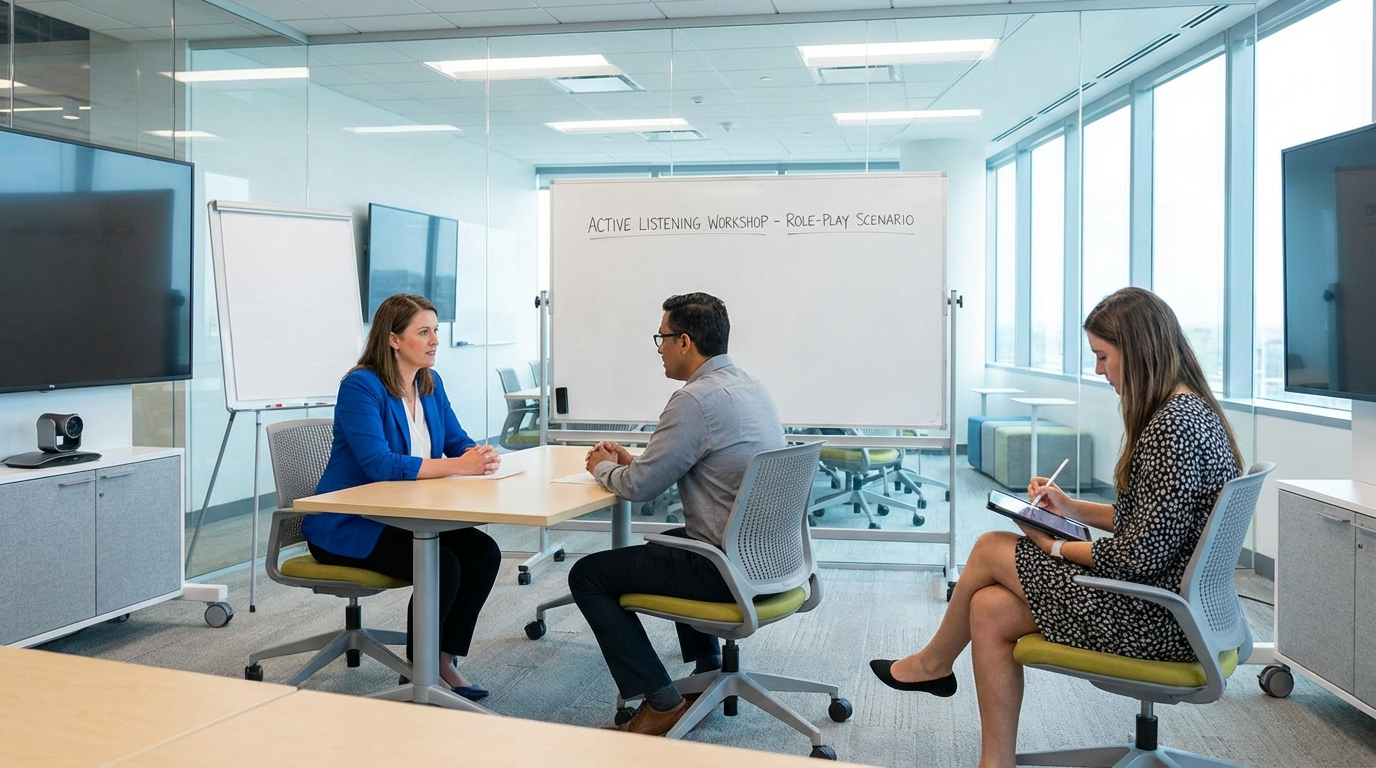
- Paired exercises: two learners hold a conversation while a third observes against a grid. The output is written evidence.
- Group feedback: ask learners to restate what they understood, and record it.
- Trainer feedback: document the progress observed for each person ("Marc interrupted at first, then let the other person finish").
4. Assess afterwards (post-test)
The post-test has to mirror the pre-test to be comparable:
- The same scenario, or an equivalent one.
- The same assessment grid.
- The same format: written, video or spoken.
The gap between the two is your evidence of progression.
5. Collect the evidence trail
An auditor wants to see:
- The programme objectives and their measurable indicators.
- The pre- and post-assessments, with their grids.
- Individual results, anonymised or not.
- A short analysis ("80% of learners improved on paraphrasing without interpretation").
- The materials used: videos, role plays, briefs.
6. Adapt for remote delivery
Evidence is harder to capture at a distance. Use:
- Asynchronous written role plays.
- Videos of learners restating what they heard.
- Forums where they have to paraphrase other people's contributions.
- Recordings of video conversations, with consent.
The mistake to avoid
Do not confuse perception with proof. "Learners found the course useful" is not evidence that listening improved. It is one input, not a demonstration of skill acquisition.
What the audit file should show
Your audit documentation should set out:
- The specific objective: paraphrase without distortion, identify emotions, and so on.
- The assessment format, identical before and after.
- The results, as statistics or as a summary per learner.
- The analysis: "13 of 15 learners met the objective".
That structure is what reassures an auditor. Active listening stops being a vague quality and becomes a measured, documented acquisition.