
"Before the programme, where were you? After it, where are you?" That simple question hides a lot of complexity: how you ask it, when, of whom, and with what instrument determines whether the answer is credible at all. For soft skills, before-and-after assessment is the core of any demonstration of impact to a quality auditor. Yet many training providers treat it casually: a paper questionnaire on day one, another on day five, a spreadsheet to compare the two, done. The result is enormous improvements that nobody believes, noisy data, and a measurement an auditor can pick apart in ten seconds. This article shows you how to build a before-and-after assessment that holds up: rigorous, workable, defensible. Not complicated — just properly thought through.
When you ask someone "how would you rate your leadership?", they rarely answer honestly, particularly in a group. Modest people mark themselves down; others mark themselves up. The bias also shifts between the before and the after: people feel better after a training course, so they score themselves higher even without real progress. Researchers call this the training effect — apparent improvement produced by the attention rather than the content. How do you detect it? By cross-checking against external observation. A trainer or a peer who watches produces a far less biased data point.
"Rate your stress management from 1 to 10." Judged against what? How quickly someone can take a deep breath? Their ability to step back? Their tolerance for frustration? Ten people will read that ten different ways. On day one, Peter scores himself 3, thinking "I panic easily". On day five he scores 6, thinking "I'm sleeping better". In his head that is progress, but the two scores measure different things, so it is a false positive. To avoid this, define each dimension in behavioural terms. Instead of "stress management", measure "recognises their own stress signals" (rapid breathing, racing thoughts), "applies a regulation technique" (deep breathing, taking a pause) and "returns to the situation with perspective". Three dimensions, each of them observable.
A leadership and management programme does not have the same effect on a director with ten years' experience as on a first-year manager. The director already has the reflexes and improves modestly. The junior starts from nothing and improves sharply. If you measure only absolute progression (2 before, 6 after: plus four points), you are effectively rewarding the junior. An honest measurement records the starting context too: relative progression, or an adjustment for the profile. An auditor who sees "every participant went from 3/10 to 8/10" will rightly be suspicious — it is far too linear. If instead you record "less experienced managers gain 4 to 5 points, more experienced ones gain 1 to 2", that is credible.
The initial assessment should happen on the day the programme starts, not before. Why? Because anticipation biases the result too: assess people the day before or the week before and you are measuring their expectations, not their level. Day one, in the room, at the moment the programme begins, is the authentic baseline. Allow fifteen to twenty minutes: take a slot at 9:15 while the trainer is handing out the housekeeping, and run a structured questionnaire plus a very short role play (three minutes) if you can. You capture the starting state without spoiling the opening.
A questionnaire asks "how well do you listen?" The answers are abstract. A role play says: "you have two minutes to tell a colleague their idea doesn't work, in a way they can hear. Go." Now you can see. Do they interrupt? Do they listen first? Do they ask questions? You have data. The drawback is that role plays take time. The fix: use them for the before and the after, where you have the time, and a short questionnaire for interim measures, where speed matters. Better still, combine them. Before: a role play, which produces real behaviour to observe, plus a short questionnaire immediately afterwards, which captures the participant's own reflection. You get the benefit of both.
The final assessment should be run immediately after the programme, not three months later. Why? Because three months later you are measuring transfer ("have you kept the gains?"), not the direct outcome of the training. For audit purposes you measure the direct outcome first: at the end of the programme, where are you? Then, if you can, you measure transfer some weeks or months later. Two different measurements with two different purposes. The immediate after asks "have you acquired the skills?" The delayed after asks "are you actually using them at work?" Do not conflate them, or your results will be ambiguous.
Take interpersonal communication. Five observable dimensions:
Each dimension is scored 1-5 (1 absent, 5 mastered). Before, you score each one while observing a role play or a natural discussion. After, same format. Before: listening 1, clarity 2, emotional control 2, adaptation 1, summary 1 = 7/25. After: listening 3, clarity 3, emotional control 3, adaptation 2, summary 2 = 13/25. An improvement of 86%. Credible.
Every trainer in your organisation must assess using the same protocol. If Frances scores "communication = 3/10" and Dominic scores "communication = 3/10" for the same participant, they need to be working from the same reference points. Hence the importance of a shared definition: what does a 2 look like? What does a 4 look like? Write it down: "Active listening, level 2: the learner asks one or two questions but does not reformulate. Active listening, level 4: the learner reformulates systematically before answering, and asks questions to go deeper." At that level of granularity, two trainers will agree around 80% of the time. Chase 100% agreement and you are being pedantic and wasting time. Sit at 50% and your results are not reliable. Aim for roughly 80% alignment.
When an auditor opens a participant's file, they should see, within two minutes:
That is it. A six-page file speaks loudly. A one-page file, however detailed, leaves gaps.
Do not leave the before-and-after results as a raw list. Synthesise them. For example: "Before: overall score 8/25 (32%). After: 16/25 (64%). Progression: plus 8 points, plus 32 percentage points. The clearest gains: active listening (+2) and emotional control (+2). The programme acted particularly on their ability to stay calm in a conflict situation." That prose summary lands harder than a table, and it is easier to defend out loud when the auditor starts asking questions.
If you use exactly the same scenario before and after, people improve simply because they know the scenario. "The second time I know what's coming, so I settle down faster." That is not progress, it is familiarity. The fix: an initial role play and a final role play that differs slightly — same structure, new context. Or a questionnaire before and a role play after, since two different formats measure the underlying competence more honestly. It is a subtlety an auditor may well probe, so get your defence in first.
After a programme, people are more aware of their own behaviour. So they report better stress management "through awareness, not technique". That is not false, but it is fragile: awareness without technique rarely lasts. How do you detect it? Ask the participant: "when you felt stressed at work, what did you do differently?" If they cite a technique they learned (4-7-8 breathing, a five-minute pause), that is solid transfer. If they say "I just notice that I'm stressed, and it helps me panic less", that is mostly awareness. The two are not worth the same in an audit file.
A trainer who worries that assessment will slow the programme down is right about one thing: it takes time. But a well-designed assessment becomes a learning opportunity in its own right. A day-one role play forces the participant to confront their own reality: "I really do interrupt when someone contradicts me." The debrief that follows is not a mark, it is a reflection. By the end, the participant knows what they need to work on. That is better pedagogy. So do not treat assessment as an add-on; treat it as the spine of the process.
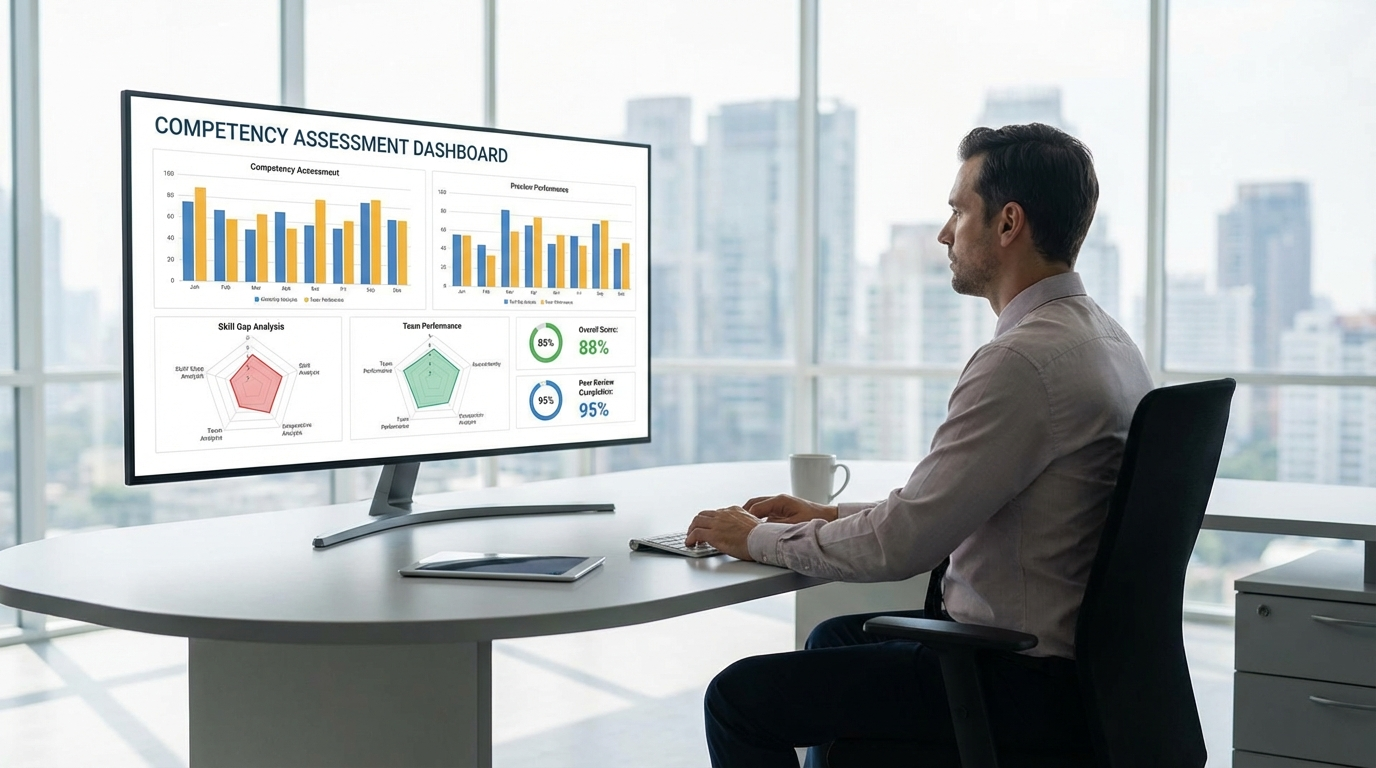
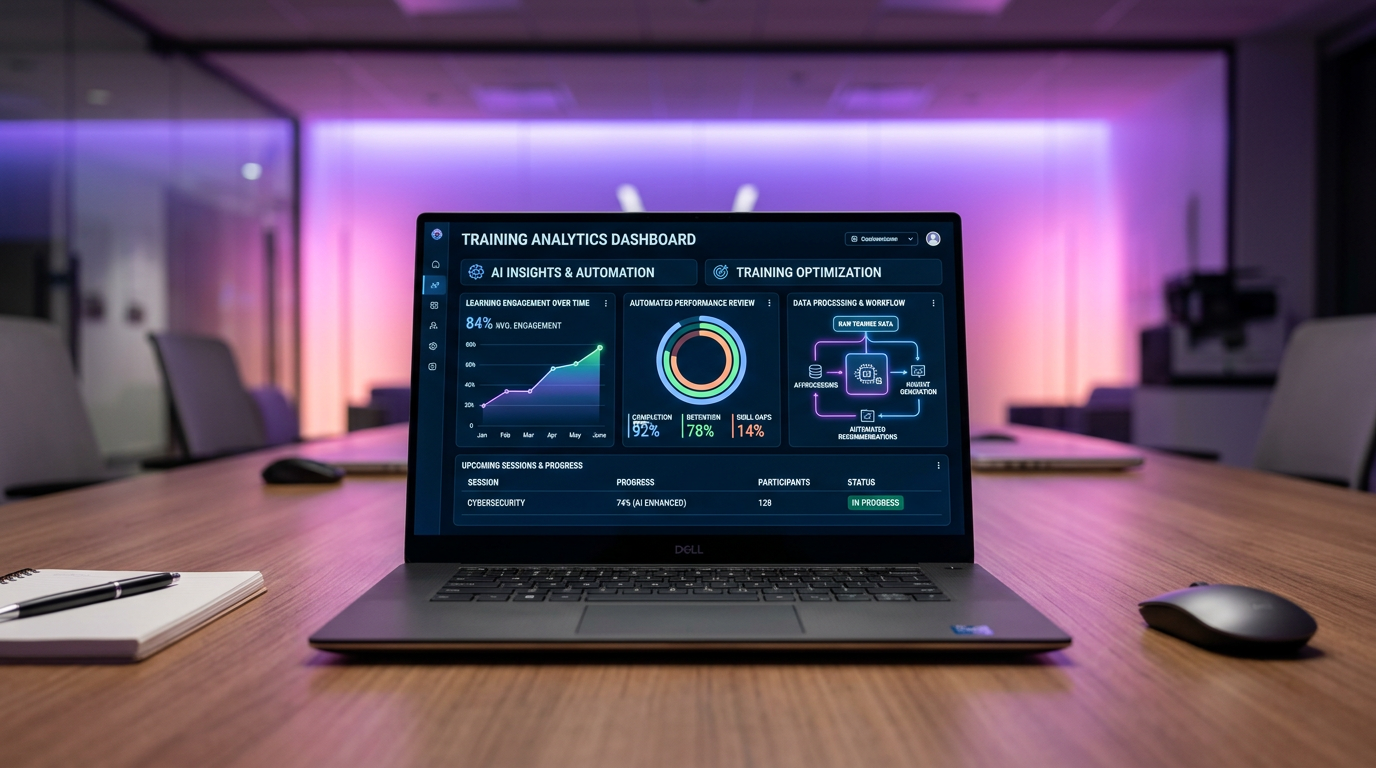
If your organisation collects scores in a spreadsheet, that is manual work that eventually runs out of steam. Build assessment into a tracking tool instead — even something simple, a form, a shared workspace, or a dedicated LMS — and documentation becomes routine: the trainer enters scores at the end of each day, the system archives them, and the final assessment is compared to the baseline automatically. You gain both time and rigour. For providers running several programmes a month, that is the difference between sustainable compliance and a chore that gets abandoned.
Before-and-after assessment is the core of any proof of impact. Avoid the three traps (self-assessment alone, poorly defined dimensions, ignored context), structure the measurement (before on day one, after on day five, role play plus questionnaire), measure five behavioural dimensions, document it in a six-page file, and screen for false positives. This protocol is not revolutionary, just rigorous. It turns a training course into a demonstration of learning. When an auditor opens your files, they see it immediately: you genuinely measure, it is reliable, it is comparable. To go further on measuring impact, our full guide also covers the long term and return on investment. But start with the before-and-after: everything else rests on it.