An annual performance review is a one-to-one meeting between a manager and a team member to take stock of the past year and prepare for the next. You look back at results, assess skills, set new objectives and listen to what the employee wants. Done well, it clarifies expectations on both sides for the next twelve months.
This guide is for the manager leading the conversation. It covers preparation, the six-step structure, the questions to ask, phrases for tricky moments and the mistakes to avoid. It ends with a checklist and a way to practise before the day itself.
Annual performance review: definition and how it differs from the French professional review
The annual performance review looks at performance. It answers three questions: what was achieved, how, and what is expected next year. In France, it is not a general legal requirement. It is a company practice, sometimes set out in a collective agreement.
The professional review (entretien professionnel) is a different exercise. It is required by the French Labour Code (Code du travail) and focuses on the employee's career path: training, qualifications, progression. It must not be used to assess their work. Its frequency was changed by a recent reform, so check the current rule with your HR team. Both reviews can take place on the same day, but they remain two separate conversations, with two separate written records.
What an annual review is not
- It is not a corrective conversation. A behaviour problem is dealt with when it happens, in a corrective conversation with the employee. Raising it for the first time at the annual review is a management mistake.
- It is not a pay negotiation. If pay is on the agenda, say so in advance and keep that part separate from the rest.
- It is not a form to fill in. The template helps to give structure. The quality of the review depends on the conversation.
How a manager should prepare for an annual review, then lead it
Preparation, two to three weeks ahead
Preparation starts two to three weeks before the meeting. It involves both people: the employee should be able to prepare their own review of the year.
- Set the date and let them know. Offer a slot of at least an hour, in a quiet room. Send the review template in advance.
- Reread last year's record. Go back over the objectives set and the commitments made, including your own.
- Gather facts. For each objective: the result, two or three dated examples, what helped and what got in the way.
- Prepare your assessment. For each skill, a rating and an example that supports it.
- Anticipate the sensitive points. A missed objective, a rating below what they hope for, a request for promotion you cannot meet.
- Choose your stance. The four managerial postures help you adapt your approach to the person's level of autonomy.
A good test for your examples: could a third party have observed them? “He's very committed” is an opinion. “He took over the client account in March while his colleague was away” is a fact.
The annual review in 6 steps
The order matters. The employee speaks first, the manager second. Starting by listening stops the conversation from turning into a verdict.
- Open. Restate the purpose and the structure. “We're going to look back at the past year together, then prepare for the next one. First, I'd like to hear how you see it.”
- Review the year. The employee presents their year, then you add your own facts.
- Assess objectives and skills. For each point, give your assessment and the example behind it.
- Set next year's objectives. Three to five specific, measurable objectives, each with a deadline and the resources needed.
- Hear their wishes. Training, career progression, ways of working, what they need from you as a manager.
- Close. Summarise the points of agreement and disagreement, each person's commitments and the date of the next check-in.
The balance rule is simple: the employee should speak at least as much as you. If you notice you are delivering a monologue, ask an open question and wait for the answer.
Annual performance review questions to ask
Open questions get people talking. Closed questions confirm a specific point. Here is a starting list to adapt to your context.
About the year
- “What are you proudest of this year?”
- “Which situation was the hardest, and how did you handle it?”
- “What helped you achieve your results? What held you back?”
About objectives
- “On this objective, where do you think you are?”
- “What would a good result look like for you next year?”
- “What do you need to get there?”
About skills
- “Which skill have you developed most this year?”
- “Where would you like to improve?”
- “In which situations do you feel least comfortable?”
About their wishes and your working relationship
- “How do you see your role in a year or two?”
- “What could I do differently to support you?”
- “Is there anything we haven't talked about that matters to you?”
The last question is often the most useful. It leaves room for whatever the template did not anticipate.
Constructive feedback: phrases for tricky moments
The difficult moments in an annual review are predictable. Preparing your key phrases saves you from improvising under pressure. The principle is the one behind constructive feedback: start from the facts, listen, then focus on what can change.
The employee disputes the assessment
Do not defend your rating on principle. Ask for their evidence, then compare it with yours.
- “I can see you don't agree. Which facts are you basing that on?”
- “Here are the examples I'm basing my view on. Let's look at them together.”
- “If we still disagree, I'll note it in the written record, along with your point of view.”
The employee is disappointed
Disappointment over a pay rise, a promotion or a rating deserves to be acknowledged. Playing it down shuts the conversation.
- “I understand you're disappointed. What were you expecting?”
- “I can't change this decision today. I can help you build what will make it possible.”
- “What, in practical terms, would make a difference for you by next year?”
The objective was not met
Separate the result from the person, and look for causes before drawing conclusions.
- “This objective wasn't met. What happened, from your point of view?”
- “Which part was in your hands, and which part wasn't?”
- “What do we change for the coming year, on your side and on mine?”
In all three cases, the reflex is the same: ask a question, listen to the answer, then come back to the facts. If things get tense, conflict management techniques for managers help bring the pressure down.
Common mistakes and the manager's checklist
Mistakes that derail the review
- Raising a problem for the first time at the review, when it should have been dealt with during the year.
- Assessing only the last few weeks and forgetting the rest of the year.
- Letting one overall impression colour every rating.
- Talking more than the employee.
- Setting vague objectives, with no deadline and no way to measure them.
- Promising a promotion or a pay rise that is not in your gift.
- Doing nothing with the written record until the following year.
The checklist to keep at hand
- The employee received the template and the date at least two weeks in advance.
- I have reread last year's record and my own commitments.
- I have dated facts for each objective and each skill assessed.
- I have prepared my phrases for the most sensitive point.
- I plan to let the employee speak first.
- The objectives I am proposing are specific, measurable and time-bound.
- I know what I can promise, and what I cannot.
- I have a date to propose for a mid-year check-in.
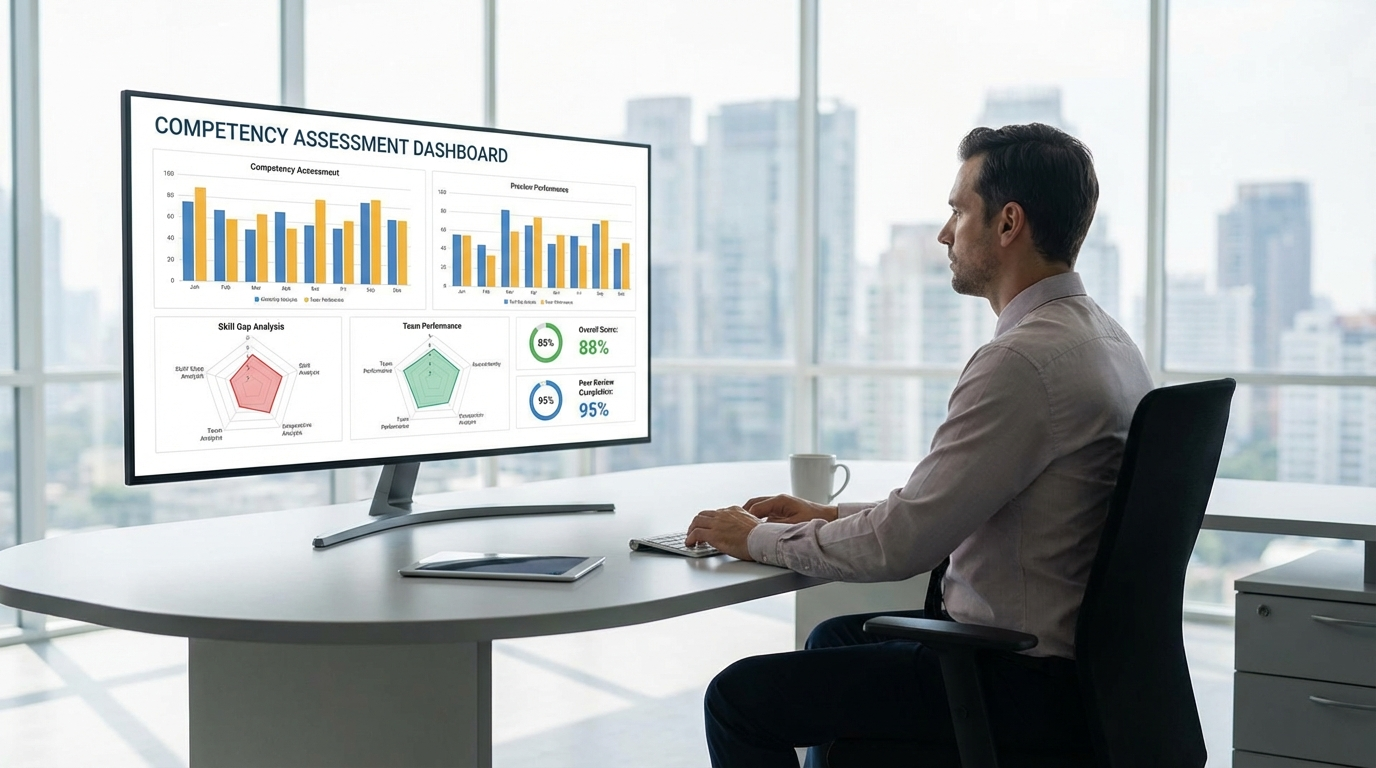
To go further on how to assess interpersonal know-how, look at the tools available for evaluating management competencies.
Frequently asked questions
How long does an annual performance review last?
Allow at least an hour, without interruptions. A review that is too short leaves little room for the employee to speak. If a topic needs more time, schedule a second conversation.
Does the employee have to sign the written record?
Practices vary from one company to another. Most often, the employee reads it, can add their comments, then signs to confirm they have seen it. Follow the procedure set by your HR team.
Can the annual review and the professional review take place on the same day?
Yes, as long as they are clearly separated. The professional review focuses on the career path and must not assess the person's work. Two distinct conversations and two written records avoid any confusion.
What if the employee says nothing?
Silence is not always a refusal. Ask a more concrete question, about a specific situation from the year. Give them time to answer, and offer to follow up on a point in writing if they prefer.
Practising before the annual review
Reading a list of questions does not prepare you for the other person's reaction. An employee who disputes their rating or takes a disappointment badly tests your reflexes, not your knowledge. These interpersonal skills are built through practice, as role play on difficult management situations shows.
With Face Up, a trainer creates an annual review scenario. The persona reacts: they get defensive, go quiet, express disappointment. The manager talks to them by voice and on video. After the role play, a debrief shows which objectives were met, strengths, areas for improvement and an action plan. The manager replays the scene and tracks their progress.
To prepare your managers for their annual reviews with this kind of practice, book a demo.