
Albert Mehrabian formalised it in the 1960s: in an interaction carrying emotional ambiguity, 7% of the message comes through the words, 38% through tone of voice and 55% through body language. Those figures are often quoted out of context, but the underlying principle holds in customer relations: what you say matters less than how you say it.
An adviser who says "I'm sorry about the inconvenience" in a flat tone, arms folded, eyes on the screen, sends a radically different message from one who says exactly the same sentence with a sincere tone, an open posture and direct eye contact. The customer picks up the difference instantly, even if only unconsciously.
Training teams to handle both dimensions — verbal and non-verbal — is a powerful lever on customer satisfaction. Yet most training programmes concentrate exclusively on the verbal script and neglect everything around it.
In customer relations, some words open doors and others close them. Compare: "That's impossible" with "Here's what I can do for you". "That's not my department" with "Let me put you through to the right person". "You should have" with "Next time, I'd suggest".
Positive vocabulary is not about lying or sugar-coating. It is about steering the exchange towards the solution rather than the problem. This is not a skill you improvise: it is built through repeated role-play in which the learner practises reframing spontaneously in constructive language.
A customer cannot absorb a continuous stream of information. To be understood, the adviser has to give the conversation a structure. The most effective pattern in customer relations is the information sandwich: acknowledge the request, give a structured answer, confirm understanding.
For example: "So you'd like to move your booking to tomorrow. [acknowledgement] I have two slots left, 2pm and 4.30pm, at the same price. [information] Which would suit you better? [commitment]" Three sentences, no confusion.
The register has to match the customer, not the internal procedure. A traveller in a hurry at a station needs direct, condensed information. A high-value client in a bank branch expects a calmer, more personalised exchange. A student discovering a service needs explanation.
That adaptation is part of active listening: reading the customer's profile quickly enough to adjust tone, vocabulary and level of detail. It is a skill that conventional training rarely addresses in an operational way.
Face to face, posture speaks before the adviser does. An open posture — relaxed shoulders, body leaning slightly forward, hands visible — communicates engagement and availability. Folded arms, a body angled away, or a wandering gaze signal disinterest or defensiveness.
Gestures accompany and reinforce speech. A nod while the customer is talking shows attention. A hand gesture indicating a direction beats a verbal explanation. But watch for the parasitic ones: fiddling with a pen, tapping the desk or glancing at a watch all send powerful negative signals.
The face is the area customers scrutinise most. A genuine smile — one that engages the muscles around the eyes, not only the mouth — creates a positive climate immediately. An involuntary frown at a complicated request can read as judgement.
The aim is not to mask emotion; customers spot a fake smile at once. It is to develop awareness of your own expressions so you avoid contradictory signals: saying "of course, happy to" while looking exasperated fools nobody.
The physical distance between adviser and customer shapes the quality of the exchange. Too far and it feels cold and institutional. Too close and it feels intrusive. Comfortable professional distance usually sits between one and two metres, with adjustments for cultural context and situation.
In a branch or a shop, standing side by side rather than facing each other to look at a document together creates a sense of collaboration. It is a small detail that changes the dynamic of the exchange.
The paraverbal layer — pace, intonation, volume, pauses — is the most underrated channel in customer relations training. Yet it is often the one that decides how an interaction goes.
Pace has to be adapted. Too fast signals stress or impatience and stops the customer keeping up. Too slow can come across as condescending. The right rhythm gives the customer time to take things in, with strategic pauses to underline the important points.
Intonation carries the emotion. A monotone voice sends people to sleep. A voice pitched too high betrays nervousness. The most effective advisers modulate their intonation naturally to convey empathy, confidence or enthusiasm as the moment requires.
Volume communicates assurance. Speaking too quietly makes the customer strain to hear and breeds frustration. Speaking too loudly reads as aggressive. The ideal volume is clearly audible without effort, lifted slightly on the key information.
On the phone, the voice becomes the only non-verbal channel. That is why a smile can be heard: the facial muscles change vocal resonance. Training contact centre teams to smile on the phone is not a cliché — it is an acoustically measurable technique.
On video calls, an increasingly common customer channel, new rules apply. The framing should show the face and upper body. The gaze should go to the camera rather than the screen, a counter-intuitive reflex that has to be practised. The background should be professional and free of distraction.
Across all of these channels, mastering omnichannel communication has become an essential skill for frontline teams.
The core difficulty is that non-verbal communication is largely unconscious. Advisers do not notice that they fold their arms, speed up or break eye contact when they are under pressure. That is why traditional methods — reading a guide, watching a video — fall short.
The most effective approach combines three elements. First, awareness, by watching your own interactions back. When an adviser sees themselves on video with folded arms facing a difficult customer, the penny drops immediately. Second, guided practice, through role-play scenarios followed by precise feedback on both the verbal and the non-verbal. Third, follow-up over time, with regular analysis to measure progress.
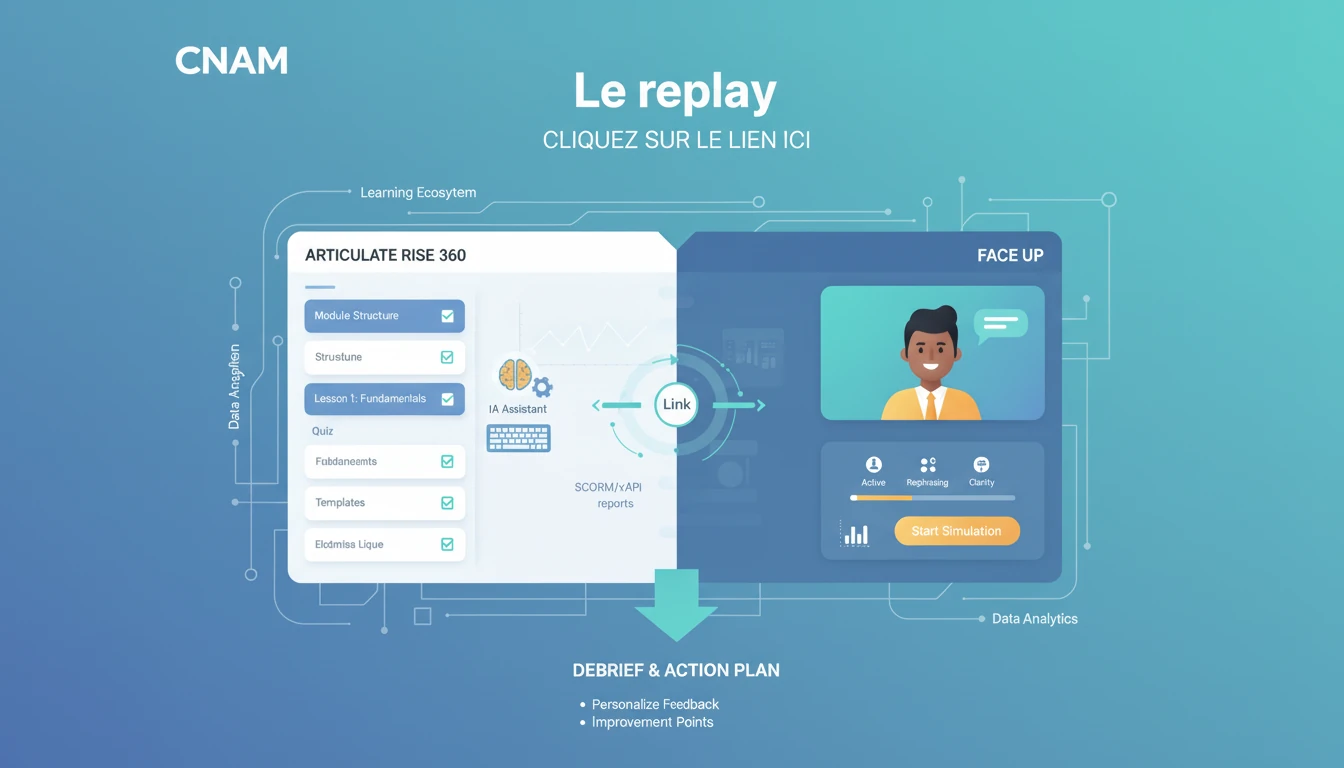
Conversational learning with AI avatars adds a new dimension here. Platforms such as Face Up build in multimodal analysis — content, tone, posture, facial expression — which makes it possible to give objective, detailed feedback across every dimension of communication. The trainer can then use that data for a precise, actionable debriefing.
Analyse hundreds of customer interactions and the same mistakes come back. A mismatch between verbal and non-verbal is the most frequent: saying "happy to help" with a sigh, or "I understand" while checking a screen. The customer remembers the non-verbal, not the words.
Technical jargon is another classic. Using internal terms ("escalate the ticket", "tier-two complaints process") instead of plain language creates distance and confusion.
Interrupting reads as a lack of respect, even when the adviser believes they are saving time. Letting the customer finish their sentence is an investment that usually shortens the exchange overall.
A defensive tone in the face of a complaint turns an unhappy customer into a furious one. The first response should always be acknowledgement, never justification. That reflex is only embedded through repeated practice, which is the basis of our approach to customer relations training.
To improve your teams' verbal and non-verbal communication, here is a plan structured in three levels.
Level 1 — Diagnosis. Record real interactions (with consent) and analyse them on both dimensions. Identify the recurring patterns: pace too fast, negative vocabulary, closed posture. That objective diagnosis is the foundation of any effective programme.
Level 2 — Targeted practice. Design training scenarios that address the specific weaknesses you have identified. An adviser who speaks too fast needs scenarios where pace is an explicit feedback criterion. An adviser who lacks verbal empathy needs emotionally charged situations.
Level 3 — Continuous reinforcement. Add short microlearning sessions focused on one aspect at a time: tone of voice this week, positive vocabulary the next, facial expression the week after. This incremental approach produces durable results.
Customer communication is a single whole. Separating the verbal from the non-verbal is useful for analysis and for training, but in real interactions it is the consistency between the two that creates trust. And that consistency is what separates an acceptable customer service from an exceptional customer experience.