
Assertiveness is a favourite target for soft skills programmes, because it affects everyone. Managers who have to say no. Employees who do not dare voice an opinion. Teams that avoid conflict. The problem is proving that assertiveness has genuinely improved. You cannot measure it with a questionnaire; the false positive rate is enormous. "Are you assertive?" "Yes, of course." And nothing has changed. To satisfy a quality audit, evidence of progress in assertiveness demands a method: rigorous role plays, reliable observation, comparable measurements. This article shows you how to build that method. It turns a vague competence into a measurable result that any auditor will recognise.
Assertiveness plays out in three moments: expressing an opinion without attacking, saying no without guilt, taking criticism without becoming defensive. Three different contexts, three reflexes to build. An assertive manager sets out their strategy without steamrollering people. They decline extra workload without over-justifying. They take criticism from their own boss without capitulating or turning aggressive. That is three micro-competences, not one. To measure real assertiveness, measure all three. Not a single score for "general assertiveness".
Knowing what is not assertive helps. Aggression: expressing an opinion by crushing the other person — raised voice, dismissive language, no listening. Passivity: staying quiet, accepting without protest, forgetting your own limits. Assertiveness: stating your view calmly, listening as well, respecting the other person's limits and your own. That continuum makes assessment possible. A participant who moves from strong passivity (never says no) to moderate assertiveness (says no hesitantly, then explains calmly) has made clear progress. A participant who moves from passivity to aggression (says no, but bluntly) has not: that is a false positive, or a training backlash. Trainers need to spot it, not congratulate it.
A good role play puts the participant in front of a dilemma where they have to hold their ground under pressure. Example one: "Your manager asks you to work this Saturday. You had plans with your family. Answer them. We are recording." You observe: do they say no, or accept and grumble? Do they explain their situation or justify themselves obsessively? Do they listen to their manager's constraints or fire back? Example two: "A colleague criticises your work in a meeting. You think they are wrong. React." You see: do they defend their position or drop it? Do they interrupt or listen? Does it escalate into conflict, or turn into a negotiation? These scenarios expose reflexes. The reflexes are what you measure.
If you only note things mentally, you forget, you introduce bias, and you are the sole judge. If you film — or at minimum record audio — you have a trace. An auditor can rewatch the day-one and day-five role plays, compare them and verify the progression themselves. That is the strongest form of evidence there is. The catch is that participants may find it intrusive. The fix: a camera that is visible but unobtrusive, a clear explanation ("this is for your record, to show your progress"), and an explicitly stated right to refuse, which is rarely used once the purpose is explained. After ten programmes you have a library of before-and-after recordings: documented, and hard to argue with.
Does the participant speak up without fear? Do they project enough? Do they use clean, direct wording ("I think", "I'm going to decline") or hedge ("well… maybe… perhaps…")? Score 1-5:
While holding their ground, do they listen? Do they ask questions? Do they reformulate? Or do they take over the whole conversation? Score 1-5:
Do they stay calm? Does their voice rise? Do they stay respectful even in disagreement? Score 1-5:
When criticised, do they take it in or shut down? Score 1-5:
Do they say yes to everything? Do they say no and hold it? Score 1-5:
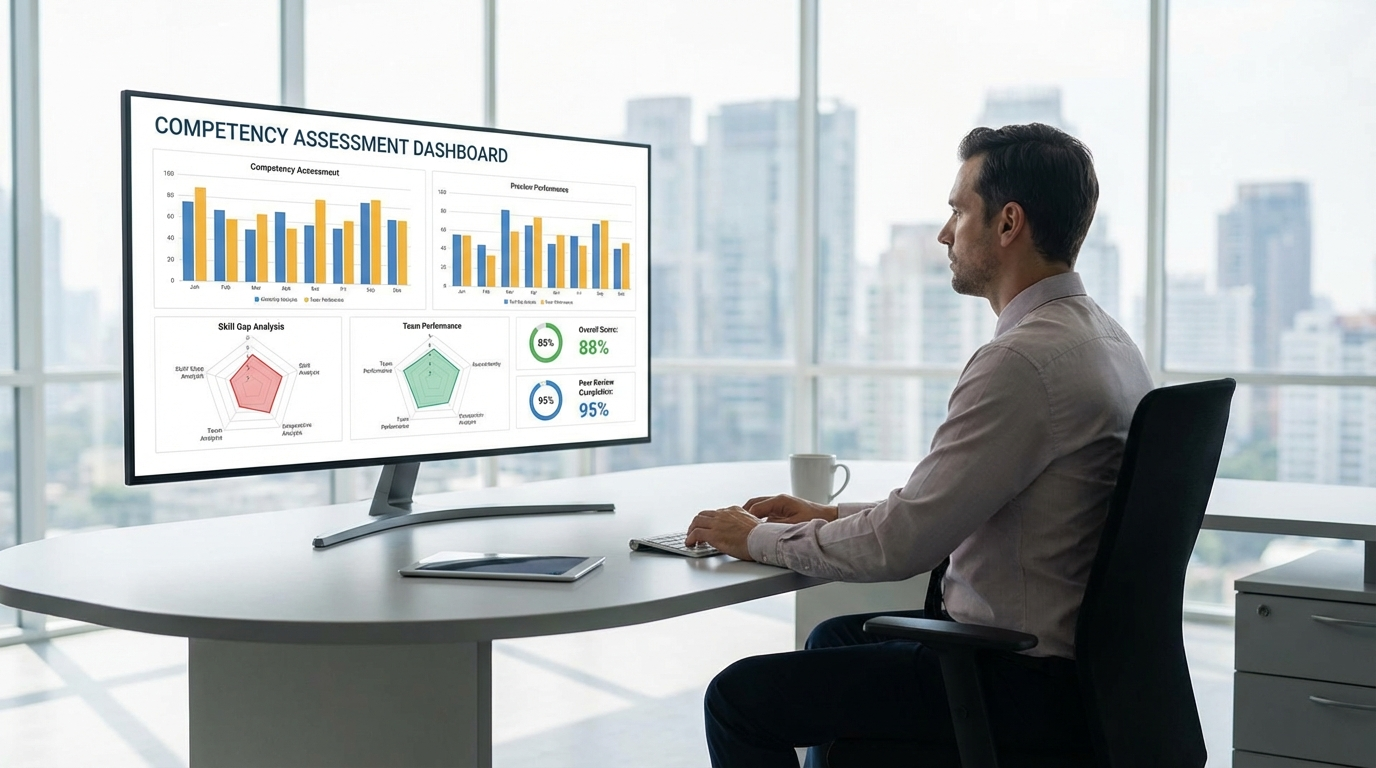
Five dimensions, each scored 1-5, for a total between 5 and 25. Score before and after on the same scale and you have your progression. Eight before, eighteen after? That is a 125% improvement: substantial, credible, measurable.
Morning: welcome and framing of the programme. Afternoon: role play one (declining a request). Observation and scoring across the five dimensions. Debrief — exploratory, not evaluative. End of day: a quick self-assessment questionnaire ("where would you place your assertiveness from 1 to 5?" for each dimension). You now have external observation across five dimensions plus a self-assessment. An auditor can already see that you measure seriously.
Each day: a role play in a different context (declining, speaking up in a meeting, receiving criticism). Structured debrief plus feedback. Trainer notes tracking progress. You build a picture: where the group stood on day one, and where it stands on days two, three and four. A simple training logbook does this job.
Final role play, using the same context as day one or something very close to it. Scoring across the five dimensions. The identical self-assessment questionnaire from day one. Debrief plus the participant's own reflection: "how do you feel different? Where have you made the most progress?" You now have day-five observation directly comparable to day one, a self-assessment, and the participant's own account. That is a robust file.
Not a raw table. A written synthesis: "Peter has progressed on expressing his opinion (2 to 4) and on receiving criticism (2 to 4). He has progressed less on listening (3 to 3). The diagnosis: Peter does not dare speak up when he feels intimidated, but he listens well naturally. After the programme he speaks up and still listens, so the gain is clear. Watch point: remind him to keep listening while being assertive, not just to assert." That narrative gives the numbers context. An auditor reads it and concludes that this person was genuinely observed, that you know where they started and where they ended up.
Type one: external observation — you record what you see. Type two: participant self-assessment — they record what they feel. Type three: manager or peer testimony — does someone else confirm the change back at work? With all three, the case is irrefutable. Two is the minimum. All three change the nature of the file: it is no longer a training course, it is a documented change evidenced from several angles.
Be careful: a participant who moves from passive to aggressive looks like they are progressing — more volume, more firmness — but they are not assertive. Assertiveness has listening built into it. If a gain comes with a drop in listening, that is a warning sign. Record it: "Eric declines more effectively, but he has stopped listening. To work on: assertiveness without aggression." That note matters for the trainer. It is also honest in front of an auditor: you name what works and what still needs refining.
A participant who was stressed on day one (unassertive because of the stress) and relaxed on day five (more assertive because they are comfortable) is a false positive. What changed is stress management, not assertiveness. How do you detect it? Compare high-pressure role plays (recorded, with an audience, with something at stake) against relaxed ones. If the gain is only "less anxious in a simulation", it is questionable. If it is "more assertive even under pressure", it is solid. Note the distinction in the file: you are pre-empting the auditor's question.
An audit asks for evidence of progress in assertiveness. A client wants the return: what does that progress actually produce? So ask the question at the end: "give me an example since the programme where you were more assertive. What was the impact?" Typical answers: "I now decline unreasonable requests, and I've got five hours a week back." "I spoke up against the consensus in a meeting. My solution was the one adopted." Those impacts are quantifiable: time recovered, solutions implemented, tensions defused. Collect them, aggregate them, and you have a return you can put numbers to. Auditors value it because it shows the training does real work.
Assertiveness gained in a training room can erode without practice, which is why follow-up matters. For example, four weeks later, contact three or four participants at random: "how have you practised assertiveness at work?" If the answer is "a lot", the learning has stuck. If it is "I haven't, I'd forgotten", that is a signal to change the programme. Document it in a follow-up file: it is the mark of a responsible provider, not one that delivers a course and disappears.
If a trainer writes "assertiveness, day 1: 3/10" with no criteria, it is vague. If they write "Dimension 1 (expression), day 1: 2/5 — speaks quietly, hesitant", it is credible. Granularity turns intuition into observation. Train your trainers on the criteria, give them a scoring grid, and insist on it. That is the difference between weak compliance and solid compliance.
A senior manager declining a request from the chief executive faces a harder task than a junior declining a peer. Assertiveness plays out at different levels of risk. Note the context: "Martin, facing high hierarchical risk in declining his own director, moves from 1 to 3 on expression. Peter, facing moderate risk in declining a client, moves from 2 to 4." That is contextual and honest. Auditors appreciate the nuance.
"General assertiveness: 3 to 7." Too simple, too opaque. "Expression 2 to 4, listening 3 to 3, emotional control 2 to 4, receiving criticism 2 to 4, holding boundaries 2 to 4 — total 11 to 19." That is transparent, granular and credible. One dimension can stay flat (listening, here) without being a problem; that is normal. But it is visible, so it can be addressed.
Assertiveness measured is assertiveness proven. Five dimensions, rigorous role plays, external observation cross-checked against self-assessment, day-by-day documentation and an honest synthesis: that is the protocol. It produces results that stand up to audit and impacts that show up in participants' working lives. Assertiveness is not a vague quality; it is a set of observable reflexes. Measure the reflexes and you measure the learning. That is the foundation of rigorous soft skills training. To go further on conflict management, which depends heavily on assertiveness, see our dedicated guide. But start with measurement: everything else rests on it.