← All articles
September 1, 2025
Mame-Mor Fall

Build training programmes faster (and better) with generative AI

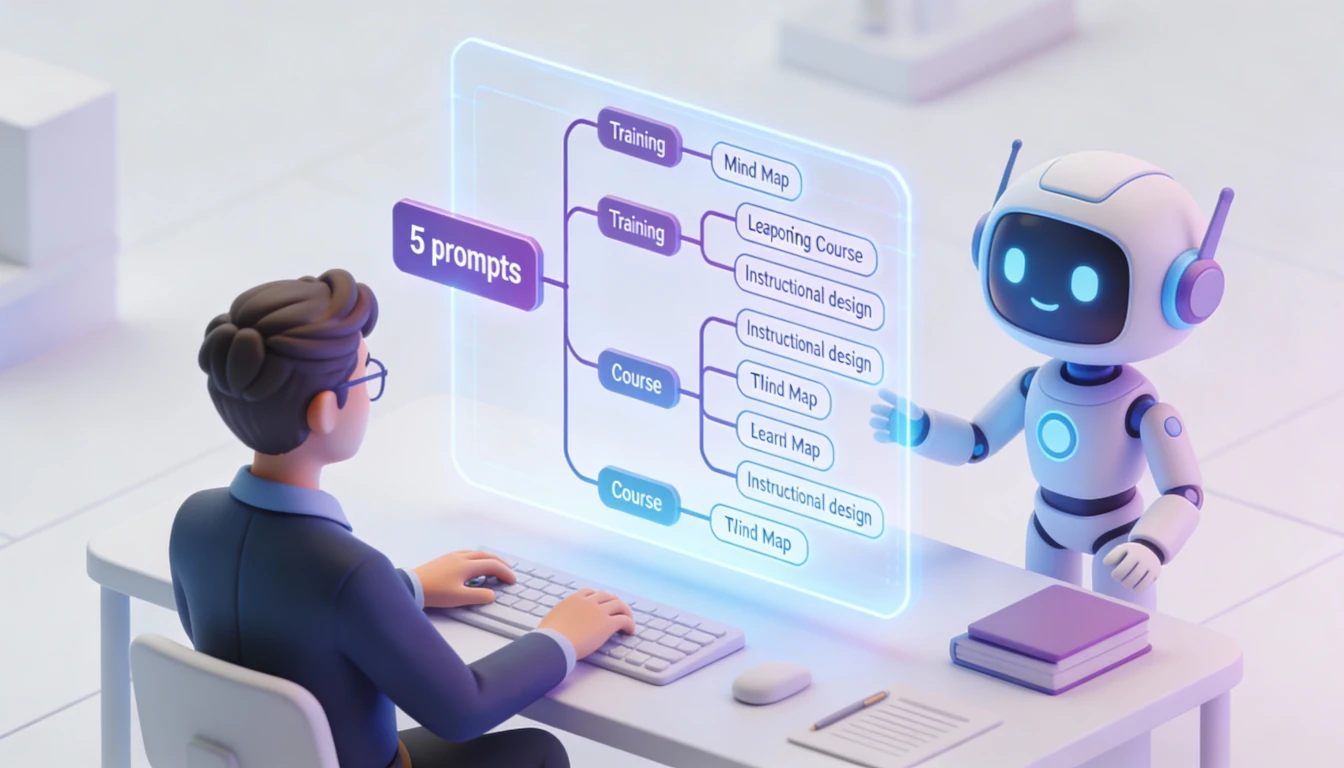
We have packaged five prompts written for learning designers and training managers. They cover the whole chain: understanding the subject, analysing needs on the ground, setting clear objectives, structuring the programme and writing practice scenarios ready to play with our AI avatars.

Who is this for?
Corporate training functions, retail, transport and banking teams, and any organisation that wants a measurable impact on customer culture and NPS.

Contents

  1. Explore the subject before you design
  2. Analyse what learners actually need
  3. Write clear objectives (Bloom)
  4. Design a programme aligned to those needs
  5. Write realistic practice scenarios
  1. Explore the subject before you design

Before you start "drafting an outline", set out the first principles of the subject and establish a shared baseline.

Prompt 1, ready to copy and paste:

You are designing a training programme on {SUBJECT}. Before structuring the programme, apply first-principles thinking to build solid foundations. I want a written, reasoned analysis.

Goal: reach a rich, nuanced and actionable understanding.

  • Define the subject and its key concepts clearly.
  • Explain why it matters in a professional context.
  • For each major principle: develop it and illustrate it (real or simulated examples).
  • Set out the implications for teaching and learning.
  • Draw out the best practices observed in the field.
  • Suggest reliable resources (to read, listen to or watch) for going further.

Expected style: a research and instructional design document.

  1. Analyse what learners actually need

Anchor the programme in day-to-day reality and prioritise what matters.

Prompt 2, ready to copy and paste:

Here are verbatim quotes, interviews and articles about the future participants:
{PASTE YOUR NOTES, VERBATIM QUOTES…}

Analyse their needs using an extended SWOT with six dimensions:

  • Strengths: resources and skills already in place
  • Weaknesses: gaps and blockers
  • Opportunities: levers in the current context
  • Threats: obstacles to learning
  • Skills to develop: the ones critical to progression
  • Prior knowledge: starting level and gaps to close

Finish with:

  • 3 learning priorities
  • 2 to 3 suitable formats (in person, e-learning, blended…)

Expected style: an in-depth, structured and reasoned analysis.

  1. Write clear learning objectives

Well-written objectives drive the choices you make about content, exercises and assessment.

Prompt 3, ready to copy and paste:

You are an expert instructional designer.

Working from:

  • Target audience: {INSERT}
  • Needs and expectations: {INSERT}
  • Specific constraints: {INSERT}

Produce 4 to 6 objectives based on Bloom's taxonomy:

  • Use precise action verbs (know, apply, analyse, evaluate, create).
  • Make every objective measurable and operational (for example "demonstrate", "analyse", "present").
  • Propose a logical progression, from simple to complex.

  1. Design a programme aligned to those needs

Build a coherent, progressive programme that matches the realities of the job.

Prompt 4, ready to copy and paste:

I want to develop a {X days/hours} programme delivered {in person/remotely/blended} on {SUBJECT}.
Overall goal: help {TARGET AUDIENCE} at {COMPANY} to {OBJECTIVE}.

Field material (verbatim quotes, notes, lessons learned): {INSERT}.
Learning objectives already defined: {INSERT}.

Propose a detailed architecture including:

  • Objectives for each day or module
  • Practical workshops plus recognised tools, methods and concepts
  • A progression that builds the skills in sequence
  • Indicative timing for each sequence
  • Smooth transitions between blocks

Approach: first-principles thinking, grounded in the job itself.

  1. Write realistic practice scenarios

Make the programme concrete through scenarios people can actually play, which is exactly what our AI avatars are built for.

Prompt 5, ready to copy and paste:

I am developing a {X days/hours} programme delivered {in person/remotely/blended} on {SUBJECT}.
Goal: help {TARGET AUDIENCE} at {COMPANY} to {OVERALL OBJECTIVE}.

Learning objectives for the programme: {INSERT}.
Interview notes and verbatim quotes: {INSERT}.

Write {X} realistic practice scenarios. For each one, provide:

  • Title
  • Context (setting, what is at stake)
  • Learning objectives (skills targeted)
  • Scenario (key steps)
  • Roles (participants, observers)
  • Duration (estimated time)
  • Assessment criteria (expected behaviours)
  • Debrief (reflection and action questions)

Why this works, according to our clients

  • Far more practice: some of the "talking about it" is replaced by doing it.
  • Actionable feedback: our automated debriefs make the behaviours to reinforce visible.
  • Scalable: no heavy logistics, and rapid rollout at scale.
  • Measurable: progression and operational impact indicators such as NPS, first-contact resolution and handling time.

Need a ready-made programme?

We modernise your existing content (videos, quizzes, AI avatars, LMS integration) and deliver a programme ready to roll out, then licences for ongoing use.

Let's talk about your use case: mame@face-up.fr

More articles

Explore our related articles

Turn your training
into immersive experiences!

Ready to build training that delivers measurable results?